Why Partition Thickness Is More Than Just a Number
Picture this: a facilities manager is finalising the workstation layout for a new 8,000 sq. ft. office. The floor plan is approved, the furniture vendor is shortlisted, and then comes the question nobody prepared for, 45mm or 60mm partition panels?
It sounds like a minor technical detail. It isn’t.
Partition thickness quietly governs how your office sounds, how well it manages technology infrastructure, how long your furniture investment lasts, and how efficiently every square foot is used. Choose the wrong spec, and you end up with either an acoustically porous open floor that frustrates employees trying to focus, or a heavier, costlier system that chews into your floor space without a proportional return.
This guide is built around that exact decision. At Vlite Furnitech, we’ve specified and installed both 45mm vs 60mm office partition systems across hundreds of corporate projects, from lean startup fitouts to large enterprise campuses. By the end of this article, you’ll know exactly which partition thickness suits your office, your team, and your budget.
Whether you’re an office designer evaluating specs, a procurement head comparing options, or a founder setting up your first real workspace, the 45mm vs 60mm partition choice will make much more sense after this.
Understanding Office Partition Specifications, A Quick Primer
What Does Partition Thickness Mean?
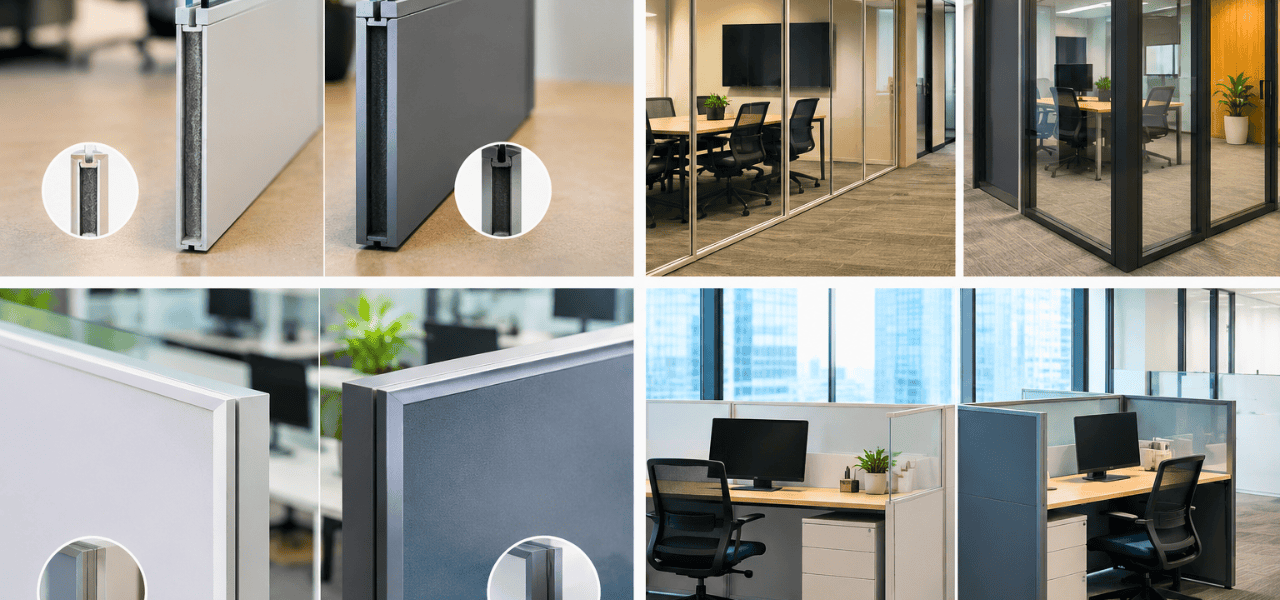
When a partition is described as 45mm or 60mm, the measurement refers to the total panel depth, the full cross-sectional width of the panel from one face to the other. This is not the height of the partition, and it has nothing to do with the length of individual panels. It is the thickness of the wall itself.
Inside that thickness sits an engineered sandwich: typically a steel or aluminium frame on the outside, a core of MDF, honeycomb board, or acoustic infill material in the middle, and a finish layer of fabric, laminate, or glass on the facing surfaces. In acoustic-grade panels, the core may also include mineral wool or foam batting to improve sound attenuation.
The difference between 45mm and 60mm may appear small in isolation. In practice, that 15mm difference changes the engineering capability of the panel significantly, what it can carry structurally, how much acoustic mass it provides, and how much space is available inside for cable routing.
Understanding partition specification at this level matters before any purchase. It is the difference between a system that performs exactly as expected for the next ten years, and one that creates operational headaches within eighteen months.
The Role of Thickness in Modular Office Design
Thickness is one of the primary determinants of how a modular partition system fits into a broader office design. A thinner panel reads as visually lighter, it takes up less floor plate, creates a more open feel, and integrates cleanly into contemporary, minimal workplace aesthetics. A thicker panel projects mass and permanence; it feels more substantial and is better suited to executive-grade or formally segmented office environments.
Beyond aesthetics, thickness determines the panel’s compatibility with accessories (monitor arms, shelving, whiteboards), the capacity of internal cable trunking channels, and the overall structural rigidity of the installation. These are functional considerations, not cosmetic ones, and they should drive the specification decision.
45mm Office Partition – Features, Benefits, and Best Use Cases
Key Features of the 45mm Partition
The 45mm modular partition is engineered for efficiency. Its defining characteristics are:
Lightweight construction. The reduced panel mass makes 45mm systems significantly easier to install, move, and reconfigure. This matters enormously in dynamic office environments where layouts evolve frequently.
Slim, contemporary profile. The 45mm depth gives workstation layouts a clean, unobtrusive visual line. In open-plan offices where light and spatial flow are priorities, this panel reads well without visually fragmenting the room.
Moderate acoustic performance. A 45mm partition provides adequate visual and partial acoustic separation for most general office settings. It reduces distraction from immediate neighbours without providing full speech privacy.
Standard cable routing capacity. Most 45mm panel systems include a single-sided or limited cable management channel, sufficient for standard power and data runs, though less suited to heavy multi-device setups.
Cost-effective per panel. For projects involving a large number of workstations, the per-panel savings of the 45mm specification compound into meaningful budget efficiency.
Where 45mm Partitions Work Best
The 45mm modular partition is not a compromise product, it is the right tool for a specific set of workplace conditions.
It performs best in open-layout workstation bays where the goal is visual separation rather than acoustic isolation. Collaborative zones, creative team areas, and hot-desking clusters all benefit from the 45mm’s lightweight configurability. It works particularly well in reception dividers and lounge-adjacent workspaces where you want definition without visual heaviness.
For smaller offices where every square foot is accounted for, the thinner panel profile of the 45mm modular partition preserves more usable floor area per workstation bay, a real advantage in high-rent urban locations.
Startups and growing SMEs often specify 45mm workstation partitions as their core system for exactly these reasons: lower upfront cost, high flexibility, and the ability to reconfigure as the team scales.
60mm Office Partition, Features, Benefits, and Best Use Cases
Key Features of the 60mm Partition
Where the 45mm panel is optimised for efficiency, the 60mm partition is optimised for performance. The additional panel depth unlocks a meaningfully different set of capabilities.
Enhanced acoustic insulation. The wider core in a 60mm partition panel provides greater acoustic mass, which directly improves sound attenuation between workstations. In departments where speech privacy is a functional requirement, finance, HR, legal, executive floors, this is not a luxury feature; it is a compliance and confidentiality necessity.
Greater structural rigidity. The heavier construction of a 60mm system makes it far more stable for taller partition configurations. Floor-to-ceiling installations and high-panel-height setups that would require additional bracing in a 45mm system sit naturally within the structural capacity of the 60mm panel.
Dual-sided cable management. The wider panel creates space for full dual-sided cable trunking channels. In workstations running multiple monitors, docking stations, power hubs, USB ports, and network connections, this internal routing capacity is critical to maintaining a clean, manageable installation.
Accessory compatibility. The structural depth of the 60mm partition panel allows it to support a full range of mounted accessories, monitor arms, overhead storage shelves, task lighting rails, whiteboards, and pin boards, without compromising panel integrity.
Premium finish and weight. The physical presence of a 60mm system projects a corporate-grade aesthetic that enterprise clients and premium office fitouts require. The panel feels, and is, more substantial.
Where 60mm Partitions Work Best
The 60mm partition specification is the correct choice wherever confidentiality, infrastructure density, or long-term structural performance are genuine requirements.
Executive cabins, HR bays, finance teams, and legal departments are the natural home for 60mm panels. These environments require acoustic separation for sensitive conversations and the ability to run complex cable infrastructure to each workstation. Large enterprise campuses with standardised, structured layouts benefit from the durability and consistency that 60mm systems deliver at scale.
Clients building offices to BIFMA compliance or acoustic performance standards will typically find that the 60mm partition panel meets those benchmarks more reliably than its thinner counterpart. And for any project where the client is making a long-term investment and durability matters more than upfront cost savings, the 60mm specification makes the stronger case.
Head-to-Head Comparison, 45mm vs 60mm Partition
| Feature | 45mm Partition | 60mm Partition |
| Panel Thickness | 45mm | 60mm |
| Acoustic Performance | Moderate | High |
| Structural Rigidity | Standard | Enhanced |
| Cable Management | Basic / Single-side | Dual-side / Wider trunking |
| Accessory Compatibility | Limited | Full (shelves, arms, boards) |
| Space Efficiency | Higher | Slightly lower |
| Weight | Lighter | Heavier |
| Cost | More economical | Premium investment |
| Best For | Open collaborative spaces | Executive / enterprise setups |
| Reconfigurability | High | Moderate |
The cost difference between a 45mm and 60mm partition panel is worth absorbing when acoustic privacy, cable infrastructure, or accessory load are genuine requirements of the space, not optional extras. In executive environments, HR zones, or campuses where the fitout is designed to last a decade or longer, the 60mm system’s durability and performance justify the premium clearly.
Conversely, the 45mm is the smart, lean specification for open-plan collaborative spaces, growing teams that need flexibility, and projects where budget efficiency across a high workstation count is a primary constraint. For these use cases, paying for the additional 15mm of panel depth delivers no meaningful functional return.
The 45mm and 60mm office partition comparison ultimately comes down to what you actually need the partition to do, not just what looks good on a specification sheet.
Factors to Consider Before Choosing Your Partition Thickness
This decision checklist is designed to help office designers, facility managers, and procurement heads arrive at the right specification before placing an order.
Acoustic requirements. This is the most important functional variable. If your team needs focused, private work, finance processing, HR conversations, legal review, executive decision-making, choose 60mm. For open collaboration, creative work, and general office use where background noise is acceptable, 45mm partition panels perform adequately.
Office layout and available floor space. In a tightly planned floor plate, the 15mm difference per partition adds up across multiple workstation bays and circulation paths. If your space is constrained, 45mm modular partitions preserve more usable area per employee. In larger premises with more generous space allocations, this consideration carries less weight.
Cable and technology infrastructure. This is an underrated factor in partition specification. If each workstation will carry dual monitors, a docking station, multiple power outlets, and structured data cabling, the 60mm partition panel’s wider cable trunking channels are a practical necessity. Trying to force a complex technology setup through a 45mm cable channel creates management headaches at installation and creates maintenance difficulties for years afterwards.
Budget and project scale. For a fitout of 20 workstations, the per-panel cost difference between 45mm and 60mm is manageable. For a 150-workstation campus rollout, that difference compounds into a significant budget line. Calculate the total cost impact across your full workstation count before finalising the specification, the number may inform a hybrid approach rather than an all-or-nothing decision.
Future flexibility. If your office layout is likely to change in the next two to three years, due to team growth, departmental restructuring, or a move, the lighter, easier-to-reconfigure 45mm modular partition system will serve you better. Heavier 60mm systems are more permanent by nature, which is a strength in stable environments and a disadvantage in dynamic ones.
Brand and aesthetic standards. Enterprise clients with premium interior standards, high-end fit-and-finish, formal segmented layouts, corporate branding built into the architecture, typically require the visual weight and quality perception of 60mm panels. The 60mm partition panel communicates permanence and seriousness that some environments demand.
How Vlite Furnitech Approaches Partition Specification
At Vlite Furnitech, partition specification is not a product selection exercise, it is a design consultation.
Our engineering team has spent years developing both 45mm and 60mm modular partition systems, understanding not just the technical performance of each panel but the real-world conditions in which they are deployed across Indian corporate offices, technology campuses, financial services environments, and manufacturing company headquarters.
Our 30,000 sq. ft. manufacturing facility in Patalganga, Navi Mumbai produces up to 14,000 workstations per month. That scale gives us the quality control infrastructure and production consistency that large-scale office fitouts demand, whether the specification calls for 45mm modular partitions across an open-plan floor or 60mm partition panels in a structured executive layout.
Every product we manufacture is developed under ISO 9001:2015 quality management systems, and our workstation and partition range carries BIFMA certification, the internationally recognised standard for commercial office furniture quality and durability. For clients building offices in LEED-rated buildings or pursuing green certification for their workplace, our LEED-compliant manufacturing processes ensure that our office furniture supports, rather than works against, those sustainability goals.
What makes the difference at the specification stage is the involvement of our dedicated design and project management team. We don’t recommend a partition thickness based on what’s in stock or what’s easiest to quote. We assess your floor plan, your team’s working style, your technology requirements, and your long-term plans for the space, and then we recommend the partition specification that makes the most sense for your exact situation.
Our team works closely with you to identify the right partition specification, whether 45mm or 60mm, based on your space, budget, and long-term goals. That consultative approach is the difference between a workstation partition system that performs for a decade and one that creates friction from the first week of occupancy.
Still comparing modular, bespoke, and traditional office furniture?
Let Vlite Furnitech LLP help you choose the smartest investment for better ROI.
Frequently Asked Questions
Q1: What is the main difference between a 45mm and 60mm office partition?
The primary differences lie in acoustic insulation, structural rigidity, and cable management capacity. A 60mm partition panel offers better sound privacy between workstations and supports heavier accessories and denser cable infrastructure, while a 45mm partition is more space-efficient, easier to reconfigure, and more cost-effective across large workstation counts.
Q2: Which partition thickness is better for a corporate office?
It depends on the nature of the workspace. For large corporate setups requiring acoustic privacy, structured cable management, and a premium finish, particularly in executive, HR, finance, or legal areas, 60mm partitions are the recommended specification. For open-plan or collaborative work environments where flexibility and space efficiency are priorities, 45mm modular partitions are the well-suited choice.
Q3: Can I mix 45mm and 60mm partitions in the same office?
Yes, and this is actually a common and sensible approach for many office layouts. It is standard practice to specify 60mm panels in private cabins, focus rooms, and confidential-function departments, while using 45mm panels across open workstation areas. Vlite Furnitech’s modular partition systems are designed to integrate flexibly, making mixed specifications manageable without compromising the overall aesthetic consistency of the installation.
Q4: Does a thicker partition always mean better acoustic performance?
Thickness is a significant contributing factor, but not the only one. The core material matters equally, a 60mm partition with a high-density acoustic infill will significantly outperform a 45mm panel for sound attenuation. It will also outperform a 60mm panel with a low-density or hollow core. When evaluating partition specification for acoustic requirements, always look at both the panel thickness and the core material specification together.
Q5: Are Vlite Furnitech’s partitions BIFMA certified?
Yes. Vlite Furnitech holds BIFMA certification across our partition and workstation product range. BIFMA (Business and Institutional Furniture Manufacturers Association) certification is the recognised commercial standard for quality and structural durability in office furniture, and it is a benchmark that many enterprise procurement processes require vendors to meet.
Choose the Right Thickness, Build the Right Office
The 45mm vs 60mm partition decision distils into a clear framework: choose 45mm for efficiency, flexibility, and cost-effectiveness in open collaborative environments; choose 60mm for acoustic performance, structural permanence, and technology-dense workstation setups in enterprise or executive contexts.
Neither specification is universally superior. The right choice is the one that matches what your office actually needs to do, how your team works, how your space is configured, how your technology is deployed, and how long you expect the layout to remain stable.
What makes the difference is not the number itself but the thinking behind it. A well-specified 45mm system in the right environment will outperform a poorly considered 60mm installation every time, because specification is ultimately a design decision, not a purchasing one.
If you’re still weighing the options for your office, don’t shortlist on panel thickness alone. Talk to a team that has specified, manufactured, and installed both systems at scale, and understands where each one earns its place.
Not sure which partition specification suits your office? Talk to Vlite Furnitech’s design team, we’ll assess your space and recommend the ideal 45mm or 60mm partition system for your specific requirements. Get in touch through our website to schedule a design consultation or request a specification proposal for your project.

Vishnu Sharma
I am the co-founder and CEO of Vlite Furnitech, creating modular office solutions since 2009. With a background in Chemistry and Marketing, and experience as Regional Head at Featherlite, I help design ergonomic, adaptable, and sustainable workspaces. Alongside a team of 120+, we serve corporates like JCB, Just Dial, KFC, and educational institutions. Let’s connect to reimagine innovative, eco-friendly office environments.