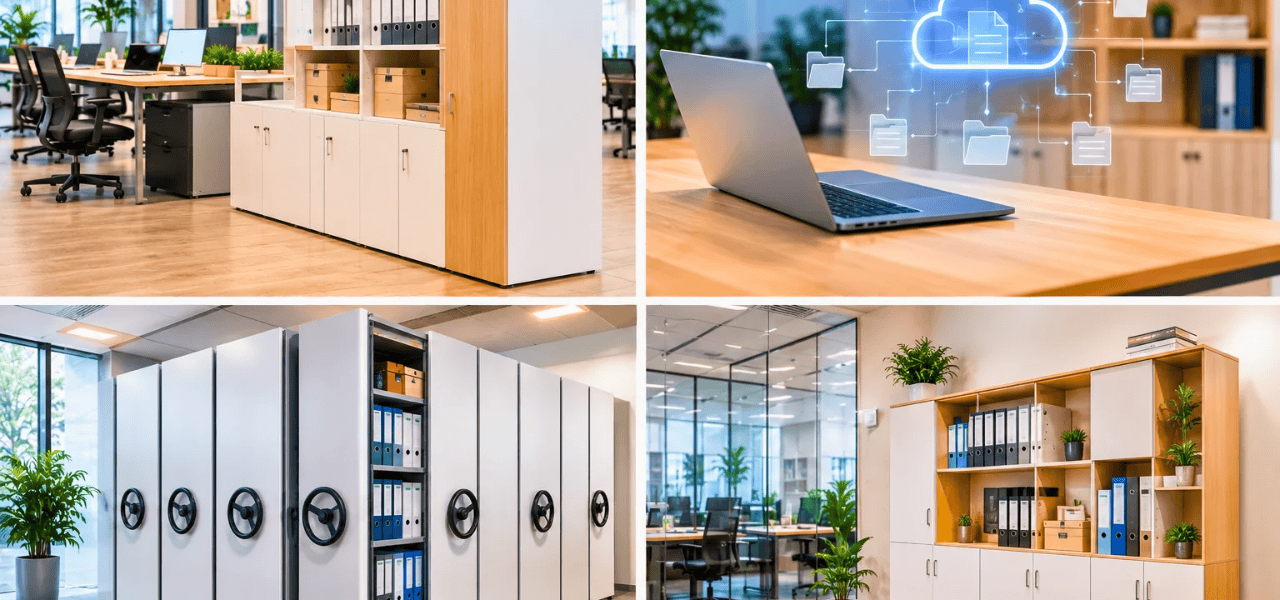
The office has changed. Has your storage? A growing share of Indian enterprises have adopted some form of hybrid work since 2022, yet many offices still run on storage systems designed for a nine-to-five, paper-heavy era. Rows of fixed pedestals, deep filing cabinets and cluttered desktops no longer match how people actually work. They eat floor space, slow people down and make a modern workplace feel dated.
Smart office storage planning closes that gap. It starts from how your people work, how often they come in, what they still need to keep physically, and what has gone digital. This guide covers the essentials of office storage planning for hybrid workplaces, from hot desking storage and personal lockers to paperless office furniture, certifications, sustainability and right-sizing for your office. If you are planning a fitout or refresh, treat it as a practical roadmap for turning office workspace storage from an afterthought into a productivity advantage.
What Is Office Storage Planning and Why Does It Matter ?
Office storage planning is the process of deciding what needs to be stored, where, for whom and in what kind of furniture, so that storage supports your workflow instead of fighting it. It covers personal belongings, devices, documents, shared supplies and archives, and it works alongside your seating, circulation and workstation layout.
The Shift from Traditional to Hybrid Office Storage
Office design has moved in stages. Fixed desks gave way to activity-based working, then hot desking, and now hybrid models where attendance changes daily. Each step changed what storage has to do.
In the traditional office, storage meant one filing cabinet or pedestal per employee. That made sense when everyone sat at the same desk five days a week and kept paper records within arm’s reach. In a hybrid office, those assumptions fail. Desks may be shared, headcount on any given day fluctuates, and the contents of a person’s “storage” are more likely to be a laptop, charger, notebook and personal items than a stack of files.
Storage needs have therefore shifted from per-employee filing cabinets to shared, flexible and secure systems. Compliance has not gone away either. Even in a largely paperless office, legal agreements, HR records, financial documents and confidential material may need secure physical storage. Planning has to balance reduced paper volume against sustained security and confidentiality requirements.
The Cost of Poor Storage Planning
Poorly planned storage carries costs that rarely show up on a single line item:
- Wasted floor space. Oversized cabinets and unused pedestals occupy square footage that could hold collaboration areas or additional seating.
- Lost productivity. Employees spend time hunting for belongings, documents or a place to put their bags when no storage is available at a shared desk.
- Security risks. Without secure personal storage, laptops, devices and sensitive papers end up in the open or carried around all day.
- Visual clutter. Cluttered environments make teams less focused and make an office look unprofessional to clients and visitors.
- Poor employee experience. If coming to the office feels inconvenient, hybrid employees are less likely to see it as a place worth coming to.
Good office workspace storage reverses each of these. It frees space, protects assets and makes the office feel organised and welcoming.
Key Principles of Office Storage Planning for Hybrid Workplaces
Audit Before You Plan: Understand What You’re Actually Storing
Every strong plan starts with a storage audit. Walk through your office and ask a few direct questions:
- What is still physical? Legal documents, contracts, certificates, devices, samples, personal protective equipment and stationery often remain.
- What has gone digital? Anything now handled through cloud systems no longer needs a cabinet.
- Who needs storage, and how much? A fully in-office employee, a three-days-a-week hybrid worker and a mostly remote employee who visits monthly have very different needs.
Map your employee types: fully remote, hybrid and in-office. Then look at real occupancy data, such as badge swipes, desk booking logs or attendance patterns. This prevents over-provisioning. Storage should scale with actual occupancy, not headcount. A 200-person company with an average daily attendance of 120 does not need 200 pedestals; it needs a thoughtful mix that serves the people actually present, plus a plan for peak days.
Zones-Based Storage Strategy
Once you know what you are storing, organise it into zones. A zone-based approach keeps storage logical and easy to find:
- Personal storage zones. Lockers or pedestals for individual belongings and devices, placed near workstation areas.
- Shared or team zones. Overhead cabinets, open shelving or lateral units for supplies and team resources used by a department or project group.
- Centralised archive zones. Secure, lockable storage for records and documents that must be retained but are rarely accessed.
Furniture layout supports each zone. Personal lockers work best in banks near entrances or between work areas. Team storage sits close to the people who use it. Archive storage can be placed in lower-traffic parts of the floor. Modular office furniture, such as the systems Vlite Furnitech designs, adapts naturally to zoning because units can be combined, resized and reconfigured as your needs change.
Prioritise Security Without Sacrificing Accessibility
Hybrid employees need a secure place for their belongings even when they are not in the office every day. If people have nowhere safe to leave a laptop bag or personal items, they carry everything with them and the office feels like a temporary stop rather than a workplace.
Smart and digital-lock lockers solve this well. Keypad or electronic locks remove the problem of lost keys, allow easy reassignment and offer a clean, modern experience. A properly designed personal locker in a hybrid office gives each person secure storage on demand without tying up a permanent desk.
Hot Desking Storage: Solving the “No Fixed Desk” Problem
What Is Hot Desking Storage?
Hot desking means employees do not have assigned desks. They choose an available workstation when they arrive. It reduces the real estate you need and suits hybrid schedules, but it creates a clear challenge: where do employees keep belongings, devices, documents and personal items when they have no permanent desk?
Hot desking storage is the answer to that question. It is the set of storage solutions that give mobile employees a secure place to leave and retrieve their things, whether for a few hours, a day or a week. Without it, hot desking can feel unsettled and unproductive, and adoption suffers.
Smart Locker Systems for Hot Desking Environments
Lockers are the cornerstone of hot desking storage. They can be assigned in two main ways:
- Dynamically, by day or shift, so a limited number of lockers serve a larger group of hybrid employees.
- Permanently, so each hybrid employee has a personal locker that holds their belongings between visits.
When choosing lockers for a hybrid or hot desking office, look for these features:
- Digital or keypad locking for easy access and simple reassignment
- Ventilation to keep contents fresh, especially for bags and personal items
- Charging ports so devices can charge while stored
- Size variants to fit laptops, bags, jackets and documents
- Durable finishes that withstand daily use
Vlite Furnitech’s locker range is engineered for exactly these hybrid scenarios, with configurations that suit hot desking, shift-based teams and permanent personal storage. Banks of lockers can also be arranged to define zones and guide movement through the office.
Under-Desk and Mobile Pedestals as Supplementary Storage
Lockers handle long-term personal storage, but hybrid employees also need convenient storage while they work. Mobile pedestals fill this role. These compact units can be wheeled to a hot desk, locked, and moved away at the end of the day. They keep frequently used items such as notebooks, chargers and stationery within reach without cluttering the desktop.
Used together, a locker bank and a set of mobile pedestals give employees the two things they need: secure storage when they are away and handy storage when they are working.
Paperless Office Furniture: Storage That Supports a Digital-First Workplace
What “Paperless” Actually Means for Storage Design
Going paperless does not mean going storage-free. It means less paper and more devices. Laptops, tablets, cables, adapters, headsets and peripherals now need a home. The storage conversation shifts from “where do we keep our files?” to “where do we keep and charge our tools?”
This changes what good storage looks like:
- Cable management becomes a design requirement, not a nice-to-have.
- Device docking and charging need to be integrated into the furniture.
- Secure digital media storage matters for drives, access cards and other physical assets that guard digital information.
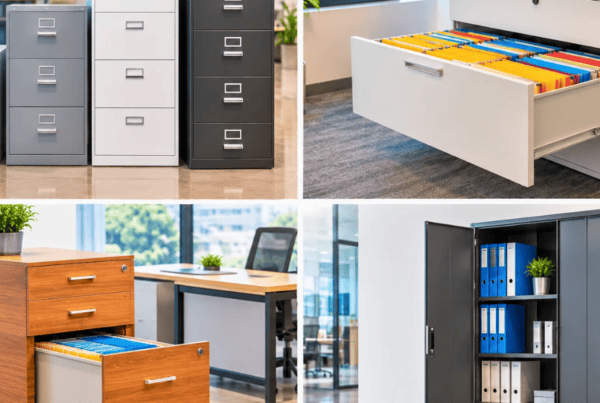
- Shallow, versatile units replace deep file cabinets, because fewer documents need to be held.
Paperless office furniture reflects this reality by prioritising flexibility, connectivity and a clean look.
Modular Storage Units Built for Paperless Workflows
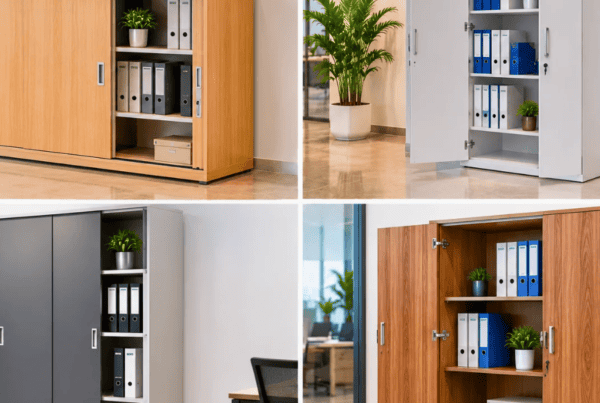
Modern storage units are lighter and more versatile than the file cabinets they replace. Lightweight overhead cabinets, open shelving and credenzas can be optimised for device storage, reference materials and personal items rather than heavy files.
Clean lines also matter. A digital-first office is usually minimal in character, with uncluttered surfaces and a modern aesthetic. Modular storage supports that look while remaining practical. Vlite Furnitech’s design philosophy is built on this idea: modular, contemporary furniture that fits the reality of today’s workplace rather than the one we left behind.
Integrating Charging and Cable Management into Storage
One of the biggest improvements in modern storage is built-in power and cable control. Look for:
- Cable trays integrated into cabinets and credenzas
- Power points inside lockers and pedestals so devices charge while stored
- Cable routing channels that keep wires off the floor and out of sight
These features reduce desk clutter, keep devices charged and ready, and lower the risk of tangled cords and tripping hazards. In a hybrid office where people move between desks, they also make each workstation feel instantly usable.
Choosing the Right Office Furniture for Storage in a Hybrid Office
Types of Office Storage Furniture to Consider
Here is a quick-reference checklist of the main storage options for a hybrid workplace:
- Personal lockers: ideal for hot desking and hybrid employees who need secure, personal storage without a fixed desk
- Mobile pedestals: portable under-desk storage that moves with the user
- Overhead storage cabinets: shared team storage mounted above workstations
- Open shelving units: accessible, visible storage for communal areas and team resources
- Credenzas and lateral filing units: storage for executive offices and meeting spaces
- Central storage walls: modular walls that combine open and closed storage for a cohesive look
Most hybrid offices use a combination of these rather than relying on one type. The right mix depends on your audit, your zones and your workforce profile.
What to Look for in a Quality Storage Furniture Manufacturer
Storage furniture is a long-term investment, so the manufacturer matters as much as the product. Evaluate these factors:
- Material durability. Powder-coated steel and high-grade laminate stand up to daily use and keep their appearance.
- Customisation. The ability to adjust dimensions, finishes and locking mechanisms means furniture fits your space and brand.
- BIFMA certification. This is a recognised industry standard for the safety, durability and performance of office furniture.
- ISO 9001:2015 certification. It signals a consistent quality management system behind the product.
- Environmental credentials. Responsible manufacturing and materials increasingly matter to buyers.
Vlite Furnitech meets these benchmarks as a BIFMA-certified and ISO 9001:2015-certified manufacturer with a LEED-compliant facility in Navi Mumbai. For a business planning a long-term fitout, those credentials provide meaningful assurance about quality, safety and responsible production. If you are comparing options, you can explore our range of modular office furniture and office lockers to see how these standards translate into real products.
Office Storage Planning Tips for Different Hybrid Office Sizes
Small Offices (Under 20 Employees)
In a small office, every square foot counts, so prioritise multi-functional furniture:
- Under-desk units and mobile pedestals that tuck away neatly
- Wall-mounted cabinets that free up floor space
- Storage ottomans or benches that combine seating and storage
- Compact locker units that can double as a room divider or a defined entrance area
Keep the audit simple, and avoid buying more storage than your actual attendance patterns require.
Mid-Size Offices (20-100 Employees)
At this scale, a zone-based storage strategy becomes critical. With more people moving through the space, clear zoning prevents confusion and congestion. Consider:
- A centralised locker bank for hot desking employees, placed where it is easy to reach on arrival
- Shared team storage near each department’s workstations
- Modular systems that can be reconfigured as team sizes change
Mid-size companies often grow or restructure quickly, so flexibility is the main selection criterion. Modular furniture lets you adapt without replacing everything.
Large Corporate Offices (100+ Employees)
Large offices need enterprise-grade solutions:
- Digital, app-based locker management for dynamic assignment and usage tracking
- Dedicated storage corridors or walls near workstation clusters
- Standardised storage specifications across floors and locations
At this scale, working with a manufacturer that can handle project management is vital. Vlite Furnitech provides dedicated project management teams and a distribution network across Mumbai, Pune, Ahmedabad, Surat and Hyderabad, helping large organisations coordinate design, delivery and installation without friction.
A Note on Locker Ratios
When sizing a locker bank, remember that not everyone is in the office at once. A common planning ratio for hybrid offices is roughly 0.6 to 0.8 lockers per hybrid employee. Your facility planner or furniture partner can refine that figure using real occupancy data and peak-day attendance.
Sustainability in Office Storage: A Growing Priority
Sustainability is now a core consideration in office procurement. Companies pursuing LEED certification or ESG commitments want furniture that supports those goals. For storage, this means attention to:
- Sustainable materials and responsible sourcing
- Long product life cycles, since durable furniture that lasts years reduces waste and replacement cost
- Eco-conscious manufacturing that limits environmental impact
- Modularity and reusability, so furniture can be reconfigured rather than discarded
Vlite Furnitech reflects this commitment through a LEED-compliant facility, responsible sourcing and eco-friendly production practices. BIFMA certification also aligns with environmental performance standards, giving buyers additional confidence. Choosing sustainable storage is no longer a niche decision; it is part of building an office that reflects your organisation’s values.
Still comparing modular, bespoke, and traditional office furniture?
Let Vlite Furnitech LLP help you choose the smartest investment for better ROI.
Frequently Asked Questions (FAQ)
What is the best storage solution for a hot desking office?
Personal lockers, either fixed or dynamically assigned, are the most effective hot desking storage solution. They give every employee a secure, personal space without requiring a permanent desk.
How do I plan office storage for a hybrid workplace?
Start with a storage audit, map your employee types (remote, hybrid and in-office), define storage zones, and select modular furniture systems that can adapt as your workforce evolves.
What is paperless office furniture?
Paperless office furniture refers to storage and workspace solutions designed for digital-first offices. It prioritises device storage, cable management and flexible modular units over traditional deep file cabinets.
What should I look for in office lockers for hybrid offices?
Look for digital or keypad locking, size variants for laptops and bags, ventilation, optional charging ports and durable finishes, ideally from a BIFMA-certified manufacturer.
How many lockers do I need for a hybrid office?
A common ratio is 0.6 to 0.8 lockers per hybrid employee, since not everyone is in at the same time. Your facility planner or furniture partner can help calculate the right number based on actual occupancy patterns.
Plan Smarter Storage, Build a Better Hybrid Office
Hybrid and paperless offices demand a fresh approach to office storage planning. The old model of one cabinet per person no longer fits a workplace where attendance fluctuates, desks are shared and most information lives on a device. The right mix of personal lockers, modular storage units and thoughtful hot desking storage turns a cluttered space into an intentional one that supports focus, security and flexibility.
The path forward is straightforward: audit what you store, understand your employee types, organise storage into zones, choose durable and certified furniture, and size your solution to real occupancy. Do that, and your office will feel ready for the way people work today and tomorrow.
Planning a hybrid office fitout? Explore Vlite Furnitech’s complete range of modular storage solutions, lockers and office furniture, engineered in India and trusted across industries. Get in touch with our team for a customised storage plan.

Vishnu Sharma
I am the co-founder and CEO of Vlite Furnitech, creating modular office solutions since 2009. With a background in Chemistry and Marketing, and experience as Regional Head at Featherlite, I help design ergonomic, adaptable, and sustainable workspaces. Alongside a team of 120+, we serve corporates like JCB, Just Dial, KFC, and educational institutions. Let’s connect to reimagine innovative, eco-friendly office environments.