Why the Right Office Table Material Matters
Offices are where productivity is born, but the wrong office table material can mean costly replacements within two to three years. A desk that sags under a dual-monitor setup, swells during the monsoon, or chips at the edges quickly turns from an asset into a recurring expense. For procurement teams, startup founders and interior designers, material choice is one of the most consequential decisions in any fit-out.
India’s office furniture market is booming. Modular workspaces, co-working spaces and corporate expansion across metro and tier-two cities are driving demand for office furniture that is durable, good-looking and cost-efficient at scale. With so many options on the market, knowing what your office workspace table is actually made of has never been more important.
Four materials dominate the market: MDF, plywood, particle board and veneer. Each has its own strengths, weaknesses and ideal use-cases. In this guide, we break down the properties, pros and cons, durability, cost and best applications of each, so you can choose the right material for your budget, your environment and your brand image.
Quick Comparison Table: Office Table Material Comparison at a Glance
Here is a scannable office table material comparison before we go deeper into each option.
| Feature | MDF | Plywood | Particle Board | Veneer |
| Durability | Moderate to good | High (15-20 years) | Low (3-5 years) | Depends on core; surface is delicate |
| Moisture Resistance | Low | High (BWR/BWP grades) | Very low | Depends on core material |
| Weight | Heavy | Light to medium | Lightest | Depends on core |
| Cost | Budget to mid-range | Mid-range to premium | Budget | Premium |
| Surface Finish Options | Laminate, paint, veneer | Laminate, veneer (grain shows if bare) | Laminate | Natural wood finishes: walnut, oak, teak, wenge |
| Best For | Workstations, conference tables, reception desks | Executive desks, heavy-duty workstations | Low-traffic desks, light storage | CEO desks, boardroom tables |
| Eco-Friendliness | Moderate (uses wood fibre and resin) | Good when sustainably sourced | Moderate (uses sawmill waste) | Good (efficient use of premium wood) |
What is MDF? Pros & Cons for Office Tables
What is MDF (Medium Density Fibreboard)?
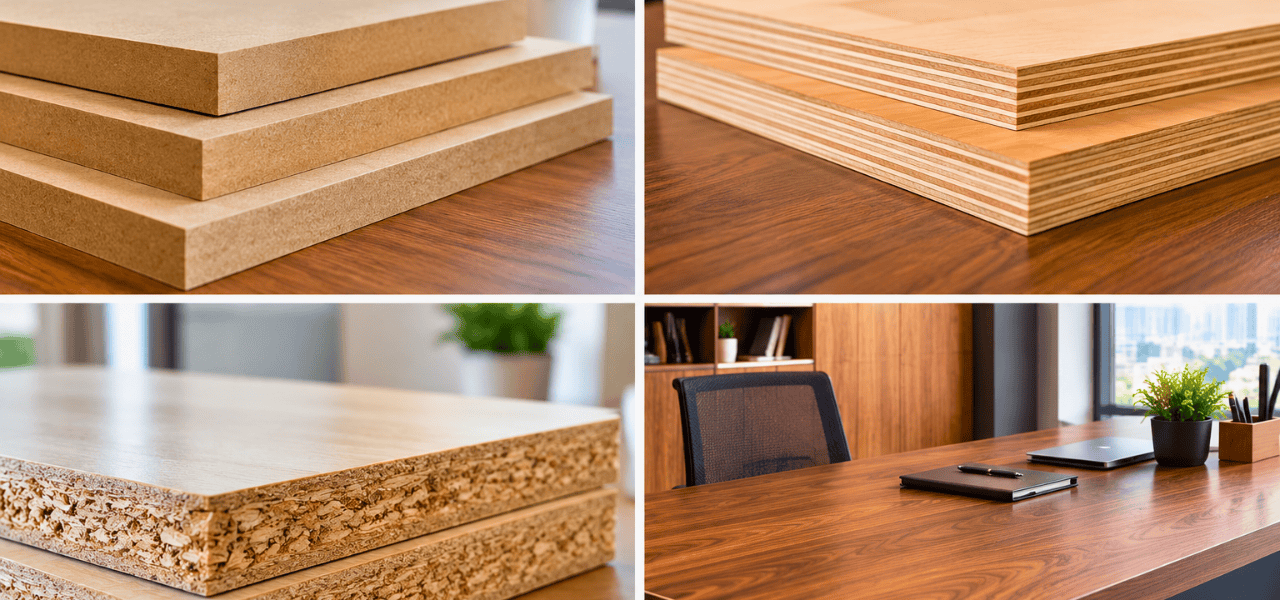
MDF is an engineered wood made from wood fibres, wax and resin, bonded together under heat and pressure. The result is a dense, uniform board with no grain and no internal voids. It is one of the most widely used materials in modular office furniture, particularly for workstations and storage units where consistency matters across hundreds of units.
Advantages of MDF for Office Tables
A smooth, uniform surface. MDF takes laminates, paint and veneer finishes exceptionally well, which is why it forms the base of so many modern office tables.
Cost-effective at scale. For large office setups with dozens or hundreds of workstations, MDF delivers a clean look without the premium price of plywood.
Consistent appearance. With no grain patterns, every panel looks the same. This is a real advantage for bulk furniture orders where visual uniformity across the floor is important.
Easy to cut and shape. MDF machines beautifully, making it ideal for custom modular designs, curved edges and detailed profiles.
Disadvantages of MDF for Office Tables
It is heavy. MDF is noticeably heavier than plywood, which affects transport, installation and any future reconfiguration of the office layout.
It is not moisture resistant. In humid conditions or areas with water exposure, standard MDF can swell and lose its shape. It should be kept away from washrooms, pantries and leak-prone zones.
Edges can chip. If edges are not properly sealed and banded, they are vulnerable to chipping and moisture ingress.
Lower load-bearing capacity. In a mdf vs plywood office table comparison, MDF is the weaker option when it comes to bearing heavy loads over long periods.
Best Use-Cases for MDF in Office Spaces
MDF performs best in conference tables, reception desks, storage units and open-plan workstations in climate-controlled offices. If your space is fully air-conditioned and your equipment is relatively light, an MDF office table with a quality laminate finish offers excellent value for money.
What is Plywood? Pros & Cons for Office Tables
What is Plywood?
Plywood is made from thin layers, or plies, of wood veneer glued together with the grain of each layer running in alternating directions. This cross-graining is what gives plywood its remarkable strength and dimensional stability.
In commercial furniture, buyers should look for ISI-graded plywood. Two grades matter most: BWR (Boiling Water Resistant) and BWP (Boiling Water Proof). BWR is suitable for most interior applications with occasional moisture exposure, while BWP is built for conditions where water contact is more likely.
Advantages of Plywood for Office Tables
Superior strength-to-weight ratio. Plywood is strong without being excessively heavy, which makes it easier to install and move than MDF.
Excellent screw-holding capacity. Heavy monitors, CPUs, printers and drawer units demand a core that grips fasteners firmly over years of use. Plywood does this better than any other engineered option.
Moisture resistance. BWR and BWP grades handle India’s varied climate zones, from coastal humidity in Mumbai to the dry heat of Ahmedabad, far better than MDF or particle board.
Long lifespan. With proper use, a good plywood office table can last 15 to 20 years.
Better environmental profile. When sourced from sustainably managed forests, plywood is a more eco-friendly choice.
Disadvantages of Plywood for Office Tables
Higher cost. Plywood is more expensive than both MDF and particle board, which can add up on large-scale projects.
Visible grain. Bare plywood shows its grain and layered edges, so it needs a veneer or laminate for a polished, professional finish.
Quality varies widely. Low-grade plywood with gaps in the inner plies can warp, delaminate or sag. Always verify grade and source.
Best Use-Cases for Plywood in Office Spaces
Plywood is the right choice for executive desks, director tables, heavy-duty workstations and office partitions. If your team uses multi-monitor setups or heavy hardware, or if your office table sits in a space with variable humidity, plywood is the safest long-term investment among all office furniture materials.
What is Particle Board? Pros & Cons for Office Desks
What is Particle Board?
Particle board is a low-density engineered wood made from wood chips, sawmill shavings and resin pressed into sheets. It is commonly used in budget office furniture across India, particularly in flat-pack and ready-to-assemble products.
Advantages of Particle Board for Office Desks
Lightest and most affordable. Particle board is the most economical engineered wood, making it attractive for tight budgets.
Smooth when laminated. With a good laminate surface, a particle board desk can look perfectly respectable.
Suited to modular and flat-pack designs. Its light weight makes shipping and assembly simple, which suits budget-conscious startups and temporary setups.
Disadvantages of Particle Board for Office Desks
The weakest of the four. Particle board has the lowest load-bearing capacity and can sag under sustained weight.
Highly susceptible to moisture. When wet, it swells and crumbles, and the damage is usually irreversible.
Poor screw-holding strength. Repeated assembly and disassembly loosens fittings, and heavy monitors or printers put it under strain.
Shortest lifespan. Expect around three to five years under normal use, and considerably less if exposed to moisture.
When assessing particle board desk quality, always check density, laminate bonding and edge sealing. These factors separate a serviceable desk from one that fails within a year.
Best Use-Cases for Particle Board in Office Spaces
Particle board works for low-traffic desks, temporary office setups and storage shelves carrying light loads. For a permanent office workspace table that will face daily heavy use, it is generally not the best long-term option.
What is Veneer? Pros & Cons for Office Tables
What is Veneer?
Veneer consists of thin slices of real natural wood, typically 0.5 mm to 3 mm thick, applied over a core material such as MDF or plywood. It is important to understand one distinction: veneer is a finish, not a structural core. When comparing veneer with the other three materials, you are really comparing a surface layer with the boards underneath it. The strength of a veneer office table depends entirely on the core beneath the veneer.
Advantages of Veneer for Office Tables
Premium natural look at a fraction of solid wood cost. Veneer delivers real wood grain and character without the price or weight of solid timber.
A consistent finish. Veneered panels can be matched for colour and grain, which is ideal for executive suites and boardroom aesthetics.
Best of both worlds. Applied over a strong plywood core, veneer combines structural reliability with beautiful surfaces.
Rich wood species. Options include walnut, oak, teak and wenge, letting you align the look with your brand identity.
A luxurious feel. Veneer instantly elevates the atmosphere of a client-facing or leadership space.
Disadvantages of Veneer for Office Tables
A delicate surface. Veneer can scratch, chip or peel if it is not maintained and protected from heat and moisture.
Higher cost. It is more expensive than plain MDF or particle board with laminate finishes.
Costly to repair. Re-veneering requires professional care and can be expensive, so protecting the surface from the start pays off.
Best Use-Cases for Veneer in Office Spaces
Veneer is ideal for CEO desks, boardroom tables, client-facing reception areas and luxury office interiors. In these spaces, a veneer office table communicates quality and permanence, which matters when visitors form impressions in seconds.
How to Choose the Right Office Table Material for Your Workspace
Selecting the right office table material comes down to five practical considerations.
Consider Your Budget
In ascending order of cost, the materials rank as follows: particle board, MDF, plywood, then veneer. Remember that veneer is a finish applied on top of a core, so its price also reflects the core you choose. Cheaper is not always more economical. A particle board desk replaced every four years can cost more over a decade than a plywood table that lasts fifteen.
Consider Load and Usage
If your team works with heavy monitor setups, desktop hardware or equipment-laden desks, go with plywood. For light laptop-based workstations, MDF or particle board is usually sufficient. Match the material to the weight it will carry every day, not just on the day of installation.
Consider Your Office Environment
For high-humidity spaces, or areas near washrooms and cafeterias, choose BWR plywood. If your office is fully air-conditioned and climate-controlled, MDF performs very well and offers good value. Think about monsoon conditions, too, particularly in coastal cities and older buildings with seepage risks.
Consider Aesthetics and Brand Image
For client-facing zones, veneer over plywood gives a premium look that supports your brand. For open-plan workstations, MDF with a quality laminate is cost-efficient and clean. The best offices often combine materials, using veneer in leadership and reception areas and laminated MDF across the workstation floor.
Consider Sustainability
Sustainability is increasingly a procurement criterion, especially for companies with ESG commitments or green building certification goals. Ask suppliers about material sourcing, formaldehyde emission levels, and production practices. At Vlite Furnitech, we engineer office furniture with sustainably sourced materials that meet BIFMA and ISO 9001:2015 standards, produced in a LEED-compliant facility with responsible, eco-friendly manufacturing.
Why Vlite Furnitech Uses the Best-in-Class Materials
Knowing which material suits your office is only half the equation. The other half is working with a manufacturer who builds to a standard. Vlite Furnitech is built around exactly that principle.
- State-of-the-art manufacturing: Our 30,000 sq. ft. facility in Patalganga, Navi Mumbai, is equipped for precision production at scale.
- Proven capacity: We produce up to 14,000 workstations per month, which means we can handle everything from a single floor to a multi-city rollout.
- Certified quality: BIFMA, ISO 9001:2015 and LEED-compliant credentials back our products and processes.
- Custom modular solutions: Our range covers ergonomic chairs, modular workstations, executive tables and storage units, all tailored to your space.
- Pan-India presence: We serve clients in Mumbai, Pune, Ahmedabad, Surat and Hyderabad, along with global projects.
- End-to-end support: Dedicated project management and after-sales service keep your project on track from design to installation and beyond.
Every product starts with choosing the right material for its purpose, whether that is a plywood core for a heavy-duty executive table or laminated MDF for a high-volume workstation cluster. Explore Vlite Furnitech’s range of modular office furniture crafted with the finest materials.
Still comparing modular, bespoke, and traditional office furniture?
Let Vlite Furnitech LLP help you choose the smartest investment for better ROI.
Frequently Asked Questions (FAQ)
Q1: Which material is best for an office table in India?
Plywood (BWR grade) is best for durability and moisture resistance. MDF is a great choice for budget workstation setups in air-conditioned offices.
Q2: Is MDF or plywood better for office furniture?
Plywood is stronger and more moisture-resistant, while MDF offers a smoother finish at lower cost. The best choice depends on usage, budget and office environment.
Q3: What is the lifespan of a particle board office desk?
Particle board desks typically last 3 to 5 years under normal use, and significantly less if exposed to moisture.
Q4: Is veneer good for office tables?
Yes. Veneer offers a premium wood aesthetic over a sturdy core such as plywood or MDF, making it ideal for executive and boardroom tables.
Q5: What material do most modular office furniture manufacturers use?
Most quality manufacturers use a combination: MDF or plywood cores with laminate or veneer surfaces, balancing durability, aesthetics and cost.
Q6: Are Vlite Furnitech office tables durable?
Yes. Vlite Furnitech uses BIFMA-certified, sustainably sourced materials and maintains ISO 9001:2015 quality standards across all products.
Make the Right Office Table Material Choice for Your Office
Each office table material has its place. Plywood leads on strength and moisture resistance, MDF offers a smooth, cost-effective base for modern workstations, particle board suits light-duty and temporary needs, and veneer adds a premium natural finish over a solid core. The right choice depends on four factors: your budget, how intensively the furniture will be used, the look you want to project, and the environment it will sit in.
Looking for premium, durable office furniture built with the right materials? Get in touch with Vlite Furnitech, India’s trusted modular office furniture manufacturer, and transform your workspace today.

Vishnu Sharma
I am the co-founder and CEO of Vlite Furnitech, creating modular office solutions since 2009. With a background in Chemistry and Marketing, and experience as Regional Head at Featherlite, I help design ergonomic, adaptable, and sustainable workspaces. Alongside a team of 120+, we serve corporates like JCB, Just Dial, KFC, and educational institutions. Let’s connect to reimagine innovative, eco-friendly office environments.