Walk through any busy office at 9:30 a.m. and the problem is easy to spot. Bags sit under desks, jackets hang over chair backs, laptops are left out at lunch, and personal items crowd the workstations that were meant to hold only work. As hybrid schedules become the norm, the problem gets harder, because employees arrive with more things to carry and fewer assigned places to put them.
Poor storage costs more than tidiness. Cluttered workstations slow people down. Unsecured belongings create anxiety and, occasionally, real losses. Shared desks without a personal storage point make staff feel they are only visiting their own workplace. A well-planned office locker system fixes these issues quietly and permanently. It gives every employee a secure, defined place for their belongings, and it frees up the working surfaces for working.
This guide covers what facility managers, HR teams, interior designers and procurement professionals need to know about office locker design: how to choose the right sizes, which locking systems fit which workplaces, which materials last, and which compliance standards matter in India. Whether you are fitting out a new floor or upgrading existing office workspace storage, the decisions below will shape how well your space works for years. Vlite Furnitech, a manufacturer of modular office furniture in India, has drawn on its project experience to keep the advice here practical.
What Is Office Locker Design? Understanding the Basics
Office locker design is the planning of how lockers are sized, configured, secured, finished and positioned within a workplace. It is easy to treat it as a purchasing decision, a matter of ordering a certain number of steel cabinets. In practice it is closer to space planning. A good design considers ergonomics (can everyone reach their compartment comfortably?), workflow (are lockers near the places people actually need them?), material (will the unit survive a decade of daily use?) and aesthetics (does it belong in the office or look bolted on?).
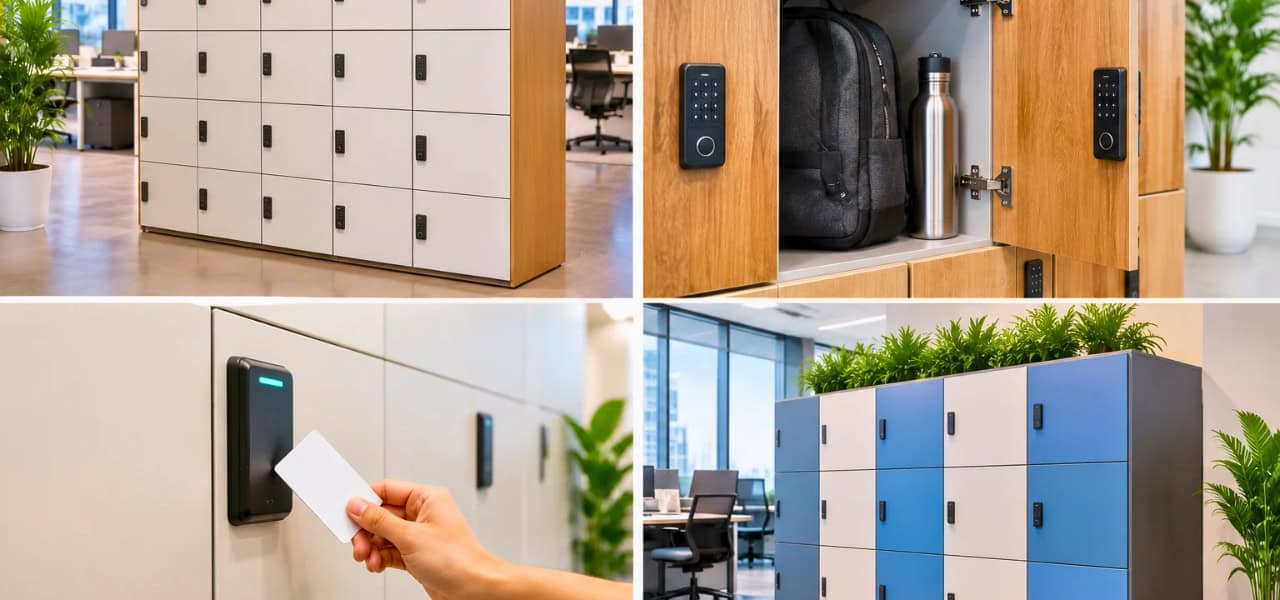
Lockers have changed a great deal. Traditional grey steel lockers, associated with factories and school corridors, still have their place. But modern offices increasingly use modular systems with powder-coated colour palettes, laminate fronts, integrated benches, digital locks and layouts that double as partitions or break-room features. The locker has moved from the back corridor into the centre of workplace design.
The need cuts across sectors. IT parks and corporate headquarters use lockers to support hybrid teams. Hospitals and clinics need secure, hygienic storage for staff who cannot carry personal items into clinical areas. Manufacturing units need robust units for shift workers. Coworking operators need flexible, rentable storage. Schools and training institutes need affordable, resilient options. Each of these has different demands, which is exactly why a one-size-fits-all approach rarely works.
Key Elements That Define a Good Office Locker Design
Before looking at specific dimensions and locks, it helps to know what separates a well-designed locker system from an average one.
- Material quality: Cold-rolled steel, high-pressure laminate (HPL) and engineered wood each suit different environments. Material choice drives durability, hygiene and appearance.
- Number of tiers: Single, double, triple and quadruple-tier configurations let you match compartment size to storage need and floor space.
- Ventilation: Louvres or perforations prevent odour and moisture build-up, especially where gym bags, damp umbrellas or work uniforms are stored.
- Aesthetic integration: Colour, finish and door style should complement the surrounding interiors rather than clash with them.
- Accessibility: Reach heights, door swing and aisle clearances should work for all employees, including those with mobility limitations.
Standard Office Locker Sizes: What You Need to Know
Sizing is where many projects go wrong. Lockers that are too small frustrate employees, and lockers that are too large waste floor area that could host workstations or collaboration space. The right size depends on three things: what employees will store, how many users you are planning for, and how much floor space you can dedicate.
Most commercial lockers follow a familiar full-height envelope of roughly 1800 mm high, 300 mm wide per column and 450 mm deep. Within that envelope, the number of tiers determines how the space is divided. Widths commonly range from 250 mm to 400 mm per column, and depths can be adjusted where laptops, bags or folded garments need more room.
Manufacturers with in-house production can also build to custom dimensions. Vlite Furnitech operates a 30,000 sq. ft. manufacturing facility with a capacity of around 14,000 workstations, which gives it the flexibility to adapt locker dimensions, tier counts and finishes to project requirements rather than forcing clients into a fixed catalogue. Custom office locker design and sizes are especially valuable in irregular floor plans, such as around structural columns or in narrow corridors.
Single-Door vs. Multi-Tier Locker Configurations
The table below summarises common configurations and where each works best.
| Configuration | Typical Dimensions (H × W × D) | Best For |
| Single-tier (full height) | 1800 × 300 × 450 mm | Garment and coat storage |
| Double-tier | 1800 × 300 × 450 mm (2 compartments) | General personal storage |
| Triple-tier | 1800 × 300 × 450 mm (3 compartments) | Compact offices |
| Quadruple-tier | 1800 × 300 × 450 mm (4 compartments) | High-density workplaces |
| Half-height locker | 900 × 300 × 450 mm | Under-desk or reception areas |
A few practical notes. Single-tier lockers suit roles that need to hang jackets, uniforms or formal wear. Double-tier lockers are the workhorse of corporate offices because each compartment comfortably holds a bag, a laptop and small personal items. Triple and quadruple-tier units pack more users into less floor area, which suits high-density offices, though compartments are smaller. Half-height units work well near reception desks, in pantries or beneath benches where full-height units would be overwhelming.
Whatever configuration you choose, plan for a minimum aisle clearance of 900 mm in front of locker rows. This ensures people can open doors, pass each other and, where required, move a wheelchair safely.
How Many Lockers Does Your Office Need?
A common rule of thumb is simple. For offices with fixed seating, plan for one locker per full-time employee. For hybrid or hot-desking environments, where not everyone is in on the same day, a ratio of 0.5 to 0.7 lockers per employee is usually sufficient.
Several factors adjust that figure:
- Shift patterns: If multiple shifts share the same lockers, you may need fewer units than headcount suggests. If shifts overlap, you may need more.
- Storage needs by role: Field staff, lab technicians and facility teams often carry more equipment than desk workers.
- Building layout: Spreading smaller locker banks across floors can be more convenient than one large bank in a single location.
It is worth building in a margin of 10 to 15 percent for growth, visitors and contractors. Re-ordering matching units later is possible, but a consistent installation looks better and costs less when done once.
Office Locker Locking Systems: Choosing the Right Security Mechanism
A locker is only as secure as its lock. The right mechanism depends on the sensitivity of what is being stored, the number of users, the administrative effort you are willing to take on, and your budget. Here are the major options.
Key Lock (Cam Lock)
The traditional cam lock is simple and inexpensive. Each locker has a key, and a master key can be held by facility staff. The drawbacks are familiar: keys get lost, duplicates circulate, and there is no record of who opened which locker. Replacing a lock core after a lost key is a recurring cost.
Best for: warehouses, factories and environments where simplicity and low cost matter more than audit trails.
Combination or Dial Lock
Mechanical combination locks remove the need for keys. Users set or are given a code and open the locker by dialling it. Many models are user-resettable, which suits temporary or rotating use. The limitation is that codes can be forgotten or observed, and there is no digital record.
Best for: schools, gyms, training centres and temporary-use office lockers.
Digital Keypad or PIN Lock
Electronic keypad locks let users set a personal PIN, and most models include a master override for administrators. They eliminate key management, are easy to reset when employees leave, and give a modern look. Battery life and override procedures should be part of your maintenance plan.
Best for: corporate offices, IT parks and coworking spaces.
RFID or Smart Card Lock
RFID locks open with an employee ID card, fob or wristband. They can integrate with existing building access systems so that one credential works across doors, turnstiles and lockers. Administrators can assign, revoke and audit access centrally, which matters in large organisations where staff turnover is constant.
Best for: large enterprises, banks, healthcare facilities and any workplace already using card-based access.
Biometric Lock
Fingerprint or facial recognition locks offer the highest level of security and a full audit trail, because access is tied to the individual rather than to something they carry. Cost and maintenance are higher, and some employees have privacy concerns, so a clear data policy is essential.
Best for: high-security environments, executive storage and regulated sectors.
For hybrid workplaces, RFID-enabled employee locker units allow dynamic assignment, so there is no dedicated locker per person. Employees tap their card to claim any available locker for the day and release it when they leave. This is how offices achieve the 0.5 to 0.7 locker-per-employee ratio without frustrating staff.
When comparing systems, think beyond the purchase price. Key locks are cheapest upfront but costly to administer. Electronic and RFID systems cost more initially but cut the long-term admin burden, particularly across hundreds of units. Advanced locking options are also a reasonable indicator of overall product quality, since manufacturers who integrate them well tend to invest in precise door alignment, sturdy hinges and robust construction.
Materials Used in Office Locker Design: Metal, Laminate and Beyond
Material determines how long your lockers last, how they look, and how they respond to humidity, impact and cleaning. Here is how the three main options compare.
Cold-Rolled Steel (Metal Lockers)
A metal locker for office use remains the most durable and widely specified option. Cold-rolled steel is strong, fire-resistant and hygienic, and it handles heavy daily use without warping. Powder-coated finishes are available in a wide colour palette, so modern steel lockers no longer look industrial unless you want them to. Powder coating also resists scratches, moisture and corrosion, which is a real advantage in humid or coastal cities such as Mumbai, Surat and Chennai.
Steel lockers are also the option most likely to meet recognised structural and safety benchmarks. Vlite Furnitech’s products are manufactured under BIFMA-aligned testing and an ISO 9001:2015 quality management system, which gives procurement teams documented assurance of consistency.
High-Pressure Laminate (HPL) Lockers
HPL lockers offer a premium look and good moisture resistance. The surface is available in wood grains, solid colours and textured finishes, making these units popular in upscale corporate offices, hospitality settings and healthcare environments where appearance matters as much as function. They are more resistant to humidity than plain wood, though edges and hinges need quality construction to last.
Wood and MDF Lockers
Wood and MDF are cost-effective for low-traffic environments and short-term installations. They can look warm and attractive, but they are less durable under heavy use, more vulnerable to moisture and generally not suited to industrial or high-turnover settings. For most commercial offices, they are a budget compromise rather than a long-term choice.
Quick comparison: choose steel for durability and compliance, HPL for premium appearance and moisture resistance, and wood or MDF only where budgets are tight and usage is light.
Compliance Standards for Office Lockers in India
For B2B buyers, compliance is not a footnote. It affects safety, insurance, tender eligibility and the reputation of the facility team that signed the purchase order. Several standards and certifications are worth checking when you evaluate a supplier.
Key Certifications and Standards to Look For
- BIFMA (Business and Institutional Furniture Manufacturers Association): An international benchmark for structural safety, durability and performance testing of commercial furniture. BIFMA-aligned products have been tested to withstand real workplace loads and repeated use.
- ISO 9001:2015: Certifies that a manufacturer runs a documented quality management system, which means consistent processes from raw material to dispatch.
- LEED compliance: Relevant for buyers pursuing green building ratings. It reflects sustainable material sourcing and eco-friendly production practices. Vlite Furnitech’s manufacturing is LEED-compliant, which can support clients’ own green certification goals.
- BIS standards (Bureau of Indian Standards): Applicable to steel furniture in India and an important reference for domestic procurement.
- National Building Code of India (NBC): Governs aisle widths, fire egress routes and accessibility provisions that affect how and where locker banks can be installed.
Ask suppliers for certificates and test reports rather than relying on claims. A credible manufacturer will provide them readily.
Ergonomic and Accessibility Compliance
Good office locker design also respects human reach and movement. Practical guidelines include:
- Top shelf height: Should not exceed 1,800 mm so that most employees can reach it comfortably.
- Bottom shelf height: Should sit at least 300 mm above the floor to avoid excessive bending and to simplify floor cleaning.
- Aisle clearance: Maintain a minimum of 900 mm between locker rows, and more where wheelchair access is required.
- Door swing: Plan for door swing in compact installations so that doors do not collide with those of the opposite row or obstruct circulation routes.
Accessibility deserves early attention rather than a retrofit. Including a few lower-height or wheelchair-accessible compartments from the start is far easier than modifying a finished installation, and it reflects an inclusive workplace culture.
Office Locker Design Tips: Making Lockers Work for Your Workspace
Once you have settled on size, lock and material, small design decisions determine whether the system feels well thought out. These tips come from the kind of planning a dedicated design team applies to real projects.
- Match colour and finish to your palette. Lockers that echo your brand colours or interior tones feel intentional. Neutral greys and whites blend in, while accent colours can turn a locker bank into a feature wall.
- Use zoned placement. Put lockers near entrances, break rooms or department clusters rather than in a single remote corner. Employees use storage more when it is convenient, and distributed placement reduces corridor congestion.
- Add integrated benches. In areas where staff change shoes, uniforms or gym wear, a locker bank with a built-in bench saves space and adds comfort.
- Label compartments clearly. In large offices, numbered doors and a digital directory make finding and assigning lockers easy, particularly with hot-desking.
- Include ventilation. Louvres or perforated panels prevent odour build-up, which is a common complaint with sealed units.
- Plan for charging. If you want charging lockers for phones and laptops, plan power supply and cable management during design, not after installation.
- Choose powder-coated finishes in humid regions. In coastal or high-humidity climates, quality powder coating significantly extends the life of steel units.
Thoughtful staff locker office planning also ties into your wider office workspace storage strategy. Lockers work best alongside pedestals, overhead cabinets and shared storage, so that each type of item has an appropriate home. When employees have somewhere secure for personal belongings, workstations stay clear for work.
Why Choose Vlite Furnitech for Your Office Locker Needs?
Choosing a locker supplier is partly about the product and partly about the partner. A good manufacturer should offer reliable quality, flexibility in design, predictable delivery and support that continues after installation. Here is how Vlite Furnitech approaches each of these.
Experience and focus
With over a decade of expertise in modular office furniture, Vlite Furnitech understands how storage fits into complete workplace environments rather than treating lockers as isolated products.
Manufacturing scale
The company’s 30,000 sq. ft. facility in Patalganga, Navi Mumbai, supports production capacity of around 14,000 workstations per month. That scale helps projects of all sizes stay on schedule, from a single floor to a multi-site rollout.
Customisation
Sizes, finishes, tier configurations and locking systems can be tailored to workspace requirements, so clients are not limited to standard catalogue options.
Certified quality
BIFMA-aligned structural testing, ISO 9001:2015 quality management and LEED-compliant manufacturing give procurement teams documented proof of performance and sustainability.
Pan-India presence
Branches in Mumbai, Pune, Ahmedabad, Surat and Hyderabad, along with global operations, allow dedicated project management teams to coordinate delivery and installation across locations.
After-sales support
Service teams across branch locations help with maintenance, lock replacements and additions, which matters when lockers are in daily use for years.
When evaluating any metal locker for office supplier, ask for certificates, sample units, references from similar projects and clarity on lead times and service coverage. A supplier that answers these questions confidently is usually one you can rely on.
Still comparing modular, bespoke, and traditional office furniture?
Let Vlite Furnitech LLP help you choose the smartest investment for better ROI.
Frequently Asked Questions (FAQ)
What is the standard size of an office locker?
Standard office lockers are typically 1800 mm (H) × 300 mm (W) × 450 mm (D) for a full-height single-tier unit. Multi-tier lockers share the same height but divide the compartments vertically.
Which locking system is best for corporate offices?
RFID or digital keypad locks are most recommended for corporate environments because of their keyless convenience, audit trail capability and integration with existing employee ID systems.
Are metal lockers better than wooden lockers for offices?
Metal lockers made of cold-rolled steel offer superior durability, fire resistance and hygiene, making them the preferred choice for most commercial offices. They are also more likely to meet BIFMA compliance standards.
How many lockers do I need for my office?
For full-time seating, plan for one locker per employee. For hybrid or hot-desking environments, a ratio of 0.5 to 0.7 lockers per employee is typically sufficient.
What compliance standards should office lockers meet in India?
Look for BIFMA certification for structural safety, ISO 9001:2015 for manufacturing quality and BIS standards for steel furniture, and ensure aisle dimensions comply with the National Building Code of India.
Can office lockers be customised in size and finish?
Yes. Leading manufacturers like Vlite Furnitech offer customisation in dimensions, number of tiers, door finishes, colours and locking systems to suit specific workspace requirements.
Invest in the Right Office Locker Design From Day One
Good office locker design rests on three pillars. First, right sizing: matching tier configurations and quantities to how your people actually work, with room to grow. Second, the right locking system: balancing security, convenience and administrative effort, whether that means a simple cam lock or an RFID system tied to employee ID cards. Third, genuine compliance: verifying BIFMA, ISO 9001:2015, BIS and NBC alignment so your installation is safe, durable and defensible.
Skipping any of these has consequences. Poor planning leads to wasted floor space, security gaps, frustrated employees and, in the worst cases, non-compliance with building and safety norms that is expensive to correct. Getting it right at the start costs little more and pays back every working day.
Whether you are planning a new fit-out or upgrading existing storage, the choices you make about each employee locker unit shape how your workplace feels and functions.
Planning a new office fit-out or upgrading your existing storage? Vlite Furnitech’s expert team can help you design and procure the right employee locker units for your workspace: customised, certified and delivered on time.

Vishnu Sharma
I am the co-founder and CEO of Vlite Furnitech, creating modular office solutions since 2009. With a background in Chemistry and Marketing, and experience as Regional Head at Featherlite, I help design ergonomic, adaptable, and sustainable workspaces. Alongside a team of 120+, we serve corporates like JCB, Just Dial, KFC, and educational institutions. Let’s connect to reimagine innovative, eco-friendly office environments.