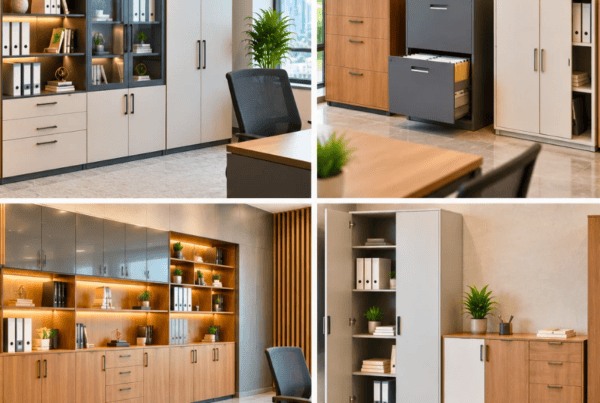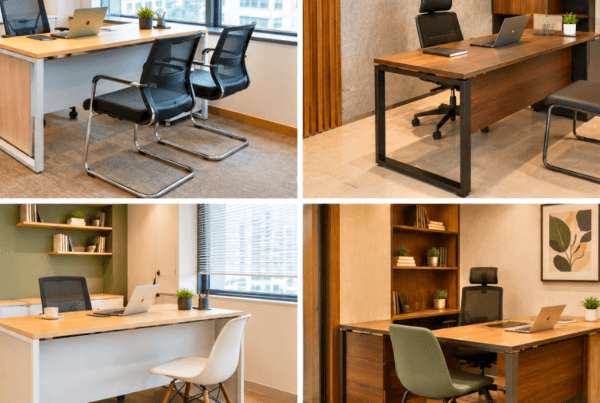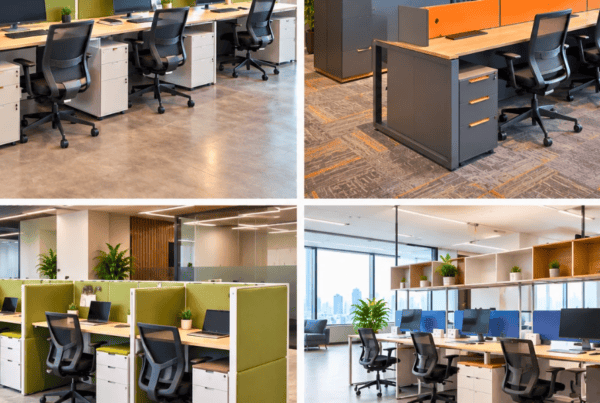
Walk through any busy office in Mumbai, Pune or Hyderabad and you will notice the same problem. Desks buried under files, chargers, binders and personal items, while the wall space above each workstation sits empty. The floor is crowded, but the vertical space is barely used.
That is where overhead storage for office spaces comes in. Done well, it clears the desk, protects confidential documents, keeps essentials within arm’s reach and adds a cleaner, more organised look to the entire floor. Done badly, with the wrong height, wrong size or wrong fixing method, it becomes a safety hazard and an ergonomic headache.
This guide covers everything you need to plan overhead storage properly: what it is, how to design it, how to size it, how to install it, and how to choose the right setup for your type of office. Whether you are an interior designer, a facility manager or a business owner furnishing a new space, you will find practical, specific guidance here.
Why Overhead Storage Is the Smartest Investment for Modern Offices
Research on workplace organisation consistently links cluttered desks with lower focus and reduced productivity, with some studies estimating losses of up to 13%. Employees spend time hunting for documents, shuffling items to make room for a laptop, or working around piles that should have a permanent home.
The root cause is usually simple: horizontal space is overused and vertical space is ignored. A standard workstation offers limited desk surface, yet the area above it, between desk height and the ceiling or partition top, often goes completely unused.
Overhead storage solves this by moving everyday items upward and out of the way. The benefits are practical and measurable:
- Cleaner desk surfaces, giving employees more usable working area
- Better use of floor space, since you need fewer floor-standing cabinets
- Improved document and cable management, with files and cabling kept tidy and concealed
- A more professional appearance, which matters for client-facing offices
- Stronger security, especially with lockable closed units
In the sections below, you will learn the types of units available, how to design and size them correctly, how installation works, and how to choose a trustworthy supplier for your office workspace storage needs.
What Is Overhead Storage in an Office?
Definition and Core Purpose
Overhead storage refers to cabinets or shelving positioned above desk height, either fixed to a wall or partition, or attached directly to a workstation frame. The purpose is straightforward: hold documents, stationery, personal belongings and small equipment in a place that is easy to reach but does not occupy desk space.
An overhead storage unit for office use differs from other storage formats in important ways:
- Pedestal units sit under the desk and hold drawers for files and personal items
- Lateral cabinets are floor-standing units, usually placed along walls or between teams
- Floor-standing cupboards and lockers take up valuable floor area
Overhead units, by contrast, use the airspace above the work surface. They are the only option among these that adds storage without consuming either desk or floor area, which is why they are such a staple of modern office furniture planning.
Types of Overhead Storage Units for Office
Not all overhead storage is the same. The right choice depends on your layout, your wall or partition type, and how much privacy and flexibility you need.
1. Wall-Mounted Overhead Cabinets
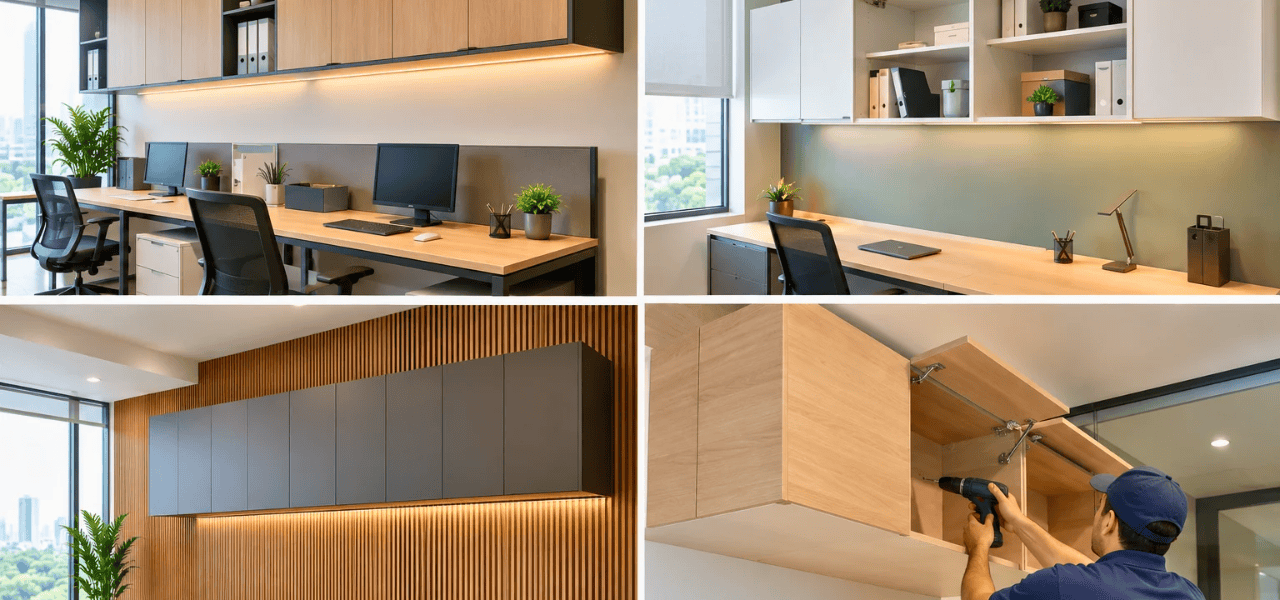
These are fixed to structural walls or solid partitions. They suit perimeter offices, cabins and areas where the layout is unlikely to change. They offer a clean, built-in look and can carry substantial loads when fixed properly.
2. Workstation-Integrated Overhead Units
These attach directly above a workstation desk, typically through brackets or upright posts that form part of the desk system. They are the most popular choice for open-plan offices because they need no wall fixing.
3. Overhead Cabinet Workstation Combinations
In this format, the cabinet is a designed component of the overhead cabinet workstation system rather than an add-on. Desk, screens and storage are engineered together, which gives better stability, neater cable routing and a consistent finish.
4. Open Overhead Shelving
Open shelves suit binders, reference books, display items and even small planters. They are easy to access but offer no privacy, so they work best for non-sensitive items.
5. Closed Overhead Storage Cabinets with Locks
An overhead storage cabinet with doors and locks is the right answer for confidential files, IT accessories and personal belongings. Hinged or flap-door shutters keep contents hidden and the workstation looking tidy.
Quick comparison
| Type | Best For | Privacy Level | Installation Complexity |
| Wall-mounted cabinet | Cabins, perimeter walls | High (with doors) | Medium to high |
| Workstation-integrated unit | Open-plan offices | Medium to high | Low |
| Cabinet workstation combo | New fit-outs, modular layouts | High | Low (factory engineered) |
| Open overhead shelving | Display, reference material | Low | Low to medium |
| Closed cabinet with lock | Confidential and personal items | Very high | Medium |
Designing Overhead Storage for Your Office Space
Key Design Principles to Follow
Good overhead storage looks effortless, but it is built on a few firm principles.
Ergonomics first
The bottom of an overhead unit should sit roughly 400 to 500 mm above the desk surface. Too low, and employees bump their heads or feel boxed in. Too high, and they strain to reach the contents. Visibility matters too: seated employees should still be able to see across the room comfortably.
Visual consistency
Cabinet colour, finish and edge detailing should match the existing workstation desking system. Mismatched finishes make even expensive furniture look patched together.
Modular flexibility
Teams grow, shrink and reorganise. Choose overhead systems that can be reconfigured, extended or relocated without replacing the entire installation.
Integrated cable management
Well-designed overhead units can conceal cable trays, power spines and data ports, reducing visible clutter and trip hazards below.
Lighting and airflow
Plan for light reaching the desk surface, and never allow units to obstruct air-conditioning vents. Under-cabinet LED strips are a smart addition that solves the shadow problem directly.
Material and Finish Options
The material you choose affects durability, cost, weight capacity and appearance.
- Pre-laminated particle board: The most common choice for modular office furniture. Cost-effective, available in a wide range of finishes and suitable for most standard loads.
- Powder-coated steel: Ideal for high-traffic zones and heavier loads. Durable, resistant to wear and easy to maintain.
- Glass-front cabinets: A premium option for executive cabins, adding visual depth and a sense of openness.
- Fabric or acoustic panel fronts: Useful in collaborative spaces where sound absorption matters as much as storage.
Many manufacturers, including Vlite Furnitech, can customise finishes and combinations to match a client’s design brief, which is especially valuable for brand-led interiors.
Aesthetic Trends in Overhead Office Storage
Design preferences in workplace storage continue to evolve. Some of the clearest directions right now include:
- Minimalist flush-panel designs with handleless fronts and clean lines
- Mixed-material combinations, such as timber-look panels paired with slim metal frames
- Biophilic touches, with open shelves styled with planters to soften the workspace
- Neutral palettes that align with WELL and LEED-certified workspace standards, favouring calm, natural tones
Sustainability credentials increasingly matter alongside looks. Vlite Furnitech’s BIFMA-certified products and LEED-compliant manufacturing reflect this shift toward responsible workplace furniture.
Getting the Size Right: Overhead Storage Dimensions Explained
Size is where many overhead storage projects go wrong. Units that are too deep, too heavy or poorly matched to the desk below create problems that are expensive to fix after installation.
Standard Dimensions for Overhead Storage Units
- Width: Usually matches the workstation desk width. Common sizes are 900 mm, 1200 mm, 1500 mm and 1800 mm.
- Height of the cabinet: Typically 300 to 400 mm.
- Depth (projection from the wall or screen): 280 to 350 mm is the accepted industry range.
One rule is worth remembering: an overhead unit should never project beyond the front edge of the desk below it. If it does, users risk striking their heads when standing up or leaning forward.
How to Size Overhead Storage for Different Office Setups
| Office Type | Recommended Unit Width | Notes |
| Individual workstation | 900 mm or 1200 mm per seat | One unit per user keeps storage personal and accessible |
| Linear workstation cluster | Continuous run matching total desk length | Creates a uniform, built-in look |
| Back-to-back workstations | 1200 mm or 1500 mm on central spine screens | Mounted to the spine; check screen load rating |
| Executive cabin | 1800 mm or custom width | Often paired with credenza and glass or veneer fronts |
| Home office | 600 to 900 mm | Compact, dual-purpose with display shelving |
In practice, the cleanest approach is to match unit width to desk width module by module. This keeps proportions consistent and avoids awkward gaps or overhangs.
Weight Load Considerations
Weight capacity is a safety issue, not just a specification.
- Standard laminated overhead units typically support 15 to 25 kg
- Heavy-duty steel units can support 40 to 50 kg
Always calculate the combined weight of files, books, equipment and accessories that will realistically be stored. Binders and boxed files are heavier than they look. Check the manufacturer’s load rating, and distribute weight evenly across shelves, placing heavier items on the lowest shelf.
Installation Guide: How Overhead Storage Units Are Installed
Installation method depends on whether the unit is wall-mounted or integrated into the workstation. Both have a clear process, and both reward careful preparation.
Wall-Mounted Installation
Step 1: Identify the wall type
Masonry, drywall and glass partitions each need a different fixing approach. Never assume.
Step 2: Mark anchor or stud positions
Mark fixing points at the correct height, with the unit base at least 300 mm above the desk surface, and confirm the line is level.
Step 3: Choose the right fixings
Use heavy-duty wall anchors or Fischer plugs for masonry, and toggle bolts for drywall. Using the wrong fixing is the most common cause of sagging or failure.
Step 4: Fix the mounting rail or back panel
Secure it firmly and recheck alignment before going further.
Step 5: Hang and level the cabinet
Mount the unit, check it is level, and secure hinges and soft-close mechanisms.
Step 6: Test the load
Before full use, load the cabinet gradually to confirm stability.
This approach suits wall mounted office storage in cabins, boardrooms and perimeter zones with solid walls.
Workstation-Integrated Installation
Workstation-integrated overhead units mount directly to the desk system, with no wall fixing required. They connect through side brackets or central upright posts that are part of the workstation frame.
This method is ideal for open-plan offices, particularly those with glass partitions or non-structural walls where drilling is impractical or not permitted. Because the overhead storage becomes a plug-in component of the workstation desking system, it can be added, moved or removed as the layout changes, and it moves with the furniture.
Vlite Furnitech’s modular workstation systems are designed with this approach, so overhead storage integrates with the desk, screens and cable management from the start rather than being retrofitted.
Important Pre-Installation Checklist
Before any unit goes up, run through these checks:
- Confirm ceiling height allows comfortable head clearance
- Check power and data outlet positions to avoid conflicts
- Confirm AC vent clearances so airflow is not blocked
- Ensure lighting is not obstructed, and consider under-cabinet LED strips
- For rented or leased offices, check the tenancy agreement before drilling into walls
This checklist reflects realities common in Indian commercial buildings, where ceiling heights, partition types and HVAC layouts vary widely from one building to the next. A ten-minute check on site can prevent a costly reinstallation.
Overhead Storage for Different Office Types
Different workplaces have different priorities. Here is how overhead storage typically works across common office environments.
Open-Plan and BPO Offices
In high-density environments, every linear metre of desk space counts. Continuous runs of overhead cabinets above bench or cluster workstations create a uniform look, give each employee a personal storage zone and free up the desk surface for screens and tasks. This is where well-planned office workspace storage delivers its biggest return, because the gains multiply across hundreds of seats.
Executive and Director Cabins
Executive spaces call for a more refined approach. Premium wall-mounted units with glass shutters and locks look impressive while keeping confidential material secure. An overhead storage cabinet here is often colour-matched to the executive desk and credenza, so the whole room feels designed as one piece.
Co-Working and Flexible Offices
Layouts in co-working spaces change often. Mobile overhead storage systems or freestanding tall lockers allow quick reconfiguration without drilling or rework, which suits operators who need to adapt spaces for different members and teams.
Home Offices
For home setups, compact 600 to 900 mm wall-mounted units work well. They can serve double duty, providing storage on one shelf and display space on another, so a small room stays organised without feeling like a commercial office.
Why Choose Vlite Furnitech for Overhead Office Storage?
Choosing the right supplier matters as much as choosing the right unit. Overhead storage is a long-term installation, and quality differences show up in alignment, load performance and finish over the years.
Manufacturing scale
Vlite Furnitech has the capacity to produce up to 14,000 workstations a month, which means overhead storage units are available at any volume, from a single cabin to a multi-floor corporate campus.
Customisation
An in-house design team works with clients to match exact dimensions, colours and finishes, so storage fits the space rather than the other way around.
Certifications
Products are BIFMA-certified, the facility is LEED-compliant, and quality systems follow ISO 9001:2015 standards. These are credible signals for procurement teams that need documented quality.
Pan-India delivery
With branches in Mumbai, Pune, Ahmedabad, Surat and Hyderabad, and dedicated project management, Vlite Furnitech supports installations across the country.
Sustainability
Responsibly sourced materials and eco-conscious production help organisations meet their own environmental goals.
Explore Vlite Furnitech’s overhead storage solutions, built for India’s modern office.
Still comparing modular, bespoke, and traditional office furniture?
Let Vlite Furnitech LLP help you choose the smartest investment for better ROI.
Frequently Asked Questions (FAQ)
What is the standard height for overhead storage in an office?
Overhead units are typically installed 400 to 500 mm above desk height. This places the base of the unit at roughly 1,300 to 1,400 mm from the floor.
Can overhead storage units be installed on glass partitions?
Standard wall-mounted units cannot be fixed to glass. Workstation-integrated overhead units that attach to the desk frame are the best solution in these cases.
What is the difference between a wall-mounted cabinet and an overhead cabinet workstation?
A wall-mounted cabinet is fixed directly to a wall surface. An overhead cabinet workstation is integrated into the workstation’s structural frame, so it moves with the furniture if the layout changes.
How much weight can an overhead office storage unit hold?
Standard laminated overhead units support 15 to 25 kg, while heavy-duty steel units can support up to 40 to 50 kg. Always verify the manufacturer’s load rating before use.
Are overhead storage cabinets available in custom sizes?
Yes. Leading manufacturers such as Vlite Furnitech offer customised widths, depths and finishes to suit any workstation or office layout.
What is the best overhead storage option for open-plan offices?
Modular overhead units integrated with the workstation desking system are ideal. They maintain visual uniformity, need no wall fixing and can be reconfigured as teams expand.
Make Vertical Space Work for You
Overhead storage is not an afterthought. It is a planned, engineered part of a productive and organised office. The right height protects ergonomics, the right dimensions keep the installation safe and proportionate, and the right fixing method ensures it performs for years.
Design, size and installation each follow clear best practice, and getting all three right is what separates a clean, efficient workspace from a cluttered or unsafe one. Whether you are fitting out an open-plan floor, an executive cabin or a compact home office, starting with these fundamentals will save time, money and rework.
Vlite Furnitech brings manufacturing precision, in-house design expertise and project management support to deliver overhead storage solutions that are as functional as they are good-looking.

Vishnu Sharma
I am the co-founder and CEO of Vlite Furnitech, creating modular office solutions since 2009. With a background in Chemistry and Marketing, and experience as Regional Head at Featherlite, I help design ergonomic, adaptable, and sustainable workspaces. Alongside a team of 120+, we serve corporates like JCB, Just Dial, KFC, and educational institutions. Let’s connect to reimagine innovative, eco-friendly office environments.