Most offices don’t fail at furniture buying because they chose something ugly. They fail because they chose something that looked right on day one and stopped working by day two hundred, desks that didn’t survive a reshuffle, chairs nobody could adjust, storage that ran out within a year of hiring. Knowing how to choose modular office furniture is less about picking a style and more about avoiding those slow-motion mistakes.
For facility managers, HR heads, and business owners setting up or renovating a workspace, furniture decisions ripple into productivity, employee comfort, and even how clients perceive the brand when they walk in. This guide breaks the decision into eight practical checkpoints, from space planning and ergonomics to certifications and after-sales support, so you can buy office furniture with confidence rather than guesswork.
What Is Modular Office Furniture (and Why It Matters)
Modular office furniture refers to standardized, interchangeable components, desks, storage units, partitions, and seating, that can be assembled, reconfigured, and expanded without being rebuilt from scratch. Instead of fixed, custom-built workstations, you get building blocks that adapt as your team, layout, or business needs change.
The appeal lies in three things: flexibility to rearrange as departments grow or shrink, reconfigurability to switch between collaborative and focused work settings, and scalability that lets you add workstations without redesigning the entire floor. This adaptability is exactly why modular systems have become the default choice for growing offices rather than a niche preference.
The 8-Point Checklist for Choosing Modular Office Furniture
1. Assess Your Space and Layout Needs
Before comparing catalogs, measure the space you actually have. A floor plan should account for workstation zones, private cabins, meeting rooms, storage areas, and informal breakout spaces, and how much square footage each realistically needs once walking room is factored in.
A few things are easy to overlook until it’s too late:
- Traffic flow, Can people move between desks, printers, and exits without squeezing past chairs?
- Natural light, Positioning desks near windows (without glare on screens) affects both mood and energy costs.
- Power and data points, Modular workstation desking is only as useful as the wiring behind it; plan sockets and data ports before furniture arrives, not after.
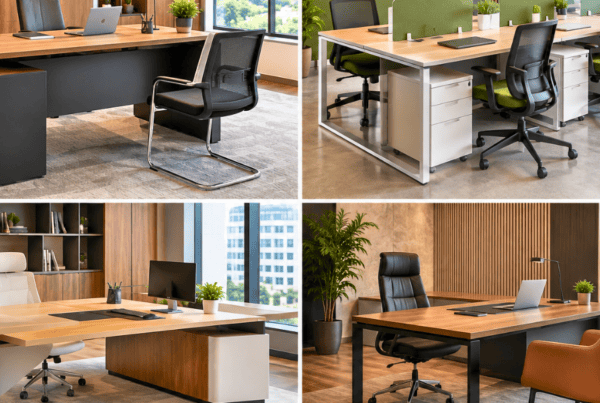
This is also where you decide on a workstation desking format. Linear desking suits departments that need quiet, individual focus. Cluster configurations work well for teams that collaborate constantly and don’t mind shared surfaces. Benching-style desking, long shared runs with dividers, is popular for maximizing headcount per square foot while still giving each person a defined zone. The right choice depends entirely on how your teams actually work, not on what looks best in a brochure.
2. Define Your Team Size and Future Growth Plans
One of the most common, and expensive, mistakes in office furniture buying is purchasing for exactly the headcount you have today. Teams grow, restructure, and sometimes shrink, and furniture that can’t move with them becomes dead weight within a year or two.
This is precisely the problem modular systems are designed to solve. Because components are standardized, you can add a workstation to an existing cluster, extend a bench, or reconfigure a cabin into two smaller ones without replacing everything. When evaluating options, ask suppliers directly: can this system expand by 20–30% without a full redesign? If the honest answer is no, it isn’t truly modular, it’s just furniture sold as modular.
3. Prioritize Ergonomics and Employee Well-being
No checklist for choosing office furniture is complete without ergonomics, and it’s often the point that gets compromised first when budgets tighten, which is a mistake, since it directly affects how people feel at the end of a workday.
Start with office workspace chairs. Look for adjustable seat height, proper lumbar support, breathable fabric (especially important in warmer climates), and castors suited to your flooring, hard floors and carpets need different wheel types. A chair that looks premium but lacks basic adjustability isn’t an ergonomic chair; it’s just a comfortable-looking one.
Desks matter just as much. Height should allow forearms to rest at roughly a right angle when typing, and workstation desking should leave enough depth for a monitor to sit at eye level without neck strain. None of this requires exotic engineering, it requires not skipping the basics in favor of aesthetics. Well-designed ergonomic office furniture is widely understood, even without formal studies, to reduce the kind of physical discomfort that leads to more sick days and lower focus during the day.
4. Evaluate Material Quality and Build Durability
Office furniture works harder than residential furniture. Desks get bumped, drawers get opened dozens of times a day, and chairs are used for eight-plus hours straight, often by more than one person over their lifespan. Materials that would be perfectly fine in a home office often can’t keep up commercially.
When comparing options, check:
- Board grade, Higher-density boards resist sagging and moisture damage better than cheaper particleboard.
- Laminate quality, Determines resistance to scratches, stains, and daily wear.
- Edge treatment, Poorly finished edges chip and peel quickly; PVC or ABS edge banding tends to hold up longer.
- Frame stability, Metal frames on desks and chairs should feel solid, not flexible, under normal use.
This is where the difference between office-grade and residential-grade furniture becomes obvious, not on day one, but after a year of continuous commercial use.
5. Check for Customization and Design Flexibility
Modular doesn’t have to mean uniform. Most reputable manufacturers offer a range of finishes, color palettes, and workstation configurations, linear, cluster, or benching, that can be mixed within the same office to suit different departments or floors.
This matters beyond aesthetics. Furniture design is one of the few tangible ways an office reflects its brand and culture, a creative team’s open, colorful cluster desks send a different signal than a finance team’s structured linear rows, and both can be built from the same modular base. When you’re choosing among the best modular office furniture for offices, flexibility in finish and configuration is what lets one system serve very different teams under one roof.
6. Look for Smart Storage and Cable Management
Clutter is rarely a discipline problem, it’s usually a design problem. If a workstation doesn’t have enough built-in storage, files and cables end up piled on the desk or floor by default.
Good modular systems typically include mobile pedestals for personal storage that can move with an employee if they relocate desks, overhead storage units for shared or infrequently used items, and integrated cable trays or raceways that keep wiring off the floor and out of sight. Beyond appearances, proper cable management reduces tripping hazards and makes it far easier to reconfigure a workstation later without untangling a mess first.
7. Verify Certifications and Sustainability Credentials
Certifications aren’t paperwork for their own sake, they’re a proxy for how carefully furniture was designed, tested, and manufactured. When comparing manufacturers, three credentials are worth checking specifically:
- BIFMA certification, Indicates the furniture has been tested against recognized safety and durability standards for commercial use.
- ISO 9001:2015 certification, Reflects a consistent, quality-controlled manufacturing process, not just a one-off good product.
- LEED compliance, Signals that materials and processes meet recognized sustainability benchmarks.
This matters more than it used to. Corporate buyers increasingly need to show that their office furniture, and their supply chain more broadly, meets sustainable and eco-friendly office furniture standards, whether for internal ESG goals or client-facing sustainability commitments. Vlite Furnitech, for instance, manufactures under BIFMA certification, ISO 9001:2015 quality standards, and LEED-compliant practices, the kind of credentials worth confirming with any supplier you’re evaluating, not just taking their word for it.
8. Choose a Manufacturer with Strong Manufacturing and After-Sales Support
Even well-designed furniture is only as good as the manufacturer’s ability to deliver it on time and support it afterward. This becomes especially important for large offices or multi-location rollouts, where delays in one city can stall an entire project timeline.
Before signing off, it’s worth asking a supplier a few direct questions: What’s their actual production capacity, and can they meet your timeline without subcontracting corners? Do they have a dedicated project management team, or will you be coordinating logistics yourself? And critically, what happens after delivery? Reconfiguration needs, minor repairs, and replacement parts are inevitable over a furniture system’s life, and a manufacturer without a genuine after-sales structure will leave you managing those problems alone.
This is one of the areas where scale genuinely helps. Vlite Furnitech, for example, runs a 30,000 sq. ft. manufacturing facility in Patalganga, Navi Mumbai, with the capacity to produce around 14,000 workstations a month, and maintains branches across Mumbai, Pune, Ahmedabad, Surat, and Hyderabad to support multi-city projects with dedicated project management and after-sales teams. Whether or not you go with Vlite specifically, this is the kind of manufacturing depth and support structure worth benchmarking any supplier against.
Common Mistakes to Avoid When Choosing Modular Office Furniture
Even with a solid checklist, a few recurring mistakes derail office furniture purchases:
- Buying based on price alone. The cheapest quote often reflects thinner boards, weaker frames, or no after-sales support, costs that resurface later as replacements.
- Ignoring future scalability. Furniture sized exactly to today’s headcount frequently needs replacing, not just adding to, when teams grow.
- Skipping ergonomic assessment. Treating chairs and desks as purely aesthetic choices, then dealing with complaints and discomfort later.
- Not verifying manufacturer certifications or after-sales support. Assuming all “modular” furniture is built and backed the same way, without checking BIFMA, ISO, or service commitments.
Avoiding these four alone resolves most of the regret buyers report after a furniture rollout.
Want office furniture that reduces long-term costs without compromising quality?
Trust Vlite Furnitech LLP for cost-effective workspace solutions built to last.
Frequently Asked Questions
What is the difference between modular and traditional office furniture?
Traditional office furniture is typically built as fixed, standalone pieces that are hard to reconfigure once installed. Modular office furniture uses standardized, interchangeable components that can be rearranged, expanded, or resized as needs change, making it far more adaptable for growing or evolving offices.
How long does modular office furniture typically last?
With good materials and normal commercial use, well-built modular office furniture generally lasts many years longer than lower-grade alternatives. Actual lifespan depends heavily on board quality, laminate grade, and how well components are maintained.
Is modular office furniture cost-effective for small businesses?
Yes, modularity allows small businesses to start with a minimal setup and add workstations incrementally as headcount grows, rather than investing in a large fixed layout upfront or replacing furniture entirely later.
What certifications should I look for when buying office furniture?
Look for BIFMA certification for safety and durability testing, ISO 9001:2015 for consistent quality-controlled manufacturing, and LEED compliance if sustainability credentials matter for your organization’s procurement standards.
How much does modular office furniture cost in India?
Costs vary widely based on material grade, configuration, customization, and order volume, so there isn’t a single fixed price point. It’s best to get a quote based on your specific layout, team size, and finish preferences rather than relying on generic estimates.
Conclusion
Choosing the right modular office furniture comes down to eight checkpoints: understanding your space, planning for team growth, prioritizing ergonomics, evaluating material durability, allowing for design flexibility, ensuring smart storage and cable management, verifying certifications, and picking a manufacturer with real production capacity and after-sales support. Skip any one of these, and the furniture that looked perfect in the showroom can become a source of recurring cost and frustration within a year.
If you’re currently working through how to choose modular office furniture for your own office, whether it’s a single floor or a multi-city rollout, Vlite Furnitech’s design and project team can walk through your space, headcount plans, and budget to recommend a configuration that’s built to hold up. It costs nothing to have that conversation before you commit to a supplier.

Vishnu Sharma
I am the co-founder and CEO of Vlite Furnitech, creating modular office solutions since 2009. With a background in Chemistry and Marketing, and experience as Regional Head at Featherlite, I help design ergonomic, adaptable, and sustainable workspaces. Alongside a team of 120+, we serve corporates like JCB, Just Dial, KFC, and educational institutions. Let’s connect to reimagine innovative, eco-friendly office environments.