Cafeteria Table Design – Sizes, Seating and Layout Planning
Every office has that one space everyone has opinions about: the canteen. When it is cramped, noisy, or badly laid out, employees eat quickly, skip the break, or leave the building altogether. When it is well planned, it becomes the place where teams reset, colleagues connect, and company culture quietly gets built.
Good cafeteria design is not about spending more. It is about choosing the right cafeteria table, the right size, and the right arrangement for the way your people actually eat, talk, and move. A thoughtful setup can improve employee morale, shorten lunch queues, and even support retention, because people notice when their workplace is designed with care.
This guide covers everything you need to plan the space: standard cafeteria table design and sizes, seating capacities, chair pairing, layout options, materials, and a simple formula for working out how many tables you need. Whether you are fitting out a new floor or refreshing an existing canteen, the principles apply. As a leading name in office furniture manufacturing in India, Vlite Furnitech has seen what works across hundreds of corporate spaces, and we have distilled that experience here. If you are sourcing a dining table for office use, read on.
What Is Cafeteria Table Design? Key Considerations Before You Begin
Cafeteria table design is the practice of selecting and arranging dining furniture so that a shared eating space is comfortable, durable, hygienic, and efficient. It covers the shape, size, height, material, and finish of each table, as well as how tables relate to one another and to the surrounding space.
Cafeteria, canteen, or office dining area? The terms overlap, but there are useful distinctions. A cafeteria or canteen is typically a high-capacity, self-service space serving many employees in shifts. An office dining area is usually smaller and more premium, such as an executive dining room or a pantry with a few tables. Cafe tables, meanwhile, tend to suggest a lighter, more casual setup, often found in breakout zones. The right furniture differs for each.
Before choosing any table, work through these four considerations:
- Available floor space. Measure the usable area after subtracting service counters, pillars, entrances, and circulation paths.
- Number of employees. Know your headcount and whether it is likely to grow in the next two to three years.
- Peak lunch hour occupancy. Most offices see 60–80% of staff eating within a two-hour window. Plan for the peak, not the average.
- Multi-purpose use. Will the space double as a meeting area, a town-hall venue, or an event space? If so, flexible and stackable furniture earns its place.
Tip: A well-planned cafeteria table layout can reduce wait times and improve the overall workplace dining experience.
Once these answers are clear, choosing the right canteen table design becomes much easier.
Standard Cafeteria Table Sizes: A Complete Reference
Getting dimensions right is the most important step. Tables that are too small make diners feel crowded. Tables that are too large waste floor space. The standard height for most cafeteria tables is 750–760 mm (about 2.5 ft), which pairs comfortably with a 450 mm chair seat height.
Rectangular Cafeteria Tables
Rectangular tables are the workhorse of large canteens. They align neatly in rows, maximise seating per square metre, and are easy to service.
- 4-seater: 120 cm × 75 cm (approx. 4 ft × 2.5 ft)
- 6-seater: 150 cm × 75 cm (approx. 5 ft × 2.5 ft)
- 8-seater: 180 cm × 90 cm (approx. 6 ft × 3 ft)
- 10-seater: 240 cm × 90 cm (approx. 8 ft × 3 ft)
Best for large canteens and linear seating arrangements.
Square Cafe Tables
Square tables suit compact spaces and can be pushed together to form larger groups.
- 2-seater: 60 cm × 60 cm (approx. 2 ft × 2 ft)
- 4-seater: 90 cm × 90 cm (approx. 3 ft × 3 ft)
Best for compact breakout areas and smaller office cafeterias.
Round Cafeteria Tables
Round tables encourage conversation because everyone faces each other, and they have no sharp corners, which makes movement around them easier.
- 2-seater: Ø 70 cm
- 4-seater: Ø 90–100 cm
- 6-seater: Ø 120–130 cm
Best for collaborative seating and premium canteen aesthetics.
Folding and Stackable Cafeteria Tables
These come in variable dimensions, typically accommodating 4–8 people. They can be stored away when not needed, making them ideal for multi-use halls and flexible canteen spaces.
Quick Size Comparison
| Table Type | Seater Capacity | Dimensions (approx.) | Best Use Case |
| Rectangular | 4–10 | 120 cm–240 cm length | Large canteens |
| Square | 2–4 | 60 cm–90 cm | Small offices |
| Round | 2–6 | Ø 70 cm–130 cm | Premium lounges |
| Folding | 4–8 | Variable | Multi-use spaces |
Keep this table handy when briefing your interior designer or procurement team. It is the quickest way to match a cafeteria table design and sizes decision to your floor plan
Cafeteria Table 4 Seater: The Most Popular Choice for Offices
If there is one format that dominates Indian corporate canteens, it is the cafeteria table 4 seater. It offers the best balance of capacity, flexibility, and footprint, and it suits almost every layout style.
Why it works so well
A four-person table fits the natural size of most lunch groups. It is large enough for a team of colleagues, small enough to avoid wasted seats, and easy to rearrange. Facility managers also appreciate that a standard unit simplifies maintenance, replacement, and capacity calculations.
Ideal dimensions
- Rectangular: 120 cm × 75 cm
- Square: 90 cm × 90 cm
Space required
Do not just measure the table. Allow roughly 90–120 cm of clearance around each side for chairs to be pulled out and for people to pass behind seated diners. A single 4-seater unit with circulation space can occupy roughly 6–8 square metres.
Material options
- Laminate top for scratch and stain resistance
- Powder-coated metal frame for strength and value
- Solid wood edge detailing for a warmer, more refined look
Pairing with chairs
Always consider your cafeteria chairs at the same time. A table with the right height but poorly matched seating leads to discomfort, especially during longer lunch breaks. Vlite Furnitech has deep experience crafting modular, durable 4-seater cafe tables for corporate environments, designed to hold up to daily, high-volume use.
Cafeteria Chairs: Pairing the Right Seating with Your Tables
Tables and chairs are always purchased together, so treat them as a single system rather than separate decisions.
Key considerations for cafeteria chairs
- Stackability. Stackable chairs save space during off-hours and make cleaning or event reconfiguration quick.
- Material. Polypropylene is lightweight and easy to wipe down. Upholstered seats feel more comfortable and premium. Metal frames add strength and longevity.
- Seat height. A standard seat height of around 450 mm matches a 750 mm table, leaving comfortable knee and thigh clearance.
- Ergonomics. Employees may sit for 30–60 minutes. Look for a supportive backrest, adequate seat depth, and rounded front edges.
Chairs versus benches
Bench seating packs more people into less space and suits high-throughput canteens, but it offers no back support and less personal comfort. Individual chairs cost more per seat but are far better for comfort, accessibility, and employee satisfaction. Many modern cafeterias combine both.
At Vlite Furnitech, our cafeteria chairs are engineered to complement our canteen table designs, combining durability with refined aesthetics. If you are building a broader seating plan, our range of ergonomic office chairs also works well for adjoining collaborative areas.
Cafeteria Layout Planning: How to Arrange Tables for Maximum Efficiency
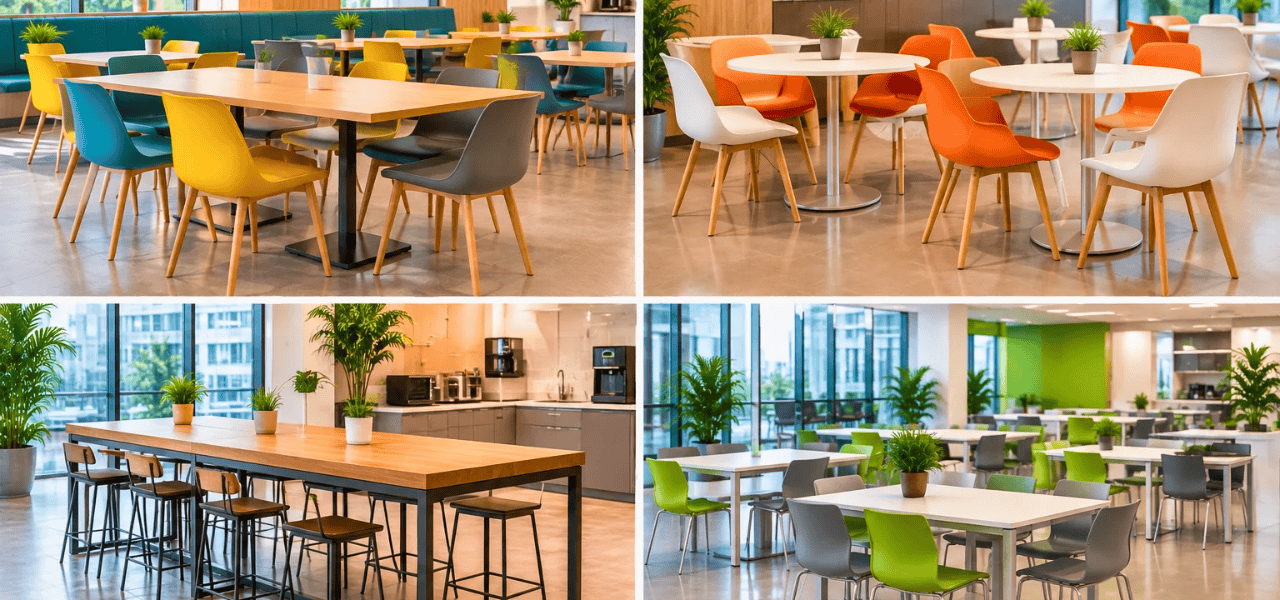
Even the best furniture fails in a poor layout. The arrangement you choose affects capacity, noise, traffic flow, and the overall feel of the space. Here are the four most common approaches.
Rows / Linear Layout
Traditional rows of rectangular tables running the length of the space.
- Best for: large canteens serving 100+ employees
- Pros: maximises capacity, simple service flow, easy to clean
- Cons: feels institutional and less social
Cluster / Island Layout
Groups of 4–6 seater tables spread across the floor, each forming its own small “zone”.
- Best for: mid-sized corporate offices
- Pros: conversational, modern, and more inviting
- Cons: needs more floor space per person
Mixed / Zoned Layout
A blend of long communal tables, individual 4-seater cafe tables, and softer lounge-style seating.
- Best for: modern, tech-company-style cafeterias
- Pros: caters to different preferences and combines dining and breakout in one space
- Cons: needs careful planning to avoid a cluttered look
Counter / Bar-Style Seating
High tables (900–1050 mm) paired with bar stools, often along a window or wall.
- Best for: compact spaces, quick-service areas, and cafes within offices
- Pros: space-efficient and great for short breaks
- Cons: less comfortable for long meals
Aisle clearance note: Allow a minimum of 90 cm for single-person passage and 120–150 cm wherever service trolleys or wheelchairs need to pass.
If you are creating relaxed seating near your dining area, you may also want to explore office lounge furniture to complete the zone.
Material and Finish Guide for Cafeteria Tables
Cafeteria furniture takes more punishment than almost any other office furniture: spills, hot trays, heavy daily use, and constant cleaning. Choosing the right materials protects your investment.
Tabletop materials
- Compact laminate: the most popular choice for canteens. It is scratch-resistant, stain-resistant, and easy to maintain.
- MDF with PVC edge: economical and versatile, suited to lower-traffic areas.
- Solid wood: warm and premium, but needs more care.
- Glass: striking and high-end, usually reserved for executive or showcase dining spaces.
Frame materials
- Powder-coated mild steel: durable and economical, the standard for most corporate canteens.
- Stainless steel: premium and highly hygienic, ideal where cleanliness is critical.
- Aluminium: lightweight, perfect for folding and movable tables.
Finish options
Matte finishes hide fingerprints and glare, while gloss finishes look sleek but show wear sooner. Wood-grain laminates add warmth, and solid colours create a bold, contemporary look.
Hygiene matters
Since the pandemic, buyers have paid far closer attention to cleanability. Choose non-porous surfaces, sealed edges, and designs without deep crevices where food debris can collect.
Our canteen table designs use BIFMA-certified materials and processes, ensuring longevity even in high-footfall office environments.
How Many Tables Do You Need? Capacity Planning Formula
One of the most common questions facility managers ask is how many tables to order. A simple formula gives a reliable starting point:
Tables needed = (Total employees ÷ Seating turns per lunch hour) ÷ Seats per table
Example: 200 employees, 2 seating turns, 4-seater tables:
(200 ÷ 2) ÷ 4 = 25 tables
Then add a 10–15% buffer to cover peak days, visitors, and management dining areas. In this example, that brings you to roughly 28–29 tables.
Quick Planning Reference
| Employees | Recommended Tables (4-seater) | Approx. Floor Area Needed |
| 50 | 8–10 | 50–70 sq. m |
| 100 | 15–18 | 90–120 sq. m |
| 200 | 28–32 | 180–220 sq. m |
| 500 | 65–75 | 450–550 sq. m |
These figures assume a mix of seating turns and standard circulation space. If your cafeteria also hosts events or serves as a collaboration area, adjust upwards. Using this approach, you can confidently match your cafeteria table 4 seater count to your headcount instead of guessing.
Custom Cafeteria Furniture Solutions for Every Workspace
Choosing a cafeteria furniture partner is as important as choosing the furniture itself. A good partner understands your space, delivers on time, and supports you long after installation. Here is what to look for, and how Vlite Furnitech answers each point.
Proven quality standards
Look for recognised certifications. Vlite Furnitech furniture meets BIFMA standards, and our processes are ISO 9001:2015 certified. We also use LEED-compliant, sustainable materials, which matters for companies with green building targets.
Manufacturing capability
Our 30,000 sq. ft. facility in Patalganga, Navi Mumbai, can produce up to 14,000 workstations per month. That scale means reliable timelines even on large, multi-floor fit-outs.
Pan-India presence
With a presence in Mumbai, Pune, Ahmedabad, Surat, and Hyderabad, we support projects across major business hubs.
End-to-end project management
From layout planning to installation, our dedicated project team handles the details, so your facilities team does not have to.
After-sales support
Furniture is a long-term purchase. We provide dedicated after-sales service so your cafeteria stays in top condition.
Whether you need modular workstations for the floors above or a complete dining setup for the canteen, our office furniture solutions are designed for Indian corporate environments.
Frequently Asked Questions
What is the standard size of a cafeteria table?
Standard cafeteria tables are typically 120 × 75 cm for 4 seats, 150 × 75 cm for 6 seats, and 180 × 90 cm for 8 seats. The standard height is 750–760 mm. These dimensions give each person about 60 cm of width, which is comfortable for dining.
What is the best cafeteria table design for a small office?
For small offices, square or round 4-seater cafe tables work best because of their compact footprint and easy rearrangement. A 90 × 90 cm square table or a 90–100 cm round table fits tight spaces well. Folding options add flexibility when the room has to serve more than one purpose.
How many chairs fit at a standard canteen table?
It depends on table size, ranging from 4 chairs on a 120 cm table to 10 on a 240 cm table. Allow roughly 60 cm of width per person for comfortable seating. Overcrowding a table reduces comfort and makes it harder for people to sit down and stand up.
What material is best for cafeteria tables?
A compact laminate top with a powder-coated steel frame is the most practical choice. It resists scratches, stains, and heat, cleans easily, and lasts for years under heavy use. For premium or hygiene-critical spaces, stainless steel frames are a worthwhile upgrade.
What is the difference between a cafeteria table and a dining table for office use?
Cafeteria or canteen tables are built for high capacity, durability, and uniformity, serving many people daily. A dining table for office use is usually a more premium piece, found in executive dining rooms or boardroom lunch areas, with finer finishes and a focus on appearance over volume.
How do I calculate how many cafeteria tables I need?
Use this formula: (total employees ÷ seating turns per lunch hour) ÷ seats per table, then add a 10–15% buffer. For example, 200 employees with 2 turns and 4-seater tables need about 25 tables, or roughly 28 with the buffer.
Design a Cafeteria Space Your Team Will Love
A great cafeteria starts with understanding your space and your people. Choose table sizes that match your floor area and headcount, pair them with comfortable, stackable chairs, and select a layout that supports both efficiency and social connection. Durable, hygienic materials will keep the space looking good for years, and a simple capacity formula takes the guesswork out of ordering. Done well, cafeteria design is a long-term investment in employee wellbeing.
Ready to transform your office cafeteria? Explore Vlite Furnitech’s range of cafeteria tables, canteen chairs, and complete dining solutions, or connect with our design team for a customised layout plan.

Vishnu Sharma
I am the co-founder and CEO of Vlite Furnitech, creating modular office solutions since 2009. With a background in Chemistry and Marketing, and experience as Regional Head at Featherlite, I help design ergonomic, adaptable, and sustainable workspaces. Alongside a team of 120+, we serve corporates like JCB, Just Dial, KFC, and educational institutions. Let’s connect to reimagine innovative, eco-friendly office environments.