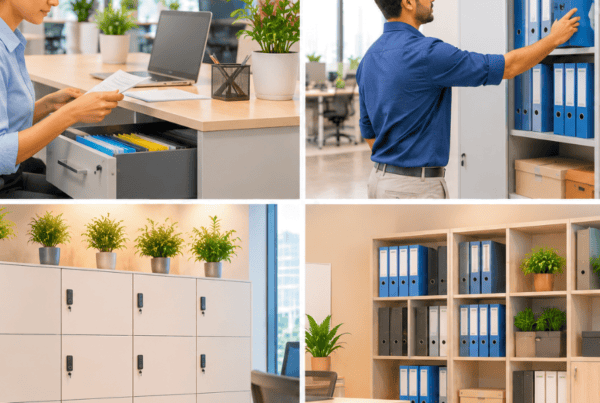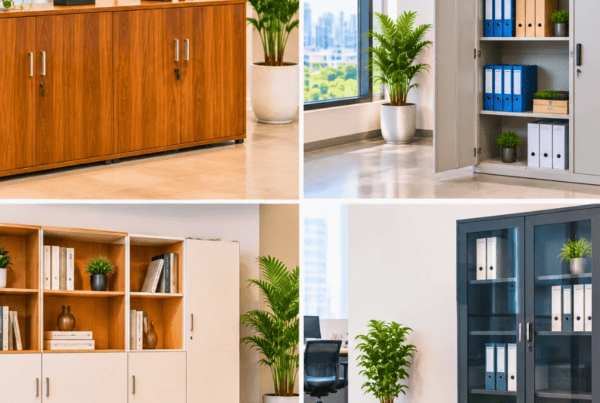

Walk through any busy Indian office and you will spot the same problem. A cabinet door swings into a walkway, a colleague has to wait for someone to close it, and a corner of the floor goes unused because nobody wants to risk a collision. The cabinet itself is rarely the issue. The door is.
Choosing between a sliding door storage cabinet and a hinged option looks like a minor detail, but it shapes how your team moves, how much usable floor you keep, and how polished the workspace looks. The right door storage cabinets disappear into the workflow. The wrong ones create daily friction.
Understanding cabinet door types for offices helps facility managers, architects, and business owners avoid expensive layout mistakes. This guide breaks down how each type works, where it performs best, and where it falls short. You will also find a head-to-head comparison and a five-step framework for choosing with confidence.
Understanding the Main Cabinet Door Types for Offices
Most office furniture specifications come down to four door styles. Each solves a different problem, and the best offices often use more than one. Here is how they differ.
Sliding Door Storage Cabinets
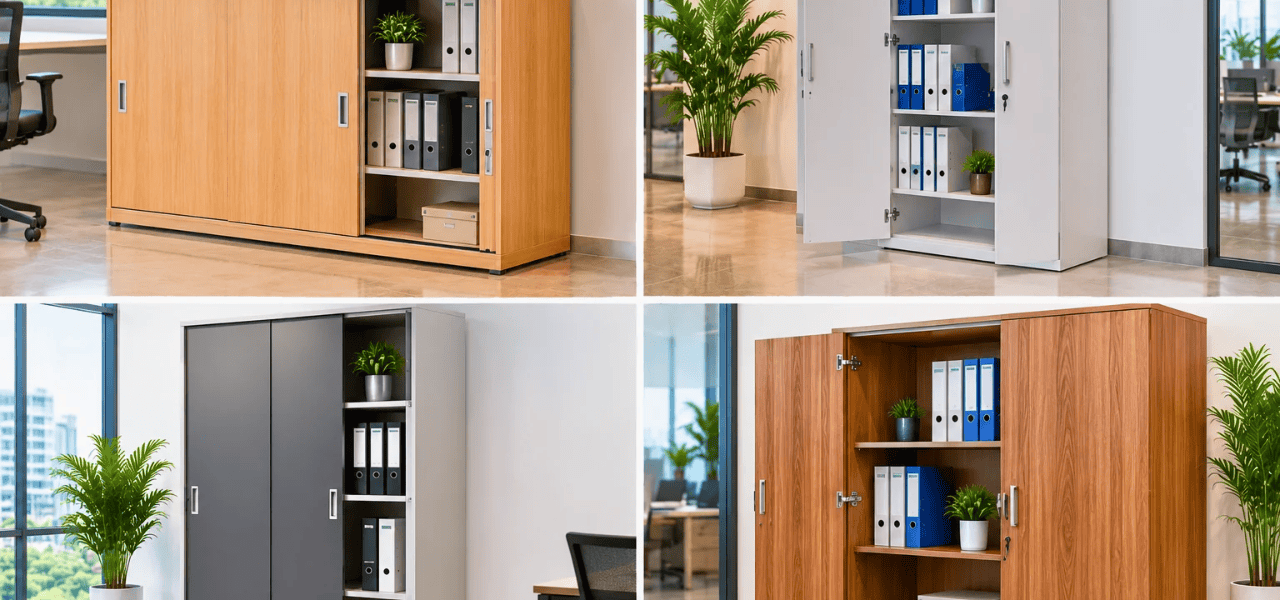
A sliding door storage cabinet uses panels that glide along top and bottom tracks, usually on bearings or rollers. The doors move parallel to the cabinet face instead of opening outward. That means no swing arc and no clearance requirement in front of the unit.
This makes sliding cabinets a natural fit for narrow corridors, tight bays, and densely planned floors. Premium systems use soft-glide hardware and aluminium or laminate panels that stay quiet through thousands of cycles.
Swing Door (Hinged Door) Storage Cabinets
Swing doors are the traditional choice. Hinges mounted on the cabinet side let the door pivot outward, giving a full-width view of the interior. Anyone who has used a wardrobe or a kitchen cupboard already knows how they work.
Their biggest strength is accessibility. Open the door fully and you can reach every shelf, drawer, or compartment at once. Their biggest requirement is space, because the door needs room to open.
Tambour Door Cabinets
A tambour door cabinet uses a flexible door made of narrow horizontal or vertical slats. The slats roll along a curved channel and retract into the cabinet body, much like a roll-top desk. Think of it as a door that folds itself out of the way.
Tambour doors suit workstation clusters and open-plan layouts, where a swinging panel would block a neighbour’s desk. They need no clearance in front, and they stay out of the way when open.
Glass Door Storage for Offices
Glass door storage office solutions use clear, frosted, or tinted glass panels in either sliding or swing configurations. They add visibility, so you can see contents at a glance, and they bring a lighter, more premium look to a space.
You will find them in executive cabins, reception areas, and conference rooms, where display and presentation matter. Frosted options balance transparency with privacy for files and supplies.
Sliding Door Storage Cabinets: Pros, Cons & Best Use Cases
A sliding system trades full-width access for a smaller footprint. For many offices, that trade is worth making.
Advantages
- Space efficiency: No swing arc means you can place the cabinet beside a corridor, behind a desk cluster, or in a shallow bay.
- Clean aesthetics: Flat door faces create a sleek, minimalist look that suits contemporary interiors.
- Safe in traffic zones: Doors never project into walkways, which cuts collision risk.
- Both sides accessible: You can reach either half of the cabinet, though not both at once.
Limitations
- Limited simultaneous access: One panel always covers part of the opening, so you can only reach half the interior at a time.
- Track maintenance: Dust and debris collect in the bottom track. Regular cleaning keeps movement smooth.
- Hardware dependence: Quality rollers matter. Low-grade mechanisms wear quickly and the door starts to stick.
Best suited for: high-density offices, collaborative zones, open-plan floors, pantry-adjacent storage, and any area with limited clearance. If your floor plan is tight, a sliding option usually earns its place.
Swing Door (Hinged) Storage Cabinets: Pros, Cons & Best Use Cases
Hinged doors remain popular for good reason. They are simple, familiar, and give complete access.
Advantages
- Full-width opening: You see and reach the entire interior at once, which suits deep shelving and bulky items.
- Familiar design: Nobody needs to learn how to use them.
- Simpler hardware: Hinges have fewer moving parts than tracks, so there is less to maintain.
- Easy to lock and secure: Hinged doors work well with standard locking systems for confidential files.
Limitations
- Swing clearance: The door needs open floor in front of the cabinet. Planners must account for it in the layout.
- Collision risk: In narrow aisles, an open door can strike a passing colleague or block a pathway.
- Larger effective footprint: The cabinet occupies its own dimensions plus the arc of the door.
Best suited for: private cabins, manager rooms, record rooms, and storage rooms with dedicated space. If the cabinet sits against a wall in a spacious room, swing doors make excellent sense.
Sliding vs Swing Door Office Cabinet: Head-to-Head Comparison
The sliding vs swing door office cabinet question rarely has a universal answer. The table below puts the two styles side by side so you can match each factor to your own priorities.
| Factor | Sliding Door Cabinet | Swing Door Cabinet |
| Space Required | Minimal. No front clearance needed | Needs swing clearance in front of the unit |
| Ease of Access | Access to one half at a time | Full-width access to the entire interior |
| Aesthetic Style | Sleek, flat, modern and minimalist | Classic, familiar, and versatile |
| Ideal Office Setting | Open-plan floors, corridors, compact offices | Private cabins, manager rooms, storage rooms |
| Maintenance | Periodic track cleaning and roller checks | Occasional hinge tightening or adjustment |
| Cost Consideration | Often higher upfront due to track hardware | Typically lower upfront with simpler hardware |
| Customization Options | Wide range of panel finishes, glass, and laminate | Broad range of finishes, handles, and locking choices |
Which Should You Choose?
Choose sliding if:
- Floor space is tight or aisles are narrow.
- The cabinet sits in a shared or high-traffic zone.
- You want a streamlined, modern look across the floor.
- Several people use the unit throughout the day.
Choose swing if:
- You need unobstructed access to everything inside.
- The cabinet sits in a private room with open floor space.
- You store bulky items that need full-width loading.
- Simple hardware and lower upfront cost take priority.
Special Mention: Tambour Door Cabinets for Modern Workstations
Many buyers overlook the tambour door cabinet, yet it solves several problems that the other two types cannot.
The mechanism is elegant. A series of narrow slats connects to form one flexible door. When you push the door sideways or upward, the slats travel along a curved channel inside the cabinet and tuck out of sight. The opening is clean, and no panel remains in the way.
This design suits modern workstations for three reasons. First, it needs no clearance, so it works in tight seating clusters where a swinging door would hit someone. Second, it avoids the half-blocked access of sliding panels, because the door retracts fully. Third, its smooth, continuous surface gives the cabinet a refined look.
Tambour doors work especially well on personal pedestals, under-desk storage, and shared units between workstation banks. They keep paperwork and personal items out of sight while staying quiet to operate.
A tambour door cabinet pairs naturally with modular workstations and storage units, where consistent finishes and proportions matter. Vlite Furnitech designs its storage lines to integrate with its workstation systems, so doors, carcasses, and desks read as one coordinated set.
How to Choose the Right Office Storage Cabinet for Your Space
A structured approach prevents most mistakes. Work through these five steps in order.
Step 1: Measure your floor space and swing clearance.
Measure the cabinet footprint and the aisle in front of it. For hinged doors, add the full door width to your clearance calculation. If you cannot spare that distance, choose sliding or tambour.
Step 2: Define your storage needs.
List what the cabinet will hold: files, stationery, electronics, or personal belongings. Bulky or deep items favour full-width access. Everyday supplies suit sliding or tambour systems.
Step 3: Consider your office layout.
Open-plan offices usually benefit from sliding or tambour doors, since many people move through a shared space. Private cabins have room for swing doors, which also lets you place the cabinet freely.
Step 4: Match the door to your workspace aesthetic.
Look at your existing finishes, colours, and brand identity. Glass door storage office solutions suit executive zones, while laminate sliding doors fit a minimalist floor. Consistency across cabinets raises the whole interior.
Step 5: Consult an office furniture expert.
Layouts have constraints that a spec sheet will not show, including column positions, services, and future headcount. A specialist can flag problems early. Vlite Furnitech offers end-to-end project management and design consultation, from space planning to installation, which helps you finalise door choices before you commit to a full order.
Why Vlite Furnitech Is India’s Trusted Source for Office Storage Cabinets
Good storage starts with how it is built. Vlite Furnitech manufactures from a 30,000 sq. ft. facility in Patalganga, Navi Mumbai, with capacity for 14,000 workstations a month. That scale allows consistent quality across large orders and predictable delivery on corporate projects.
Its range of door storage cabinets covers sliding, swing, tambour, and glass configurations, all designed to work alongside modular office furniture systems. Products meet BIFMA standards, and manufacturing follows ISO 9001:2015 processes with LEED-compliant practices.
Branches in Mumbai, Pune, Ahmedabad, Surat, and Hyderabad support clients across India, and project teams work from layout stage through handover. Buyers sourcing from office furniture suppliers often value that combination of manufacturing control and local support.
Explore Vlite Furnitech’s range of modular door storage cabinets designed for modern Indian offices.
Still comparing modular, bespoke, and traditional office furniture?
Let Vlite Furnitech LLP help you choose the smartest investment for better ROI.
Frequently Asked Questions (FAQ)
Q1: What is the difference between a sliding door storage cabinet and a swing door cabinet?
A sliding door storage cabinet moves its panels along tracks, so it needs no clearance in front. A swing door cabinet uses hinges and opens outward, giving full access to the interior but requiring open floor space. In the sliding vs swing door office cabinet decision, space availability usually drives the answer.
Q2: What is a tambour door cabinet and when should I use one?
A tambour door cabinet uses a flexible slat door that rolls along a curved channel and retracts into the cabinet body. Use one in open-plan offices, workstation clusters, or tight bays where you want clean access without a swing arc or a panel blocking half the opening.
Q3: Which type of cabinet door is best for a small office?
Sliding and tambour doors usually work best in a small office because they need no front clearance. They keep walkways open and reduce collision risk. A swing door can still work if the cabinet sits against a wall with enough free floor space.
Q4: Can I get glass door storage cabinets for executive offices?
Yes. Glass door storage office cabinets are popular in executive cabins, reception zones, and conference rooms. You can choose clear, frosted, or tinted glass in sliding or hinged formats, depending on how much visibility and privacy you want.
Q5: What cabinet door types are available in modular office furniture?
Modular office furniture typically offers sliding doors, swing (hinged) doors, tambour doors, and glass doors. Many systems also let you mix laminate, glass, and metal finishes so cabinets match the surrounding workstations and interiors.
Q6: Does Vlite Furnitech offer customized door storage cabinets?
Yes. Vlite Furnitech provides customization in dimensions, finishes, door types, and locking options, so cabinets fit specific layouts and brand palettes. Project teams advise on the most practical configuration for each space.
Conclusion
No single cabinet door type wins every time. A sliding door storage cabinet saves space and suits busy, open floors. Swing doors give full access in private rooms. Tambour doors combine clean looks with zero clearance, and glass adds visibility where presentation counts. The right choice depends on your space, your storage needs, and the look you want.
Plan the layout first, test your clearances, and let function lead your decision. Vlite Furnitech brings manufacturing depth and customization capability to help you get it right the first time.
Get in touch with Vlite Furnitech to explore the full range of office storage cabinets tailored to your workspace needs.