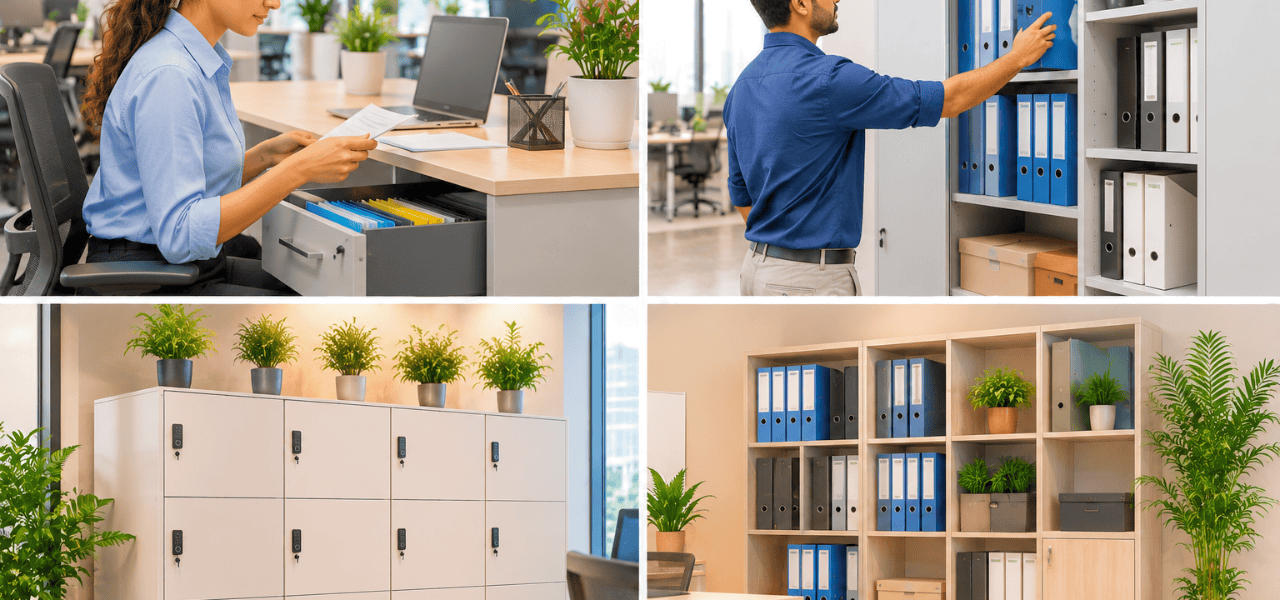
Picture a typical workday. An employee spends ten minutes hunting for a signed contract, another five looking for a charger, and then pushes a pile of folders aside to make room for a laptop. None of these moments feels serious on its own, but across a team of 50 or 500, the lost time adds up quickly. Cluttered desks, overflowing cabinets, and files stacked on window sills are signs of a planning gap that quietly drains productivity and makes a workplace feel disorganized to employees and visitors alike.
Workplace studies consistently show that time spent searching for documents and supplies is a meaningful productivity drain. Before publishing, add a verified statistic here from a source such as BIFMA or a recognised workspace productivity study.
The good news is that this problem is predictable and fixable. Office Storage needs follow patterns based on role, industry, and layout, and once you know those patterns, you can plan accurately instead of guessing. At Vlite Furnitech, we design and manufacture storage solutions for enterprises across India, and the question we hear most often from facility planners and procurement teams is a simple one: how much storage does each person actually need?
This guide answers that question. You will find clear benchmarks for office storage per employee, the factors that change those numbers, a step-by-step method to calculate your own requirement, and practical advice on choosing the right units for your space.
What Counts as “Office Storage”? (Defining the Scope)
Before you can measure storage needs, you need to define what you are measuring. In a standard office, storage falls into two broad categories.
Personal storage belongs to one employee, or is assigned to one workstation. It includes:
- Pedestal units and under-desk drawers, which hold daily-use files, stationery, and small items
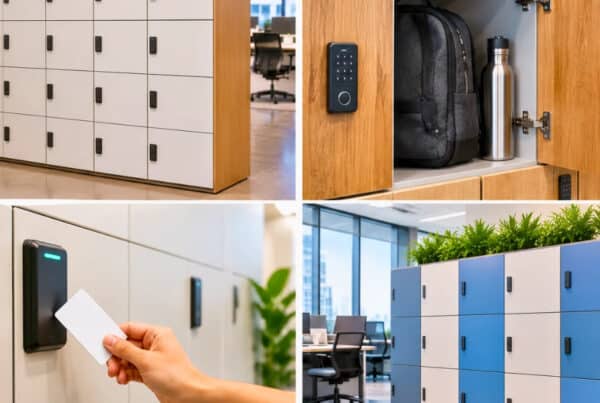
- Locker units, which give secure space for bags, laptops, and personal belongings, especially in shared or hot-desking setups
Shared storage serves a team or department. It includes:
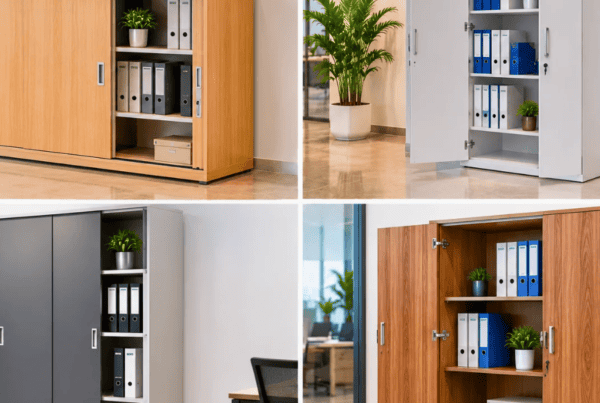
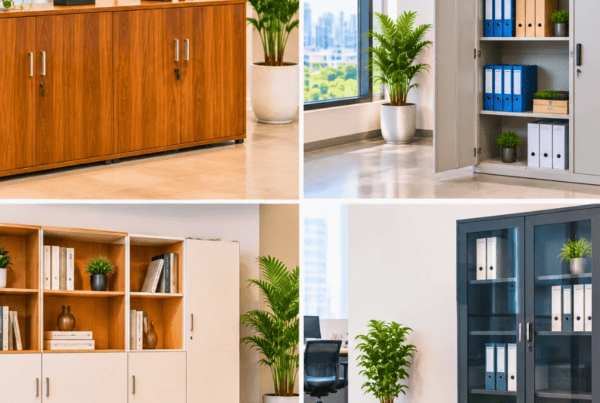
- Filing cabinets, for active and semi-active documents
- Credenzas, which combine storage with a work or display surface
- Shelf units and open bookcases, for reference material, binders, and supplies
There is also the question of digital versus physical storage. Many Indian offices have moved a large share of their records to cloud systems, and that shift is real. But physical storage remains essential. Contracts, compliance records, HR files, invoices, and client documents still exist on paper in most organisations. Employees also need room for stationery, personal items, chargers, and equipment. Going paperless reduces the volume of paper, but it does not remove the need for well-planned office workspace storage.
Vlite Furnitech’s range covers each of these needs, including pedestals, standalone storage units, and storage integrated directly into workstations. The rest of this guide helps you decide how much of each your office actually requires.
The Standard Office Storage Requirement Per Employee
Industry Benchmarks You Should Know
Planners often ask for a single number, but storage needs are better expressed as a small set of benchmarks that work together. These ranges are widely used in workplace planning and make a reliable starting point for your office storage requirement per employee:
- Active filing space: 3 to 5 linear feet per employee. This covers the documents a person needs to reach regularly during the working week.
- Personal pedestal or under-desk storage: One or two drawer units per person, taking up roughly 0.3 to 0.5 sq. ft. of floor footprint.
- Shared filing: About one filing cabinet for every three to four employees as a general rule.
- Stationery and supplies: A small dedicated tray or organiser for each person, so that desk surfaces stay clear.
- Total dedicated personal storage footprint: Typically 2 to 4 sq. ft. per employee.
Think of these as a baseline. Together they form a practical office storage capacity guide that you can adjust once you understand your team’s real working habits.
Industry matters a great deal here. Document-heavy sectors such as legal, finance, banking, insurance, and healthcare typically need 20 to 30 percent more storage than technology or creative firms. In India, where regulatory requirements, audit trails, and physical signatures remain common, this gap can be even more noticeable. A software team might get by with a single pedestal and a locker per person. A chartered accountancy firm or a law office will almost certainly need deeper filing capacity and more shared archival space.
The filing space per person figure also deserves special attention. Active files are the ones people touch weekly. Archived files, which you keep for compliance but rarely open, should be moved to central shared storage or an off-site facility so they do not consume prime space at employee workstations.
Factors That Affect How Much Storage Each Employee Needs
Two employees sitting side by side can have very different storage needs. These are the main factors that shift the benchmark up or down.
Nature of work. A paper-intensive role, such as an accounts executive handling invoices, needs far more storage than a developer who works almost entirely on screen.
Seniority and role. Senior managers and executives usually hold more documents, reference materials, and personal items, and they often need space for confidential files. Junior or support staff typically need less personal storage but may rely more on shared units.
Industry type. Legal, finance, government, and healthcare organisations carry archival and compliance burdens that most other sectors do not.
Office layout model. An open-plan office with hot desking calls for compact, mobile, lockable storage. Private cabins allow larger, fixed furniture such as credenzas. Hybrid offices sit somewhere in between, with fewer permanently assigned desks but a strong need for lockers.
Document retention policy. If your company keeps records for seven years instead of three, you need more filing capacity, whether at the workstation or in a central bay.
Ratio of shared to personal storage. A team that relies heavily on shared cabinets needs less personal storage per head, but needs more central units. Deciding this balance early prevents duplication and wasted space.
Storage Planning by Office Layout Type
Good storage planning in an office starts with the layout, because the layout determines what kind of storage is practical. Here is how recommendations differ across the three most common formats:
| Layout Type | Recommended Personal Storage | Recommended Shared Storage |
| Open Plan / Hot Desk | Mobile pedestal + locker | 1 filing cabinet per 4–5 people |
| Assigned Workstation | Fixed pedestal + overhead unit | 1 filing cabinet per 3 people |
| Private Cabin / Executive | Full credenza + side drawers | Individual filing system |
Open plan and hot desk offices need flexibility. Mobile pedestals can move with the employee or be tucked under a desk when not in use, while lockers hold personal belongings securely between shifts. Because people carry less paper in these setups, shared filing can be leaner.
Assigned workstations allow more permanent storage. A fixed pedestal under the desk, combined with an overhead unit or hutch, gives each person generous capacity without adding to the floor footprint. Since employees stay at the same desk, they tend to accumulate more documents, so the shared filing ratio tightens to about one cabinet per three people.
Private cabins and executive offices can support a full credenza with side drawers, giving senior staff space for confidential files, reference material, and personal items. These users usually manage their own filing systems rather than sharing.
Vlite Furnitech’s modular storage units adapt to all three formats. The same design language and components can be configured as mobile pedestals for open plan areas, fixed units for workstations, or credenzas for cabins, so your office keeps a consistent look as it grows.
How to Calculate Office Storage Needs for Your Team (Step-by-Step)
You do not need specialist software to estimate your requirement. Follow these six steps, and you will have a workable figure in under an hour.
Step 1: Count your employees and group them by role.
Total your headcount, then divide it into categories such as administrative staff, executives, and field or hybrid staff. Different groups will use storage very differently.
Step 2: Classify the document load for each category.
Label each group as high, medium, or low. Accounts, legal, and compliance teams are usually high. Sales and operations are often medium. Design, tech, and field staff tend to be low.
Step 3: Apply the linear footage rule to each category.
A practical guide is 5 linear feet for high-load roles, 3 feet for medium, and 1.5 feet for low. Multiply the footage by the number of people in each group, then add the totals together.
Step 4: Add personal pedestal or locker allocation.
Assign one or two drawer units per person at assigned desks, or one locker per person for hot-desking staff. Use the 2 to 4 sq. ft. personal storage footprint to check that your floor plan can accommodate them.
Step 5: Factor in shared storage.
Divide your team size by the number of people each shared unit can reasonably serve. For example, 40 employees in an assigned-desk layout, at one cabinet per three people, need about 13 cabinets.
Step 6: Add a 15 to 20 percent growth buffer.
Offices rarely stay the same size. A buffer lets you add people without redesigning the space or buying emergency furniture.
Plan storage for 20 percent more headcount than you have today. Offices grow faster than budgets, and it is far cheaper to specify modular units that can expand than to retrofit a crowded floor later.
This approach turns the question of office storage per employee into a repeatable calculation, and it gives your procurement team numbers they can defend.
Smart Storage Solutions That Maximize Space Without Clutter
Once you know how much storage you need, the next question is what kind. The right mix of furniture can deliver your capacity without crowding the floor. These are the main options, and where each one works best.
Mobile pedestals
These are compact drawer units on castors. They are flexible, they can follow an employee between desks, and they slide neatly under a work surface. They suit open plan and hybrid offices well. Vlite Furnitech offers mobile pedestals in configurations that include a stationery drawer, a file drawer, and a locking mechanism.
Overhead storage units and hutches
These use vertical space above the desk, which is often the most underused part of a workstation. They keep reference files and supplies within reach and free up the desk surface.
Integrated workstation storage
When drawers, shelves, and overhead units are built into the desk design, the result is cleaner and more efficient than adding separate pieces later. Our office workstations are designed with storage in mind from the start, so there are no awkward gaps or wasted corners.
Lockers for hot-desking environments
In offices where employees do not have a fixed desk, lockers give each person a secure place for belongings, devices, and personal documents. They also help teams maintain a clean-desk policy.
Credenzas and sideboards
Ideal for executive cabins, a credenza offers closed storage below and a useful surface above. It keeps confidential material out of sight and gives a private office a polished look.
Central filing bays
For shared document management, a central bay of cabinets or shelving keeps team records in one place. This is also the best home for semi-active and archived files that do not need to sit at every desk.
When you shop for office furniture, choose modular office storage systems wherever possible. Modular units can be reconfigured as teams change, which protects your investment as the business evolves. Our range of modular office storage units is built to do exactly that, and it is manufactured to the standards you would expect from a certified enterprise supplier. Vlite Furnitech holds BIFMA certification and ISO 9001:2015 accreditation, and our capacity of 14,000 workstations a month means we can support everything from a single floor to a multi-site rollout.
Good storage also supports sustainability. When employees can store and find what they need, there is less duplication, less wasted paper, and less premature furniture replacement. Well-designed, durable storage contributes to the kind of efficient workplace that supports LEED-compliant goals.
Common Office Storage Mistakes to Avoid
Even well-intentioned planning can go wrong. Watch out for these frequent errors:
- Underestimating paper volume in regulated industries. Compliance-heavy sectors almost always need more filing capacity than the first estimate suggests.
- No clear distinction between personal and shared storage. Without it, files pile up on desks and cabinets become dumping grounds.
- Ignoring vertical space. Walls and overhead zones can add significant capacity without taking any floor area.
- Using one-size-fits-all units for every role. A uniform solution leaves some employees short of space and others with unused drawers.
- Skipping growth buffer planning. A layout that is perfect today can feel cramped within a year.
- Prioritising aesthetics over ergonomic accessibility. Beautiful storage is not useful if employees cannot reach frequently used items comfortably. Good ergonomic office furniture balances appearance with everyday usability.
Still comparing modular, bespoke, and traditional office furniture?
Let Vlite Furnitech LLP help you choose the smartest investment for better ROI.
Frequently Asked Questions (FAQ)
How much storage space does one office employee need?
On average, an employee needs 2 to 4 sq. ft. of dedicated personal storage space and 3 to 5 linear feet of active filing space. This varies with their role, industry, and whether they share storage with teammates.
What is the standard filing space per person in an office?
The standard benchmark is about 3 to 5 linear feet of filing space per employee for active documents. Document-heavy roles in legal or finance may require up to 7 to 8 linear feet.
How do I plan office storage for a growing team?
Start by assessing your current headcount and document volume, then apply a per-employee storage formula. Always add a 15 to 20 percent buffer so you can accommodate future hires without redesigning the space.
What type of office storage unit is best for open-plan offices?
Mobile pedestals and locker units are ideal for open-plan offices, offering flexibility and personal security. They integrate cleanly with workstations without consuming extra floor space.
How does office furniture affect storage capacity?
Modular office furniture can significantly increase storage capacity by integrating drawers, shelves, and overhead units directly into workstations. This maximises space without adding to the floor footprint.
Storage Is an Investment, Not an Afterthought
Getting office storage per employee right comes down to three ideas.
- Start with a clear benchmark. Plan for roughly 2 to 4 sq. ft. of personal storage and 3 to 5 linear feet of active filing space per person.
- Plan by role and layout. Adjust the baseline for document load, industry, seniority, and whether your office is open plan, assigned, or cabin-based.
- Always build in a growth buffer. Add 15 to 20 percent so your storage keeps pace with your team.
Used together, these principles make a practical office storage capacity guide that any facility planner, HR head, or procurement team can apply. Storage that is planned well improves productivity, keeps the workplace tidy, and shows employees that their working environment has been thought through.
Vlite Furnitech is a trusted partner for storage planning and procurement, with the manufacturing scale, certified quality, and design experience to support offices of every size across India.
Explore Vlite Furnitech’s range of modular office storage solutions, from pedestals to integrated workstations, designed for the modern Indian workplace. Get in touch with our team for a customised storage assessment.

Vishnu Sharma
I am the co-founder and CEO of Vlite Furnitech, creating modular office solutions since 2009. With a background in Chemistry and Marketing, and experience as Regional Head at Featherlite, I help design ergonomic, adaptable, and sustainable workspaces. Alongside a team of 120+, we serve corporates like JCB, Just Dial, KFC, and educational institutions. Let’s connect to reimagine innovative, eco-friendly office environments.