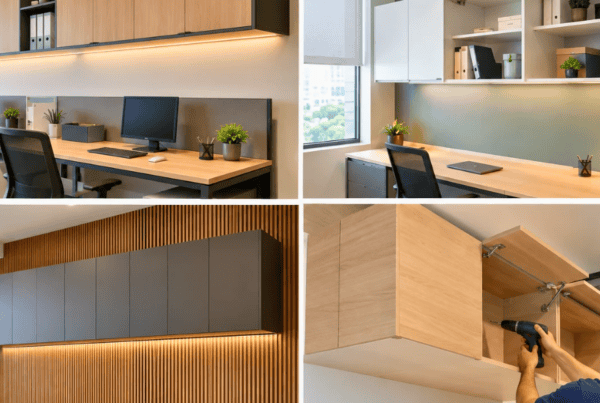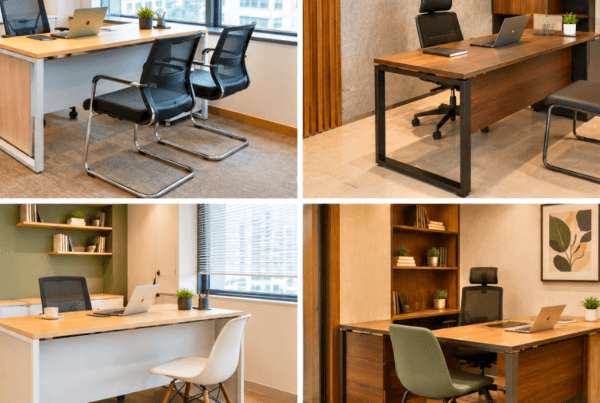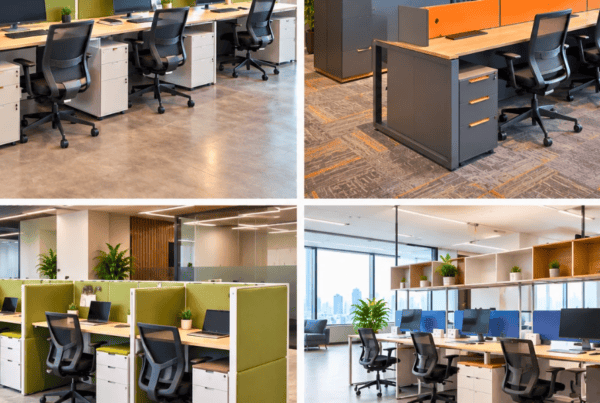
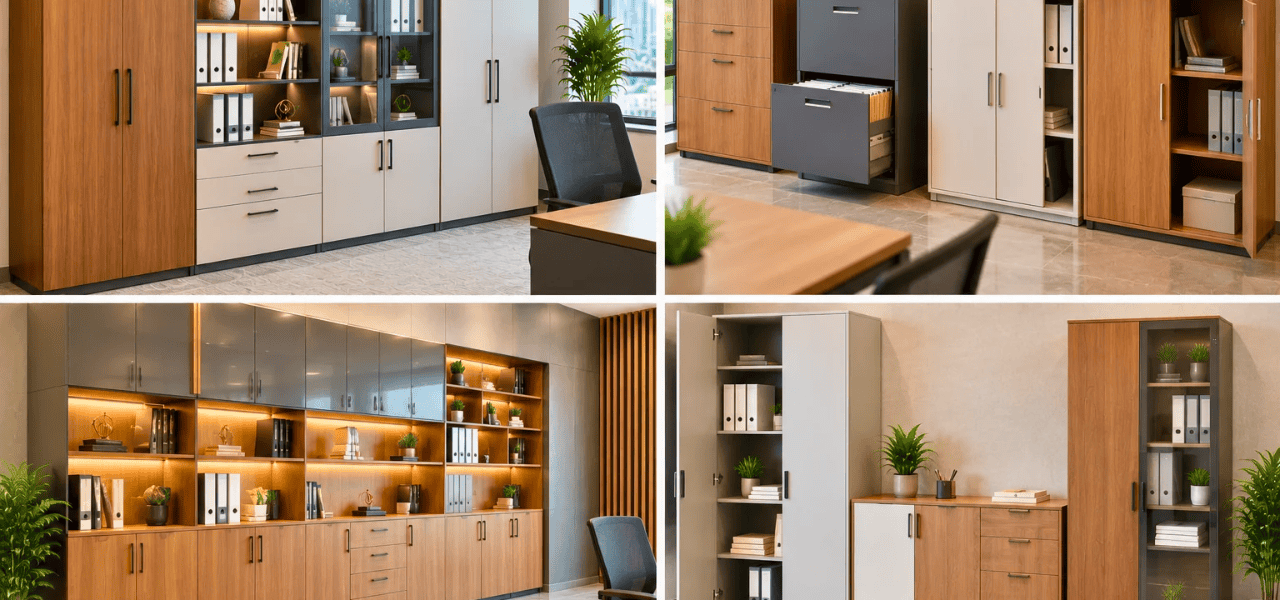
Ask any office manager what slows a team down, and misplaced files will come up quickly. Time spent hunting for documents, contracts, or supplies adds up over a year. Smart office storage cabinet design reclaims that time by giving every item a logical home.
Office storage cabinet design covers the type, size, material, and layout of the units that hold your files, stationery, equipment, and personal belongings. Good design affects productivity, security, aesthetics, and how organised your office workspace storage feels day to day.
In this guide, Vlite Furnitech, a modular office furniture manufacturer, walks you through the main cabinet types, standard sizes, materials, and a practical framework for choosing the right one.
What Is an Office Storage Cabinet?
An office storage cabinet is a furniture unit built to hold files, documents, supplies, and equipment in a work environment. Unlike household storage, it has to handle heavier loads, frequent daily access, fire and security considerations, and the visual standards of a professional space.
Office furniture has changed a great deal over the years. Bulky, grey steel almirahs once dominated Indian offices, and they still have their place. But today’s workplaces also use sleek modular units, lateral files that double as work surfaces, and cabinets finished in laminates that match the rest of the interior.
At Vlite Furnitech, the design philosophy is simple: storage should be as functional as it is good-looking. A cabinet should protect what is inside, fit the space around it, and add to the look of the office rather than detract from it.
Types of Office Storage Cabinet Designs
Not every office needs the same cabinet. A law firm buried in paperwork has different needs from a design studio with a few personal items per desk. Here are the seven most common designs and who each one suits.
1. Vertical Filing Cabinet Design
What it is: A tall, narrow cabinet with stacked drawers that pull straight out. It is the classic solution for letter and legal-size files.
Key design features: Vertical filing cabinets usually come in 2-drawer, 3-drawer, 4-drawer, and 5-drawer configurations. Good filing cabinet design includes full-extension telescopic runners, anti-tilt mechanisms so only one drawer opens at a time, a central locking system, and label holders on each drawer.
Best for: Law firms, accounting offices, HR departments, and any document-heavy team. Because the footprint is small relative to the storage capacity, it works well where floor space is limited but wall height is available.
2. Lateral Filing Cabinet
What it is: A wider, lower-profile cabinet where drawers open side to side along the width of the unit rather than front to back.
Key design features: Lateral cabinets typically stand between 650 mm and 1,050 mm tall, which means the top surface can hold a printer, plants, or display items. Files are stored side-facing, so you can see more labels at once.
Best for: Open-plan offices and corridors where space efficiency matters. Since lateral units need less clearance in front for drawers to open, they are a smart choice for narrow walkways. They are also a good fit for office workspace storage that needs to look neat and stay accessible.
3. Steel Almirah (Office Almirah Steel)
What it is: A heavy-duty steel cupboard with hinged or sliding doors, built for secure, long-term storage.
Key design features: A good office almirah in steel includes a robust locking mechanism, adjustable shelves, powder-coated finishes that resist scratches and rust, and reinforced panels that can carry heavy loads without sagging. Many designs add a lockable inner compartment for valuables or confidential records.
Best for: Government offices, factories, back-office environments, and archives. It remains the most dependable storage cabinet for office use when security and durability come first. Vlite’s BIFMA-certified steel furniture range is built to handle demanding daily use while still looking refined.
4. Modular Storage Cabinet for Office
What it is: A configurable system of units that can be stacked, combined, and rearranged to suit any workspace layout.
Key design features: Modular storage mixes open shelves, drawers, and closed compartments in a single system. You can add a unit when your team grows or reconfigure it when the layout changes. That flexibility is why modular systems have become the favourite choice in modern office furniture planning.
Best for: Corporate offices, co-working spaces, startups, and modern workstations. This is Vlite Furnitech’s flagship strength. With a 30,000 sq. ft. manufacturing facility producing up to 14,000 units a month, Vlite can deliver modular storage at scale without compromising on finish or consistency.
5. Pedestal Cabinet (Under-Desk Storage)
What it is: A compact unit that sits beneath an office table, either fixed or on castors, for personal storage.
Key design features: Most pedestals have three drawers: a shallow one for stationery, a middle one for small items, and a deep one for files. Mobile versions can be wheeled out and used as an extra seat or side table. Ergonomic design means everything stays within arm’s reach without leaving the workstation.
Best for: Individual employees at any workstation. When specifying office table solutions, pairing each desk with a matching pedestal keeps the workspace tidy and consistent.
6. Open Shelving and Credenza Units
What it is: Low, wall-hugging units with open shelves, sliding doors, or a mix of both.
Key design features: Credenzas combine storage with display. Closed sections hide clutter, while open shelves showcase books, awards, or décor. Finishes range from rich wood grains to contemporary two-tone laminates.
Best for: Reception areas, boardrooms, and executive cabins, where presentation matters as much as storage. Vlite’s in-house design team customises credenzas to match each client’s interiors, from dimensions to finishes and hardware.
7. Wardrobe and Personal Locker Cabinets
What it is: Tall, multi-compartment units that give each employee a lockable space for bags, jackets, and personal belongings.
Key design features: Wardrobe and Personal Locker Cabinets come in single, double, four-door, and six-door formats. Ventilation slots help keep the interiors fresh, and each compartment has its own lock. They can be built in powder-coated steel or finished in laminated wood.
Best for: BPOs, hospitals, manufacturing units, and large offices with shift-based staff. A steel locker is also a practical extension of the office almirah family when security and hygiene are priorities.
Office Storage Cabinet Sizes: Standard Dimensions Guide
Knowing standard dimensions makes planning far easier for facility managers and interior designers. The table below is a quick reference for the most common cabinet types.
| Cabinet Type | Standard Width | Standard Height | Standard Depth |
| Vertical Filing Cabinet | 375–460 mm | 1,320–1,830 mm | 550–650 mm |
| Lateral Filing Cabinet | 760–900 mm | 650–1,050 mm | 450–600 mm |
| Steel Almirah (Office) | 900 mm | 1,800 mm | 450 mm |
| Modular Storage Unit | Customisable | Up to 2,000 mm | 300–600 mm |
| Pedestal Cabinet | 400–450 mm | 550–650 mm | 450–500 mm |
Remember to leave clearance for drawers and doors to open fully, ideally at least 900 mm in front of a vertical cabinet. These figures are typical starting points, not strict rules.
At Vlite Furnitech, all storage cabinets can be customised to fit your specific office layout. Our design team works closely with clients across Mumbai, Pune, Ahmedabad, Surat, and Hyderabad to deliver bespoke solutions.
Key Materials Used in Office Storage Cabinet Design
The material you choose affects durability, appearance, maintenance, and cost. Here are the four main options.
Steel
The toughest option. Powder-coated steel resists impact, moisture, and pests, and it offers the best security. It suits industrial settings, archives, and high-traffic areas. Maintenance is minimal: a wipe-down is usually enough. It is the natural choice for any office almirah in steel.
Engineered wood (MDF/HDF)
Stable, smooth, and easy to finish, engineered wood gives a warmer look than metal. It works well in executive cabins and client-facing areas, though it should be kept away from persistent moisture.
Laminate
Laminate finishes are applied over engineered wood and come in a huge range of colours, textures, and wood grains. They resist scratches and stains, and they are easy to clean. They are ideal for modern workstations and credenzas.
Combination builds
Many contemporary designs pair a steel carcass with laminate or wood-finish fronts. This delivers the strength of steel and the style of laminate.
Material sourcing matters too. Vlite Furnitech follows eco-friendly, LEED-compliant practices, using responsibly sourced materials and low-emission finishes wherever possible, so your storage supports your sustainability goals.
How to Choose the Right Storage Cabinet for Your Office
Choosing well saves money and avoids awkward replacements later. Use this simple framework.
- Assess your storage needs. Are you storing active files, archives, supplies, equipment, or personal items? Capacity and drawer type depend on the answer.
- Measure your space. Use the sizes table above, and account for clearance so drawers and doors open comfortably.
- Match the design to your aesthetic. Steel suits industrial and utilitarian spaces, while laminate and wood finishes suit modern and executive interiors.
- Consider security. Confidential records need robust locks. Open shelving is fine for non-sensitive materials.
- Think about mobility. Teams that move desks often benefit from mobile pedestals and modular units. Fixed almirahs suit permanent layouts.
- Factor in sustainability. Look for BIFMA-certified products and eco-friendly materials. They last longer and reflect well on your brand.
Still unsure? Vlite Furnitech’s project management team can help you design the perfect office workspace storage solution.
Office Storage Cabinet Design Trends to Watch in 2026
Storage design keeps evolving as offices change. These are the trends shaping new projects.
Integrated storage-workstation combos
Wall units with built-in desks save floor space and keep everything within reach, which is especially useful in compact offices.
Minimalist hidden storage
Flush doors, push-to-open mechanisms, and handle-free fronts create clean, uncluttered lines, so storage almost disappears into the wall.
Biophilic accents
Wood-grain finishes, earthy tones, and natural textures bring warmth into corporate spaces and support employee wellbeing.
Smart locking systems
Digital and RFID locks replace keys, allow access logs, and make it easy to assign and reassign lockers in shared environments.
Sustainable materials
Recycled steel, low-VOC laminates, and responsibly sourced boards are moving from nice-to-have to standard expectation.
Vlite Furnitech’s design team continues to develop new storage concepts around these ideas, so clients get furniture that feels current today and stays relevant for years.
Still comparing modular, bespoke, and traditional office furniture?
Let Vlite Furnitech LLP help you choose the smartest investment for better ROI.
Frequently Asked Questions (FAQ)
What is the best office storage cabinet design for small offices?
Modular vertical units and under-desk pedestals are usually the best choice. They use vertical space and sit close to workstations, so you get plenty of capacity without crowding the floor. Modular systems also let you add storage as your team grows, making them a smart long-term investment for compact workspaces.
What is the difference between a filing cabinet and an office almirah?
A filing cabinet is purpose-built for organising documents, with drawers, rails, and label holders designed for hanging files. An office almirah, particularly in steel, offers broader general storage with shelves behind hinged doors. It suits bulkier items such as stationery stock, binders, boxes, and equipment, as well as files.
Which material is best for an office storage cabinet: steel or wood?
It depends on your priorities. Steel is the best choice for durability, security, and heavy-duty use. Engineered wood and laminate are better for aesthetics, particularly in executive cabins, reception areas, and modern offices. Many offices combine both: steel for back-office storage and laminate for visible, client-facing areas.
Can office storage cabinets be customised in size?
Yes. At Vlite Furnitech, all modular storage units are fully customisable in dimensions, finishes, internal layouts, and hardware. This is particularly helpful for offices with unusual floor plans, alcoves, or specific equipment needs. Share your measurements with the design team, and they will propose a configuration that fits.
How do I organise a storage cabinet for office use?
Start by sorting contents into categories: active files, archive files, and supplies. Assign each category to its own drawer or shelf, and use clear labels and colour coding to make retrieval quick. Keep frequently used items at waist-to-shoulder height, and review the cabinet every few months to remove outdated documents.
What is the standard height of an office storage cabinet?
Standard heights range from about 650 mm for low lateral units and pedestals to roughly 1,830 mm for full-height vertical filing cabinets. Steel almirahs typically stand around 1,800 mm, while modular units can go up to 2,000 mm. The right height depends on the cabinet type and your ceiling and layout.
Build a Smarter Office Workspace with Vlite Furnitech
The right storage cabinet is more than a place to keep paperwork. It shapes how organised, secure, and professional your office feels. Start with your storage needs, check your measurements, choose a material that fits your environment, and consider modular options for flexibility. Thoughtful office storage cabinet design pays off every day in saved time and a cleaner workspace.
Vlite Furnitech brings BIFMA certification, ISO 9001:2015 quality standards, LEED-compliant practices, a 30,000 sq. ft. manufacturing facility, and a pan-India presence to every project.
Ready to upgrade your office storage? Explore Vlite Furnitech’s complete range of modular office storage cabinets and get in touch with our design experts today.

Vishnu Sharma
I am the co-founder and CEO of Vlite Furnitech, creating modular office solutions since 2009. With a background in Chemistry and Marketing, and experience as Regional Head at Featherlite, I help design ergonomic, adaptable, and sustainable workspaces. Alongside a team of 120+, we serve corporates like JCB, Just Dial, KFC, and educational institutions. Let’s connect to reimagine innovative, eco-friendly office environments.