Meeting Table vs Conference Table – What Is the Difference
You’re furnishing a new office or redesigning your existing workspace, and suddenly you’re stuck on a question that seems simple: do you need a meeting table or a conference table? They sound interchangeable, and plenty of people use the two terms as if they mean the same thing. They don’t.
Choosing the wrong one has real consequences. A table that’s too large swallows a small room and makes every conversation feel stiff. A table that’s too small makes a boardroom look underwhelming in front of clients and investors. The right office workspace table improves collaboration, supports productivity, and makes the best use of every square foot you’re paying for.
This guide gives you clear definitions, a side-by-side comparison, practical advice on when to choose each, and a few things to look for in an office furniture partner. At Vlite Furnitech, we’ve spent years helping Indian businesses furnish everything from compact startup huddle rooms to full-scale corporate boardrooms, and the questions in this guide are ones we answer every week. If you’re a procurement head, office manager, interior designer, or founder doing your homework before a purchase, this is for you.
What Is a Meeting Table?
Definition and Purpose
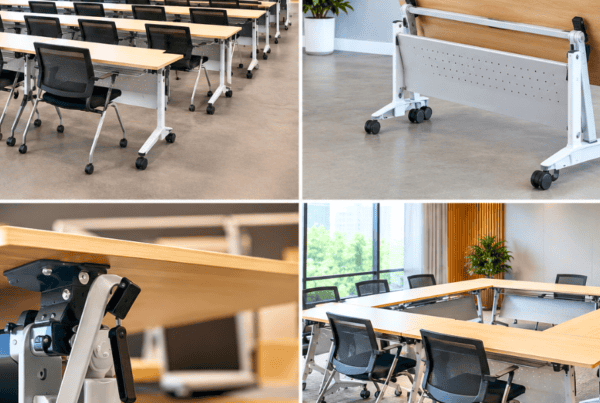
A meeting table is designed for small, informal or semi-formal gatherings, typically for 4 to 8 people. It’s the workhorse of the modern office: the table where teams hold quick check-ins, daily stand-ups, brainstorming sessions, project reviews, and one-on-one discussions that need more room than a desk.
Meeting tables are compact and versatile. You’ll find them in huddle rooms, breakout zones, open-plan offices, and small cabins. They’re built for the pace of everyday work, where people walk in, talk through an issue, make a decision, and walk out.
Key Features of Meeting Tables
- Smaller footprint: Most meeting tables run between 4 and 8 feet in length, which suits compact rooms and flexible layouts.
- Modular and reconfigurable design: Many modern meeting tables can be joined, split, or rearranged as your team’s needs change.
- Lightweight pairing: They’re usually matched with stackable or lightweight chairs that are easy to move around.
- Built for informal, fast-paced environments: The design priority is function and flexibility rather than formality.
- Works as a discussion table for office use: In open offices, a meeting table often doubles as a casual discussion table, a spot where colleagues gather without booking a room.
Because a meeting table is such a flexible piece, it also tends to be the more budget-friendly choice, which is a big reason startups and growing SMEs lean toward it.
Common Meeting Table Shapes
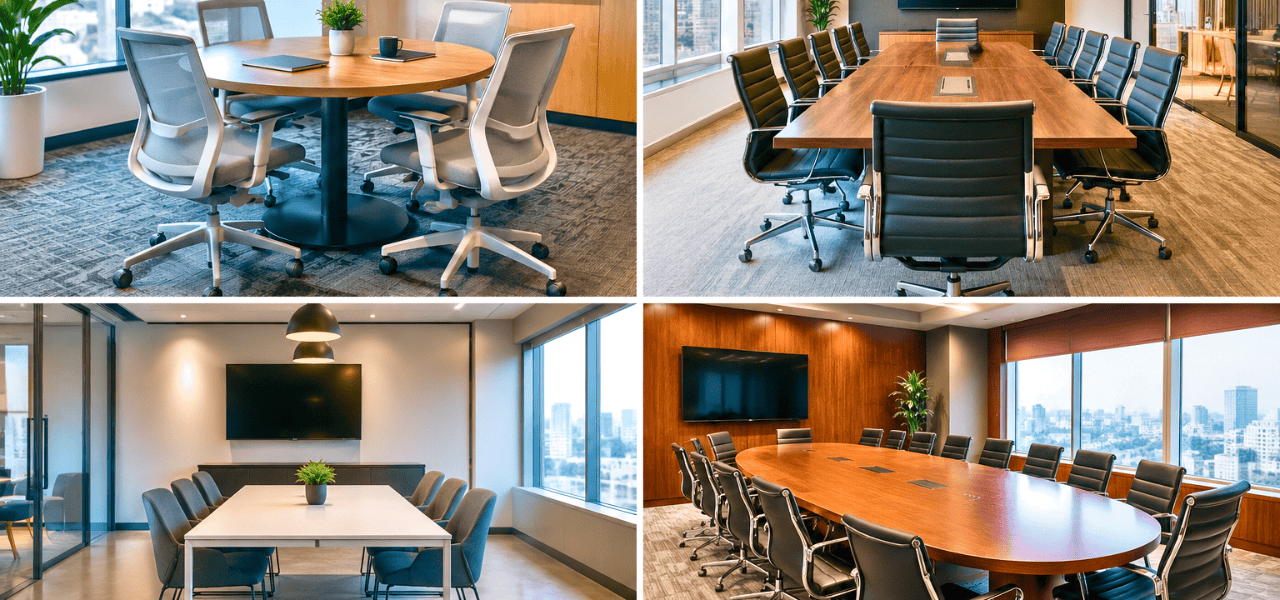
- Rectangular: The most common and space-efficient option, ideal for rooms with straight walls and a clear focal point such as a screen.
- Round: Round tables encourage equality and open dialogue because nobody sits at the “head.” They’re excellent for team discussions and creative sessions.
- Oval: A softer alternative to rectangular, with rounded edges that improve movement around the table.
- Boat-shaped: A tapered design that gives a slightly more formal look while remaining compact.
A good huddle room table is typically a small round or rectangular unit seating 2 to 6 people, enough for a quick, focused conversation without crowding the room.
What Is a Conference Table?
Definition and Purpose
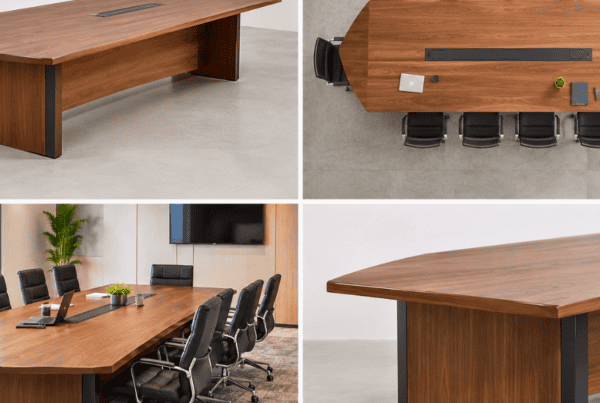
A conference table is designed for formal, large-scale gatherings, typically for 10 to 20 people or more. This is the table you see in boardrooms: the one used for board meetings, client presentations, investor pitches, executive reviews, and corporate decision-making.
A conference table is more than a place to sit. It’s the centerpiece of the room. It commands authority, sets the tone for important conversations, and reflects the prestige of your brand. When a client walks into your conference room, the table is often the first thing they register.
Key Features of Conference Tables
- Large format: Conference tables generally range from 10 to 20 feet or more in length, and some custom boardroom tables go even larger.
- Premium materials: Wood veneer, glass, high-pressure laminate, and engineered wood are all common, chosen for both durability and visual impact.
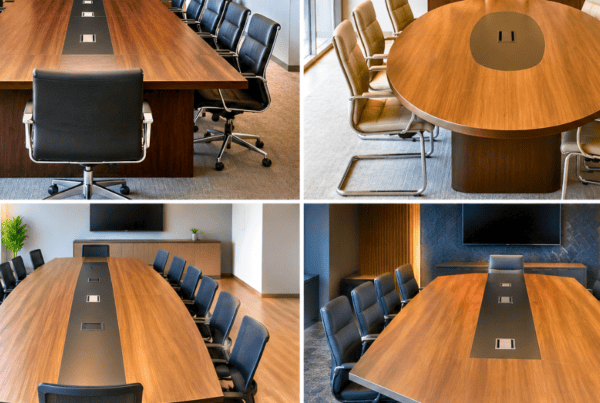
- Integrated cable management: Built-in power points, data ports, and cable channels keep laptops, projectors, and video-conferencing systems running without a tangle of wires.
- Fixed, permanent placement: Unlike a meeting table, a conference table is usually installed once and stays put.
- Designed to make a statement: Everything from the edge profile to the finish is chosen to look polished and professional.
Common Conference Table Shapes
- Boat-shaped: The classic boardroom look, with curved sides that narrow toward the ends. It improves sightlines and feels naturally formal.
- Rectangular: Maximizes seating capacity and works well in long, narrow rooms.
- U-shaped or hollow square: Ideal for collaborative presentations, training sessions, and discussions where the presenter needs to face everyone.
- Racetrack: A rectangle with fully rounded ends, offering a modern look and smooth traffic flow.
Whichever shape you choose, the best conference tables are planned around the room’s dimensions, the number of attendees, and the technology you’ll use in it.
Meeting Table vs Conference Table: Key Differences at a Glance
Here’s the quick answer to the question most people search for, the difference between a meeting table and a conference table:
| Feature | Meeting Table | Conference Table |
| Size | Compact (4-8 ft) | Large (10-20+ ft) |
| Seating Capacity | 4-8 people | 10-20+ people |
| Setting | Huddle rooms, breakout areas | Boardrooms, formal conference rooms |
| Formality | Informal to semi-formal | Formal |
| Design | Modular, flexible | Fixed, statement piece |
| Tech Integration | Basic | Advanced (AV, cable management) |
| Best For | Daily team discussions | Board meetings, client presentations |
| Common Materials | Engineered wood, laminate | Veneer, glass, premium laminate |
Reading Between the Rows
The table gives you the headline differences, but a few deserve more explanation.
Purpose drives everything. A meeting table is built around frequency and flexibility: many short conversations through the day. A conference table is built around occasion and impression: fewer, higher-stakes meetings where presentation matters.
Technology expectations differ. In a huddle room, a wall-mounted screen and a couple of power sockets are usually enough. In a boardroom, you may need a video-conferencing setup, a presentation system, microphones, and power at every seat. A conference table is designed with those requirements in mind from the start.
Permanence matters. Meeting tables tend to be mobile or modular, so your layout can change as your team grows. Conference tables are an investment you plan around and rarely move.
Materials reflect the setting. Both can be made from durable laminates and engineered wood, but conference tables more often use veneer or glass finishes to create a premium feel.
When to Choose a Meeting Table for Your Office
A meeting table is the right choice when:
- You have a huddle room or small breakout space. If your room seats six or fewer, a conference table will overwhelm it.
- Your team needs quick, frequent collaboration. Agile teams, design studios, and sales groups meet often and informally, and a flexible table supports that rhythm.
- You want flexible, reconfigurable office workspace tables. Modular meeting tables can be joined for a workshop and split again for small group work.
- Space is limited but collaboration is a priority. In compact urban offices, where every square foot is expensive, a well-chosen meeting table delivers a lot of function in a small footprint.
- You run a startup, SME, or agile team. Growing businesses benefit from furniture that adapts as headcount and priorities change.
Meeting tables also suit the outer areas of larger companies, such as department-level discussion rooms, project war rooms, and training corners. Even enterprises with grand boardrooms need plenty of smaller spaces where everyday work happens, and a good Conference & Meeting Room Furniture plan accounts for both.
When to Choose a Conference Table for Your Office
A conference table is the right choice when:
- You host formal board meetings, investor presentations, or client pitches. These occasions call for a setting that signals credibility and professionalism.
- You need to seat 10 or more people in a structured arrangement. Larger groups need a table sized and shaped to keep everyone engaged and in view.
- You want your conference and meeting room furniture to reflect brand authority. The boardroom is often where clients form their lasting impression of your company.
- Your business is an enterprise, law firm, financial services firm, or corporate headquarters. Organizations in these categories typically hold regular formal meetings and benefit from a dedicated, well-equipped space.
If your calendar includes a regular stream of external visitors, such as clients, auditors, partners, and investors, a conference table is a worthwhile investment. It also works best when paired with ergonomic chairs for conference rooms, since long meetings demand comfortable seating that still looks professional.
Can You Use the Same Table for Both?
In many cases, yes. Modern modular office furniture has blurred the line between the two categories.
A well-designed modular meeting table can serve a small conference room perfectly well, especially in companies with fewer than ten people attending formal meetings. Likewise, modular conference tables built from separate sections can be split into smaller units for different uses, turning one large room into two working zones when needed.
This is where multi-purpose office workspace tables earn their place. Instead of dedicating a room to a single function, many Indian offices now invest in flexible furniture that adapts: a boardroom by day, a workshop space in the afternoon, a training room on Fridays. For growing businesses without the luxury of unlimited floor space, that adaptability is valuable.
The trade-off is simple. A flexible table gives up some of the grandeur of a purpose-built boardroom piece, but it gains versatility and often better value. Vlite Furnitech’s range of Meeting & Conference Tables is designed with this balance in mind, offering versatility without compromising aesthetics, so you can choose between a dedicated statement piece and a table that does double duty.
Whichever way you lean, the key is to be honest about how your space is actually used. If the room hosts a formal board meeting twice a year and team discussions every other day, a flexible solution probably serves you better than a ceremonial one.
Why the Right Office Furniture Partner Makes All the Difference
Choosing between a meeting table and a conference table is only part of the decision. Who you buy from affects quality, delivery timelines, customization, and long-term support. When evaluating a supplier of office furniture, here’s what to look for.
Manufacturing capability. A manufacturer with its own facility has far more control over quality and lead times than a reseller. Vlite Furnitech operates a 30,000 sq. ft. state-of-the-art manufacturing facility in Patalganga, Navi Mumbai, with a capacity of 14,000 workstations per month. That scale means large projects, such as a full corporate campus fit-out, can be handled without delays.
Recognized certifications. Standards matter when you’re buying furniture meant to last years. Vlite Furnitech is BIFMA-certified, ISO 9001:2015 certified, and LEED-compliant, which signals tested durability, consistent quality processes, and support for sustainable building goals.
Customization. Every office is different, and off-the-shelf tables don’t always fit unusual room dimensions or brand aesthetics. A dedicated in-house design team can tailor table size, shape, finish, and cable management to your exact requirements.
Geographic reach. Look for a supplier with a presence where your offices are. Vlite Furnitech has branches in Mumbai, Pune, Ahmedabad, Surat, and Hyderabad, along with the ability to deliver projects globally, so multi-location businesses can maintain consistency across sites.
End-to-end service. The best partners manage the project from consultation to installation, and they stay available afterward. Ask about after-sales support, warranty terms, and how quickly issues are resolved. Furniture is a long-term purchase, and service after installation is just as important as the product itself.
When you shortlist suppliers, ask to see completed projects, request material samples, and confirm timelines in writing. A reliable partner will welcome those questions.
Still comparing modular, bespoke, and traditional office furniture?
Let Vlite Furnitech LLP help you choose the smartest investment for better ROI.
Frequently Asked Questions (FAQ)
1. What is the main difference between a meeting table and a conference table?
A meeting table is smaller and designed for 4 to 8 people in informal or semi-formal settings, while a conference table seats 10 to 20 or more people in formal boardroom environments. Meeting tables prioritize flexibility, whereas conference tables prioritize presence, capacity, and technology integration.
2. Can a meeting table be used in a conference room?
Yes. In smaller conference rooms or huddle spaces, a well-designed meeting table can fulfil conference room functions, especially modular versions that can be extended or combined. For large formal gatherings, though, a dedicated conference table is a better fit.
3. What size meeting table do I need for my office?
For a 4 to 6 person team, a table of 4 to 6 feet works well. For 8 to 10 people, opt for an 8-foot table. Conference rooms for 12 or more people typically need tables of 12 to 20 feet. Always leave enough clearance around the table for chairs and comfortable movement.
4. What is a huddle room table?
A huddle room table is a compact meeting table designed for small, informal collaboration spaces. It typically seats 2 to 6 people and suits quick, focused discussions where a full meeting room would be excessive.
5. What materials are best for conference and meeting room furniture?
High-pressure laminate, engineered wood, wood veneer, and glass are all popular choices. The best option depends on your aesthetic preference, durability needs, and budget. Laminates and engineered wood offer excellent durability and value, while veneer and glass deliver a more premium look.
6. Does Vlite Furnitech offer customized meeting and conference tables?
Yes. Vlite Furnitech’s dedicated design team creates fully customized Meeting & Conference Tables tailored to your space, seating capacity, and brand identity.
Choose the Table That Fits Your Work Style
The difference between a meeting table and a conference table comes down to purpose. Meeting tables deliver flexibility and collaboration: compact, adaptable, and built for the everyday rhythm of teamwork. Conference tables deliver formality and authority: large, polished, and equipped for the meetings that matter most to your business.
Both are essential parts of a complete office furniture strategy. Most thriving offices need a mix, with several meeting tables for daily collaboration and one well-chosen conference table for high-stakes occasions. The right balance depends on your team size, your space, and how you actually work.
Whether you’re setting up a compact huddle room or a grand boardroom, Vlite Furnitech has the perfect office workspace table for your needs. Explore our range of Meeting & Conference Tables, or get in touch with our design team for customized office furniture solutions built around your space and your brand.

Vishnu Sharma
I am the co-founder and CEO of Vlite Furnitech, creating modular office solutions since 2009. With a background in Chemistry and Marketing, and experience as Regional Head at Featherlite, I help design ergonomic, adaptable, and sustainable workspaces. Alongside a team of 120+, we serve corporates like JCB, Just Dial, KFC, and educational institutions. Let’s connect to reimagine innovative, eco-friendly office environments.