Why the Shape of Your Conference Table Matters
Walk into any boardroom and the first thing you notice is the table. It anchors the room, dictates where people sit, and quietly sets the tone for every conversation that happens around it. The shape of a boardroom table influences far more than aesthetics. It shapes communication, hierarchy, collaboration, and the overall energy of every meeting.
Yet choosing the right shape is one of the most overlooked decisions in conference and meeting room furniture planning. Many organizations spend weeks debating finishes, chairs, and technology, then pick a table shape almost by default. The result is often a room that looks impressive but works poorly: people who cannot see one another, cramped corners, or a seating arrangement that clashes with how the team actually collaborates.
For office managers, interior designers, procurement heads, architects, and HR leads planning workspace upgrades, getting this decision right pays off for years. A well-chosen table improves eye contact, supports hybrid meetings, makes better use of floor space, and reflects your brand the moment a client walks in.
In this guide, we break down the four main boardroom table shapes: Rectangular, Oval, Boat-Shaped, and Gable End. We cover what each one offers, where it works best, and how to match it to your room size and meeting culture. Whether you are furnishing a new corporate headquarters or refreshing an existing meeting room, understanding these options will help you invest wisely in office furniture that performs as well as it looks.
Vlite Furnitech, one of India’s trusted manufacturers of premium Meeting and Conference Tables, works with organizations across the country on exactly these decisions, and the insights below draw on that experience.
4 Main Types of Boardroom Table Shapes
Before investing in office furniture, it is essential to understand how each table shape serves your space and your meeting culture. A shape that suits a formal board meeting may feel stiff in a brainstorming session, while a table built for open collaboration may not carry the authority a leadership team wants. Let’s look at each option in detail.
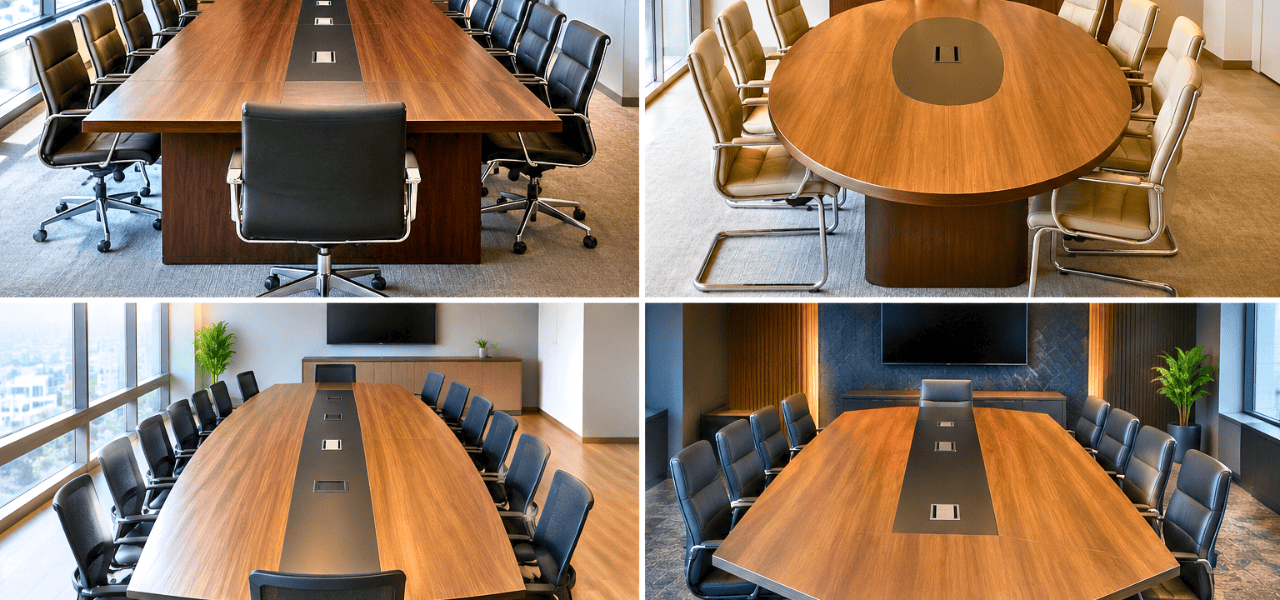
1. Rectangular Meeting Table
What it is: The rectangular meeting table is the most traditional and widely used boardroom table shape. Its straight edges and right-angled corners have defined the corporate meeting room for decades, and for good reason: it is simple, versatile, and efficient.
Key characteristics:
- Establishes a clear head position, which naturally signals who leads the meeting
- Maximizes seating along both long sides, making it the most space-efficient option for large groups
- Easy to extend or configure with additional modules as teams grow
- Familiar and professional, requiring no explanation to anyone entering the room
Best for: Formal boardroom presentations, hierarchical organizations, and larger meeting rooms where seating capacity is a priority. Law firms, financial institutions, manufacturing companies, and traditional corporates often favor this shape because it mirrors the structure of their decision-making.
Room size recommendation: A rectangular table works best in long, narrow conference rooms. The shape follows the room’s proportions, which keeps circulation space balanced on all sides. In a square room, a long rectangle can leave awkward gaps at the ends or crowd the sides.
Design tip: Pair your rectangular table with ergonomic chairs and integrated cable management for a clean, professional look. Because rectangular tables are often long, consider placing power and data modules at intervals along the surface so every participant has access without trailing wires.
The Vlite angle: Vlite Furnitech’s rectangular meeting table options are modular and customizable, so you can specify length, width, finish, and technology integration to suit your room. They are also BIFMA certified, which gives procurement teams confidence in durability and quality standards.
The trade-off with a rectangular table is that people seated at the same side cannot easily see those further down the line, and the strong hierarchy it creates may feel limiting for teams that want a more open discussion style.
2. Oval Conference Table
What it is: The oval conference table is a softer, rounded take on the rectangle. With no sharp corners, it flows naturally and feels more approachable while still looking premium.
Key characteristics:
- Promotes inclusivity, as there is no obvious head of the table
- Maximizes legroom, since there are no corner legs or edges to work around
- Appears visually spacious, which helps rooms feel open rather than crowded
- Encourages natural conversation because curved edges draw people toward one another
Best for: Collaborative teams, creative agencies, consulting firms, and organizations with flat hierarchies. If your meetings are discussion-driven and you want every voice to carry equal weight, an oval table sets the right tone.
Room size recommendation: Oval tables suit square or slightly rectangular rooms. The rounded edges soften the layout and make movement around the table easier, which is also why they work well in compact spaces where a rectangular table might feel bulky.
Design tip: An oval table is ideal when you want a premium, executive aesthetic without the formality of a traditional boardroom. Choose a rich veneer or a refined laminate finish and pair it with upholstered chairs for a look that feels both polished and welcoming.
The Vlite angle: Vlite Furnitech places strong emphasis on craftsmanship and material quality in its oval conference tables, offering veneer and laminate options along with full customization of size and finish. Clean edge detailing and precise joinery ensure the table looks as good up close as it does from across the room.
The main limitation is capacity. Oval tables seat fewer people than rectangular ones of comparable footprint, so they are best suited to small and mid-sized groups.
3. Boat-Shaped Conference Table
What it is: The boat-shaped conference table is wider in the middle and tapers at both ends, resembling the hull of a boat. It combines the capacity of a long table with the visual softness of a curved one.
Key characteristics:
- Enhances sightlines so that every participant can see one another clearly
- Ideal for video conferencing, since the angled sides help people face the camera and screen naturally
- Feels less imposing than a rectangular table of the same length because the tapering ends reduce visual bulk
- Offers generous working space in the center, where most of the discussion happens
Best for: Mid-to-large boardrooms, hybrid meeting environments, and tech-forward organizations. Companies that regularly host remote participants, such as IT firms, startups, and multinational teams, benefit most from the improved visibility this shape provides.
Room size recommendation: Boat-shaped tables perform best in longer rooms. The taper creates additional breathing space at the ends, making the room feel more open than it would with a rectangular table of equal size.
Design tip: Integrate AV ports, power modules, and wire management directly into the table surface. Because boat-shaped tables are often chosen for hybrid and technology-driven meetings, a seamless built-in setup keeps the surface uncluttered and the focus on the conversation.
The Vlite angle: Vlite Furnitech positions its boat-shaped conference table as its most modern, tech-ready option. With customizable cut-outs and integrated connectivity, it is designed for the way contemporary teams meet.
One consideration: the tapered ends reduce seating at the extremes, so confirm your headcount against the table’s usable edge length before you finalize your order.
4. Gable End Conference Table
What it is: The gable end conference table is a rectangular table with angled or “gabled” ends. It sits between the rectangular and boat-shaped designs, keeping a formal structure while softening the ends for better visibility.
Key characteristics:
- Defines leadership positions at each end, unlike the oval table
- Offers better sightlines than a pure rectangular table, as the angled ends open up the view across the room
- Retains the large seating capacity of a rectangular layout
- Delivers a distinctive, high-authority look that stands out from standard boardroom tables
Best for: Formal boardrooms that still need strong visibility across the table, and large corporate settings where hierarchy matters but communication cannot suffer. It is a natural fit for leadership teams, board meetings, and client-facing executive rooms.
Room size recommendation: The gable end table works in both long and slightly wider rooms, which makes it one of the more versatile options when room proportions are not ideal.
Design tip: Gable end tables are often paired with executive leather chairs and premium surface finishes to create a strong, authoritative aesthetic. Rich wood veneers, contrasting edge banding, and refined metal accents all complement the angular lines of this design.
The Vlite angle: Vlite Furnitech highlights the gable end as a signature executive boardroom choice, a statement piece for organizations that want their meeting room to convey confidence and permanence. It is also a shape that few competitors offer well, which makes it a distinctive option for brands that want to stand apart.
Comparison at a Glance: Which Boardroom Table Shape Is Right for You?
If you are weighing the options, this quick comparison summarizes how each shape performs.
| Shape | Best For | Hierarchy | Collaboration | Room Type |
| Rectangular | Formal presentations | High | Moderate | Long rooms |
| Oval | Collaborative teams | Low | High | Square rooms |
| Boat-Shaped | Hybrid/AV meetings | Moderate | High | Long rooms |
| Gable End | Executive boardrooms | High | Moderate | Versatile |
How to read this table: If your priority is a clear chain of command and formal presentations, the rectangular and gable end shapes are your strongest candidates. If open discussion and equal participation matter most, look at oval and boat-shaped tables. If your meetings routinely include remote participants, the boat-shaped design gives you the best camera and screen visibility. And if your room does not fit a neat category, the gable end’s versatility makes it a safe, impressive choice.
No single shape is “best” in every situation. The right choice depends on how your team actually works, which brings us to the factors worth evaluating before you decide.
Key Factors to Consider When Choosing a Boardroom Table Shape
Beyond aesthetics, your table shape should reflect how your team meets, the size of your room, and the impression you want to make. Work through the following five considerations and the right answer usually becomes clear.
Room Dimensions and Layout
Start with the room itself. The length-to-width ratio matters, so match the table shape to the room’s proportions. Long, narrow rooms suit rectangular and boat-shaped tables, while squarer rooms are better served by oval designs. Gable end tables flex across both.
Just as important is clearance. Allow at least 36 to 48 inches (roughly 90 to 120 cm) on all sides of the table so people can sit down, stand up, and move around comfortably. Remember that chairs need space to pull back, and that doors, windows, screens, and storage units also compete for floor area. A table that looks perfect in a showroom can feel oppressive if it leaves too little circulation room.
Team Size and Seating Capacity
Count your regular attendees, then add a buffer for occasional larger meetings. Rectangular and boat-shaped tables seat more people per linear foot, making them the practical choice for bigger groups. Oval tables are more limited in capacity but prioritize comfort and visibility, so they shine for smaller teams that value close interaction.
A common mistake is sizing the table for the largest meeting of the year. Designing for your typical meeting, with flexibility for peaks, usually produces a better everyday experience.
Meeting Culture and Communication Style
Your table should support the way your people communicate. Hierarchical organizations, where decisions flow from the top, tend to be well served by rectangular or gable end tables that give leadership a defined position. Flat, collaborative cultures, where ideas are exchanged freely, usually fit oval or boat-shaped tables better.
Think honestly about how meetings run today, and how you want them to run in future. A table can nudge behavior. A shape that removes the head of the table can encourage quieter team members to contribute, while a defined head position can speed up decision-making in formal settings.
Technology Integration
Modern meetings depend on technology, and your table should support it rather than fight it. Consider built-in power modules, AV ports, and cable management, particularly for boat-shaped tables designed with hybrid meetings in mind. Think about where displays and cameras will sit, and make sure the table shape gives everyone a clear line of sight to both.
Vlite Furnitech offers customizable, tech-integrated conference table solutions so that connectivity is part of the design from the start, not an afterthought added with loose extension cords.
Aesthetics and Brand Identity
Your boardroom is often the first space clients and partners see, so the table should reflect your brand values. A traditional firm may want the gravitas of a gable end table in dark veneer, while a design-led startup might prefer the clean, flowing lines of an oval in a light, contemporary finish.
Premium finishes such as veneer and high-gloss laminate from Vlite help create the right executive impression. Consider how the table works with your flooring, lighting, wall treatments, and chairs, because the best boardrooms feel cohesive rather than assembled piece by piece.
Common Mistakes to Avoid
Even with a clear understanding of table shapes, a few pitfalls come up repeatedly in conference room planning:
- Choosing by looks alone. A beautiful table that does not fit your room or your meeting style will frustrate users daily.
- Ignoring clearance. Cramped circulation is the most common complaint in poorly planned meeting rooms.
- Overlooking technology. Retrofitting power and data later is costly and rarely looks neat.
- Sizing for the exception. Planning around the one annual all-hands meeting can leave the room feeling empty for the other 360 days.
- Forgetting the chairs. Table height, edge profile, and chair design need to work together for real comfort.
A short planning conversation with a specialist can prevent all of these, which is one reason many organizations choose to work with an experienced manufacturer from the beginning.
Why Choose Vlite Furnitech for Your Conference and Meeting Room Furniture?
Selecting the right shape is only half the decision. The other half is choosing a partner who can deliver quality, consistency, and support. Here is what Vlite Furnitech brings to your project:
- Manufacturing strength: A leading modular office furniture manufacturer in India, operating a 30,000 sq. ft. facility in Patalganga, Navi Mumbai.
- Scale: Capacity to produce 14,000 workstations per month, which means large corporate projects can be delivered reliably and on schedule.
- Certified quality: BIFMA certified, ISO 9001:2015 certified, and LEED compliant, reflecting high standards in performance, process, and environmental responsibility.
- Pan-India presence: Support across Mumbai, Pune, Ahmedabad, Surat, and Hyderabad, so teams in multiple cities can be served consistently.
- End-to-end service: Complete project management from design through installation, backed by dependable after-sales service.
- Sustainability-first approach: Responsible sourcing and eco-friendly production practices built into how the furniture is made.
- Customized solutions: An in-house design team that collaborates directly with clients to tailor tables, finishes, and technology to each space.
Whether you need a single conference table or a full fit-out of modular workstations, ergonomic office chairs, and meeting spaces, Vlite Furnitech can plan, manufacture, and install it as one coordinated project.
Still comparing modular, bespoke, and traditional office furniture?
Let Vlite Furnitech LLP help you choose the smartest investment for better ROI.
Frequently Asked Questions (FAQ)
1. What is the most popular boardroom table shape?
Rectangular is the most widely used shape because of its versatility and maximum seating capacity. It fits most room layouts, is easy to configure, and suits a wide range of organizations.
2. What is a boat-shaped conference table?
A boat-shaped table is wider in the center and narrows at both ends. This design improves sightlines and visibility for all participants, making it ideal for video conferencing and hybrid meetings.
3. What is the difference between an oval and a gable end conference table?
An oval table has fully rounded ends with no defined head position, which suits collaborative teams. A gable end table has angled ends that define leadership positions, making it better for formal, hierarchical boardrooms.
4. What conference table shape is best for small meeting rooms?
Oval tables work well in compact spaces. The rounded edges create a sense of openness and make it easier to move around the table.
5. Can I customize the shape and finish of my boardroom table with Vlite Furnitech?
Yes. Vlite Furnitech offers fully customizable conference tables in all shapes, finishes, and sizes, with integrated technology options to suit your requirements.
Conclusion
The right boardroom table is a strategic decision, not just a furniture purchase. It influences how people communicate, how decisions are made, and how your organization is perceived by everyone who steps into the room.
To recap the four shapes:
- Rectangular: Formal, hierarchical, and high-capacity, ideal for long rooms and traditional boardrooms.
- Oval: Collaborative and inclusive, perfect for square or compact rooms and flat-structured teams.
- Boat-Shaped: Tech-forward and visibility-focused, the best choice for hybrid meetings and mid-to-large rooms.
- Gable End: Executive and versatile, a statement piece that balances authority with better sightlines.
Start with your room dimensions, factor in team size and meeting culture, plan for technology, and let your brand identity guide the finish. When these elements align, your boardroom table becomes more than a place to sit. It becomes a tool that helps your team do its best work.
Ready to find the right fit? Explore Vlite Furnitech’s range of premium Meeting and Conference Tables, crafted for India’s most demanding boardrooms. Contact our design team today for a customized consultation and bring your ideal boardroom to life.

Vishnu Sharma
I am the co-founder and CEO of Vlite Furnitech, creating modular office solutions since 2009. With a background in Chemistry and Marketing, and experience as Regional Head at Featherlite, I help design ergonomic, adaptable, and sustainable workspaces. Alongside a team of 120+, we serve corporates like JCB, Just Dial, KFC, and educational institutions. Let’s connect to reimagine innovative, eco-friendly office environments.