India’s coworking industry has grown at an extraordinary pace since 2020. With over 6 million flexible workspace seats expected across the country by 2027, coworking spaces and startups are rapidly rethinking how they design and utilize office floor space. Yet despite this boom, one problem remains stubbornly common: poor workstation design.
A badly planned sharing workstation doesn’t just look uninviting, it directly costs you. Employees lose focus, space gets wasted, and operational costs climb as you try to fix problems that should have been solved at the layout stage. Whether you’re setting up a 10-seat startup office or a 200-desk coworking workstation floor, the design choices you make from day one will determine how productively your space runs for years to come.
This guide walks you through everything you need to know, from defining what a sharing workstation design actually is, to choosing the right configurations, partitions, and furniture features that make shared offices genuinely work.
What Is a Sharing Workstation?
Definition and Core Concept
A sharing workstation is a desk setup designed to be used by more than one person, either simultaneously or across different time slots. Unlike a personal desk, where one employee has a fixed, dedicated space, a shared desk workstation is built around flexibility. Users rotate in and out, which means the furniture, storage, and layout must accommodate different users without friction.
The shift from dedicated desks to shared office desk arrangements reflects a broader transformation in how companies think about space. With hybrid work models now mainstream, keeping an entire desk permanently assigned to someone who’s only in the office three days a week is simply wasteful. A shared desk workstation solves this by ensuring every seat is used to its full potential.
Hot Desking vs. Coworking Workstations, Key Differences
These terms are often used interchangeably, but they describe slightly different setups.
Hot desking operates on a first-come, first-served basis. There are no assigned seats, users arrive and take any available desk. This model works well for companies where teams are highly mobile or where a significant percentage of staff work remotely on any given day. Hot desking furniture in India has become increasingly popular among IT firms, consultancies, and hybrid-first startups precisely because it reduces per-person furniture expenditure.
A coworking workstation, by contrast, is a structured shared desk setup within a coworking environment. Desks may be allocated in time blocks, reserved in advance, or organized by zones. The furniture is typically more standardized, with shared amenities like common power modules, centralized storage, and partition systems that create defined personal zones within a shared floor.
Understanding which model fits your operation helps you choose the right furniture, layout, and partition system from the outset.
Key Design Principles for Sharing Workstations
Space Optimization and Layout Planning
The foundation of any good sharing workstation design is efficient space planning. The industry standard for shared desk environments is 50–70 square feet per person, which is notably lower than the 80–100 sq ft typically allocated for private offices. That reduction only works, however, when the layout is thoughtfully planned.
Common configurations include:
- Linear layouts, desks arranged in a straight row, ideal for larger floors
- Back-to-back layouts, two rows of desks facing away from each other, maximizing density
- L-shaped arrangements, suited to corner spaces and smaller team clusters
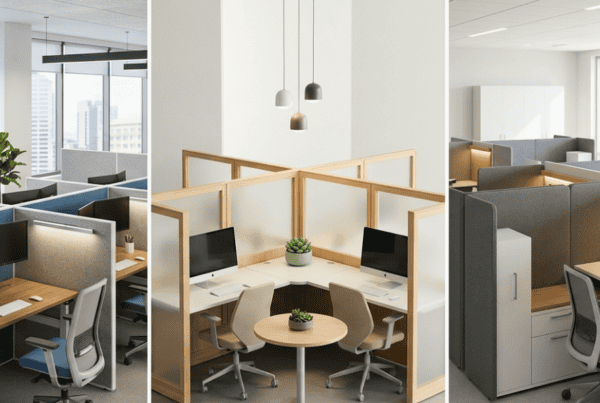
- Cluster/pod layouts, groups of 4–6 desks arranged around a central point
Modular office furniture plays a key role here. Unlike built-in carpentry, modular systems allow you to reconfigure your floor plan as your team grows or as your operational model evolves, without starting from scratch.
The Role of Workstation Partitions
One of the most underestimated elements in sharing design concepts is the Workstation Partition System. In a shared environment, users sit close to one another, and without some form of visual and acoustic separation, the space quickly becomes noisy, distracting, and uncomfortable.
Workstation partitions come in several forms:
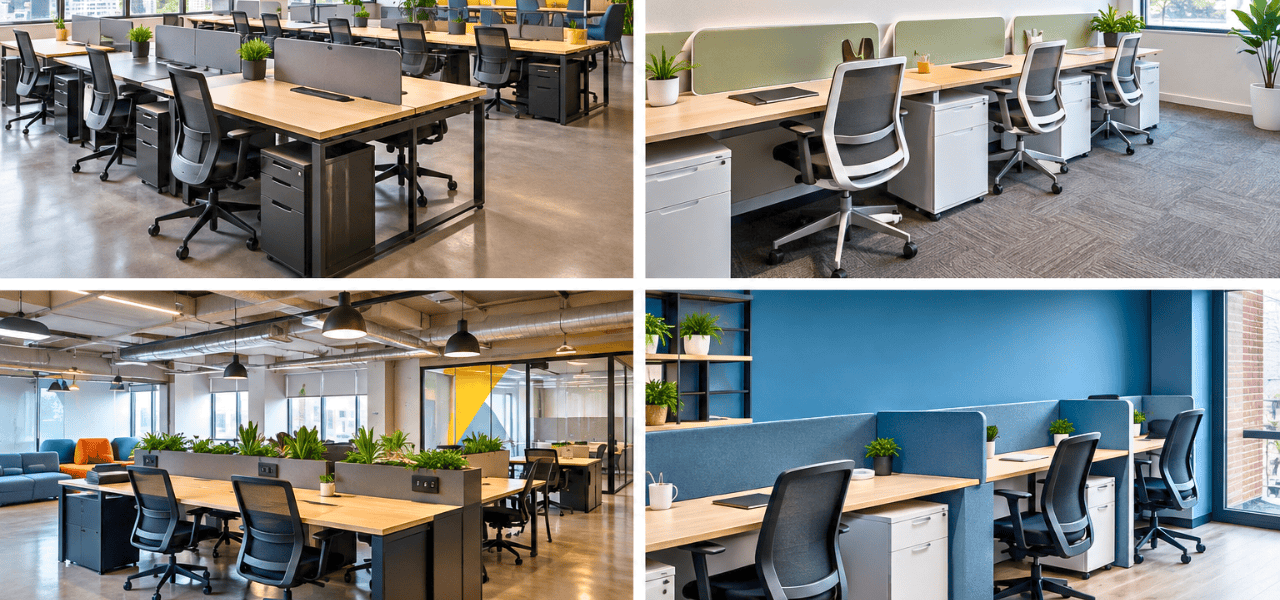
- Fabric-covered panels, excellent for acoustic absorption, available in a range of colors and textures
- Acrylic or glass dividers, maintain visual openness while creating a physical boundary
- MDF panels, durable and cost-effective for high-traffic shared environments
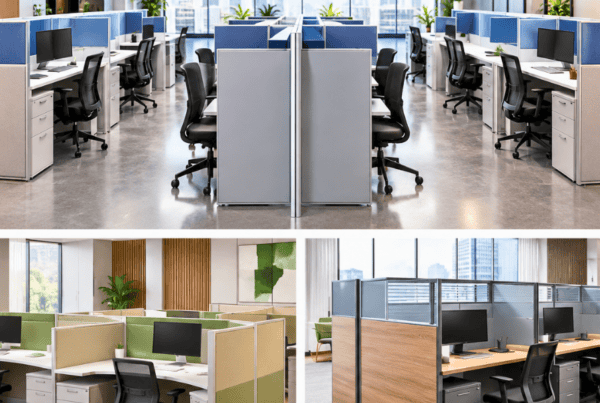
Height is a critical variable. Low partitions (around 600mm) suit collaborative zones where teams need to communicate easily. Higher partitions (1,000–1,200mm) are better for focused work zones where concentration is the priority. A well-designed coworking floor often includes both, with zones differentiated by partition height.
Vlite Furnitech offers customizable workstation partition solutions across all major types, allowing coworking operators and office managers to specify height, material, and color to suit their exact requirements.
Ergonomics in Shared Workstation Design
Ergonomics becomes more complex in a shared desk workstation setup because you cannot optimize a desk for one specific user. The furniture must work reasonably well for a range of body types and working styles.
Key ergonomic considerations for sharing workstations include:
- Adjustable desk heights, sit-stand desks are ideal in shared environments where one height setting won’t suit everyone. Even if a full height-adjustable desk isn’t feasible for every seat, consider including some sit-stand units within the layout.
- Multi-user chairs, select ergonomic chairs with easy-to-adjust seat height, lumbar support, and armrests. Avoid chairs with fixed settings that only suit a narrow range of users.
- Cable management, built-in cable trays and surface-mounted power modules keep desks clutter-free between users. In a shared office desk environment, tangled cables are not just unsightly, they’re a genuine productivity barrier.
Aesthetics and Brand Alignment
A sharing workstation is not just functional infrastructure, it communicates something about your organization. For coworking space operators, the design of your workstations directly influences how attractive your space is to potential members. For startups, it reflects company culture to every new hire and visitor who walks through the door.
Thoughtful aesthetic choices include:
- Color zoning, warmer tones for collaboration areas, cooler neutrals for focus zones
- Material selection, high-pressure laminate tops for durability, with wood veneer accents for warmth, and powder-coated steel frames for industrial-modern appeal
- Partition colors, fabric partitions in brand colors can turn a functional divider into a visual branding element
Vlite Furnitech’s modular coworking workstation systems are available in a wide range of laminate finishes, frame colors, and partition fabric options, making it straightforward to align your furniture with your brand identity.
Popular Sharing Workstation Configurations for Coworking Spaces
Back-to-Back Sharing Workstations
The back-to-back configuration remains the most widely used layout in open-plan coworking environments for good reason. Two rows of desks face away from each other, separated by a central partition spine. This arrangement is extremely space-efficient and allows a surprisingly high density of users without the space feeling cramped.
It works particularly well for startups with growing teams, where maximizing usable desk space within a limited floor plate is a priority. The central partition between facing desks also provides natural acoustic and visual separation without requiring full-height walls.
Linear Bench Desking
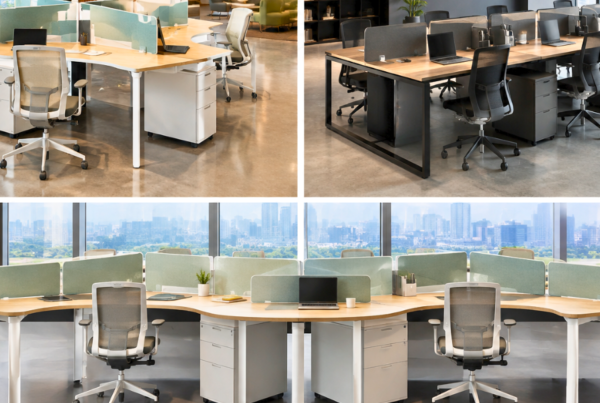
Linear bench desking features long, continuous desk surfaces where multiple users sit side by side along a shared leg structure. This setup eliminates the per-user material cost of individual desk frames and is easy to extend, simply add another section as your headcount grows.
This format is well suited to large coworking floors and high-volume hot desking furniture setups in India, particularly where the user base changes daily. It’s also the easiest configuration to sanitize and turn over between users, which has become a practical consideration in the post-pandemic office environment.
Cluster / Pod Workstations
Cluster or pod layouts group four to six desks together, usually facing inward or arranged in a square or hexagonal formation. This design promotes natural team collaboration while giving each user a defined individual zone within the cluster.
For startups with small cross-functional teams, a product team of four, a sales pod of six, this configuration maps furniture layout directly onto team structure. It reduces unnecessary movement and makes spontaneous collaboration feel organic rather than forced.
Cabin-Style Shared Workstations with Partitions
For coworking spaces that want to offer a premium product, cabin-style shared workstations provide the best of both worlds. Higher workstation partitions (800mm–1,200mm) create semi-private bays that feel closer to a private office environment, while still allowing multiple users to share a defined space.
This format is well suited to professionals who need focused, uninterrupted work time, legal consultants, financial analysts, remote developers, and who are willing to pay a premium for a coworking membership that offers genuine acoustic privacy. The shared office desk component keeps costs lower than a fully private cabin, while the partition design maintains a sense of personal space.
Must-Have Features in Coworking Workstation Furniture
The furniture itself is where design principles meet practical reality. When specifying furniture for a sharing workstation environment, these features are non-negotiable:
Integrated power modules, USB-A, USB-C, and standard power sockets should be built directly into the desk surface or a recessed module. In a hot desking environment, every user arrives with devices to charge, and relying on floor sockets creates a cable management nightmare.
Cable management trays, a clean desk surface between users is both more hygienic and more productive. Built-in cable trays route power and data cables out of sight without requiring the user to do anything.
Personal storage solutions, since hot desking users don’t have a fixed desk, they need secure personal storage nearby. Mobile pedestal drawers, personal lockers, and shared cabinet units positioned near the workstation cluster give users somewhere to store belongings without occupying desk space.
Modular and reconfigurable design, the most important long-term investment you can make is in furniture that can grow and change with your operation. Modular systems from manufacturers like Vlite Furnitech allow you to add seats, reconfigure layouts, or change partition heights without replacing entire systems.
Durability, shared environments see significantly higher daily usage than private desks. High-pressure laminate desk tops and powder-coated steel frames are the minimum standard for any serious sharing workstation investment.
Acoustic solutions, fabric-covered partitions do double duty as both visual dividers and sound absorbers, reducing the cumulative noise that builds up in dense shared spaces.
Vlite Furnitech manufactures all of these features into their coworking and hot desking furniture range, with a production capacity of 14,000 workstations per month and BIFMA-certified quality across the range.
Sharing Workstation Design for Startups, Special Considerations
Startups face a unique set of design challenges that larger corporates and established coworking operators don’t. Budget constraints are real, timelines are tight, and the organization itself is in a state of constant change. Sharing workstation design for startups needs to account for all of this.
Budget flexibility, modular furniture allows you to buy what you need today and expand incrementally. A startup with 12 employees today doesn’t need to furnish for 50 on day one. A well-chosen modular sharing workstation system scales with you.
Scalability, this is perhaps the most critical consideration. Design your initial layout with expansion in mind. Leave aisle space that could accommodate additional desk runs. Choose a furniture system that’s still available and compatible when you return to order more units in 18 months.
Brand identity, early-stage startups often overlook this, but your office environment sends a signal to every candidate you’re interviewing and every client you bring in. Custom laminate colors and partition fabric in brand colors cost very little more than standard options and make a significant visual impression.
Multi-use zones, rather than allocating every square foot to workstations, consider how your sharing workstation layout can incorporate small collaboration corners, standing meeting points, or informal breakout areas. The most effective startup offices blend focused work zones with spaces that facilitate the spontaneous conversations that drive innovation.
Vlite Furnitech’s dedicated design team works directly with startup clients to plan layouts that balance immediate practical needs with long-term growth, providing spatial planning support as part of the project engagement process.
Why Choose Modular Office Furniture for Shared Workspaces?
The case for modular office furniture over built-in carpentry or fixed furniture systems is straightforward when you examine it across several dimensions.
Flexibility, modular systems can be reconfigured without demolition, without waste, and without significant cost. When your team doubles, or when you shift from an open bench layout to clustered pods, you rearrange rather than replace.
Cost-effectiveness over time, the initial investment in a quality modular shared desk workstation system typically delivers superior lifetime value compared to cheaper fixed alternatives that need full replacement after a few years of heavy use.
Installation speed, modular furniture arrives pre-manufactured and assembles on-site in a fraction of the time required for built-in joinery. For a coworking space launch or a startup office fit-out on a tight timeline, this is a significant operational advantage.
Sustainability, modular furniture systems generate less waste over their lifecycle. When a component wears out, it can be replaced individually rather than discarding the entire piece. Vlite Furnitech manufactures to LEED-compliant standards and sources materials responsibly, making their products a credible choice for organizations with environmental commitments.
Vlite Furnitech, Your Trusted Partner for Sharing Workstation Design
When it comes to sourcing sharing workstation solutions at scale and quality in India, Vlite Furnitech occupies a distinct position in the market. Based in Patalganga, Navi Mumbai, Vlite operates from a 30,000 square foot manufacturing facility with the capacity to produce 14,000 workstations per month, a scale that allows them to serve everything from single-office startup fit-outs to large pan-India coworking network rollouts.
Their products are BIFMA certified and manufactured to ISO 9001:2015 standards, with LEED-compliant processes for clients with sustainability requirements. This isn’t marketing language, it’s third-party verified quality assurance that matters when you’re making a long-term infrastructure investment.
Vlite’s presence across Mumbai, Pune, Ahmedabad, Surat, and Hyderabad, combined with global project operations and dedicated project management teams, means that from design consultation to installation, the process is managed end-to-end. For coworking operators managing multiple locations, or for startups planning a single well-executed office, that continuity of service is genuinely valuable.
What genuinely differentiates Vlite in the hot desking furniture India market is the combination of manufacturing scale, certified quality, and a dedicated design team that collaborates with clients rather than simply fulfilling a product order. They bring spatial planning expertise to the table alongside the furniture itself.
Ready to design your perfect coworking workstation? Connect with Vlite Furnitech’s expert design team today for a free consultation.
Still comparing modular, bespoke, and traditional office furniture?
Let Vlite Furnitech LLP help you choose the smartest investment for better ROI.
Frequently Asked Questions
Q1: What is the standard size for a sharing workstation?
The standard per-person footprint in a shared desk workstation environment is typically 1,200mm × 600mm at the minimum, with 1,500mm × 750mm preferred for more comfortable setups. The right size depends on the nature of the work, screen-intensive roles benefit from wider surfaces.
Q2: What type of partition is best for a shared desk workstation?
Fabric-covered panels at 600–800mm height are the most versatile choice for most coworking environments. They balance acoustic absorption with visual openness and come in a wide range of colors to suit brand aesthetics.
Q3: Is hot desking suitable for startups?
Yes, particularly for startups with hybrid or flexible working arrangements. Hot desking furniture reduces per-person furniture cost significantly, and with the right personal storage solutions in place, it functions smoothly even in teams with strong culture around ownership.
Q4: How do I choose the right office furniture for a coworking space in India?
Prioritize modularity, BIFMA-certified durability, ergonomic compliance, and the manufacturer’s ability to support post-sale reconfiguration. Look for suppliers like Vlite Furnitech who offer end-to-end project management, not just product supply.
Q5: Can sharing workstations be customized for brand aesthetics?
Absolutely. Modular systems allow full customization of laminate colors, frame finishes, partition fabric, and layout configuration. Working with a manufacturer that offers a dedicated design team makes this process significantly more straightforward.
Q6: What makes Vlite Furnitech different from other workstation suppliers?
Vlite combines BIFMA and ISO 9001:2015 certification with a production capacity of 14,000 workstations per month, pan-India branch presence, and an end-to-end project management model. For clients who need both quality assurance and scale, this combination is difficult to match in the Indian market.
Design a Workspace That Works as Hard as Your Team
The right sharing workstation design doesn’t just save floor space, it actively shapes how your team works, how your culture develops, and how your brand is perceived by everyone who walks into your office. For coworking operators, it determines the quality of experience you deliver to members. For startups, it sets the physical foundation for a team that’s going to grow.
The principles are consistent regardless of scale: plan your layout for flexibility, choose partitions that balance privacy with openness, invest in ergonomics that serve a diverse range of users, and select modular office furniture that can evolve alongside your organization.
And when it comes to finding a manufacturing partner who can deliver on all of these dimensions, from design consultation through to certified, scalable production, Vlite Furnitech brings both the credentials and the capacity to make it happen.
Connect with Vlite Furnitech’s expert design team today and take the first step toward a sharing workstation design that truly works.

Vishnu Sharma
I am the co-founder and CEO of Vlite Furnitech, creating modular office solutions since 2009. With a background in Chemistry and Marketing, and experience as Regional Head at Featherlite, I help design ergonomic, adaptable, and sustainable workspaces. Alongside a team of 120+, we serve corporates like JCB, Just Dial, KFC, and educational institutions. Let’s connect to reimagine innovative, eco-friendly office environments.