
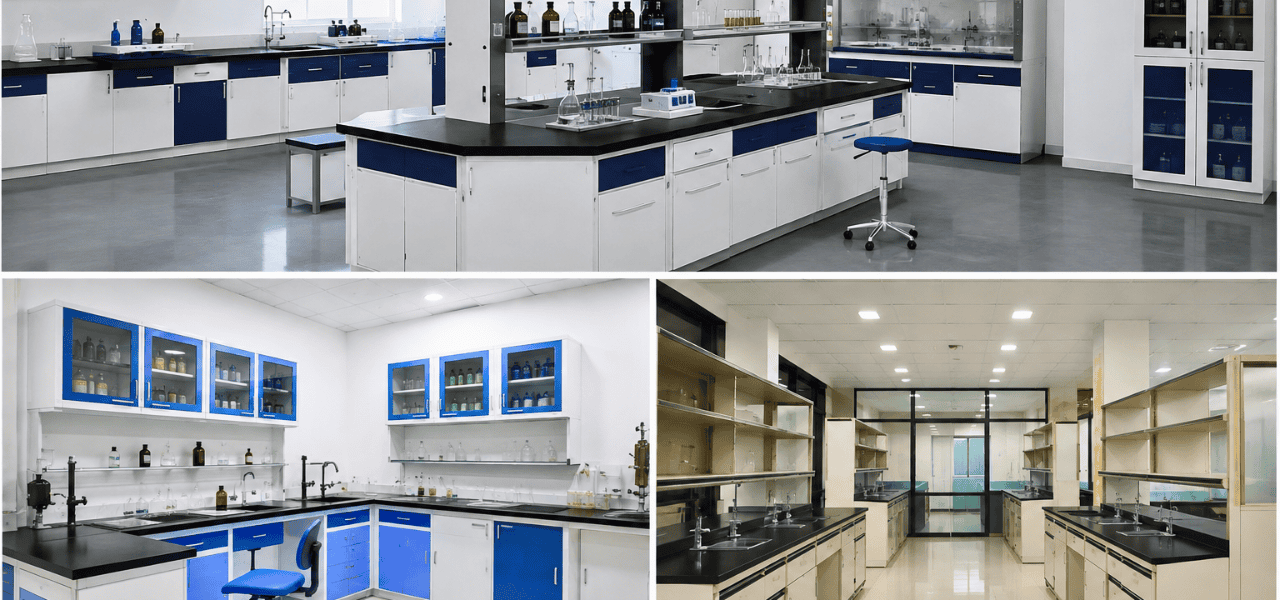
In a pharmaceutical facility, a wrong workstation is not just a design mistake, it can be a regulatory violation. This is a reality that many facility managers, procurement heads, and plant designers discover too late, often during an audit when a non-compliant surface or poorly designed storage unit becomes grounds for an observation or warning.
Furniture in pharmaceutical and laboratory environments is not a commodity procurement decision. It is a compliance decision. Every workbench, storage cabinet, cleanroom trolley, and modular lab workstation must align with applicable regulatory frameworks, GMP guidelines, ISO standards, Schedule M under India’s Drugs and Cosmetics Act, and OSHA-influenced safety norms. Yet across the industry, furniture planning remains one of the most overlooked elements of facility compliance.
This guide is written for facility managers, procurement heads, lab designers, and pharma plant heads who need to understand what pharma furniture must be made of, what standards govern it, and what to demand from a lab furniture manufacturer. We will cover material standards, compliance requirements, cleanroom-specific considerations, and why modular furniture has become the preferred choice for modern pharmaceutical lab design.
Furniture is infrastructure. In pharma, infrastructure is compliance.
Understanding Regulatory Compliance in Pharma & Lab Environments
GMP (Good Manufacturing Practice) Requirements for Lab Furniture
Good Manufacturing Practice guidelines, whether drawn from WHO, US FDA 21 CFR, EU GMP, or India’s Schedule M, are explicit about the standards surfaces and equipment must meet in pharmaceutical production and quality control environments.
GMP mandates that surfaces in contact zones must be non-reactive, non-absorbent, smooth, and easy to clean and disinfect. A porous surface, a joint that traps particulate matter, or a coating that degrades under chemical exposure creates contamination risk. This applies directly to workstation tops, storage unit interiors, shelving, and even chair surfaces in controlled zones.
Beyond surface material, furniture layout and design directly impact contamination control. GMP zoning principles, separating clean zones, grey zones, and black zones, must be supported by furniture configurations that do not disrupt airflow patterns, particularly in HVAC-managed environments. Bench placement, height, and spatial clearance are not aesthetic choices; they are compliance variables.
ISO Standards Applicable to Laboratory Furniture
ISO 9001:2015 is the globally recognised quality management system standard. For lab furniture manufacturers, ISO 9001:2015 certification signals that the organisation follows documented, auditable processes at every stage, from raw material selection and fabrication to delivery and after-sales support. Vlite Furnitech holds ISO 9001:2015 certification, which means the quality of every pharma furniture product is governed by a traceable quality management framework, not by individual workshop decisions.
Relevant laboratory safety design standards, including those governing structural integrity, load ratings, and ergonomic compliance, further define what laboratory furniture must achieve. These are not optional enhancements; they are baseline expectations for laboratory furniture supplied to research, biotech, and pharmaceutical environments.
BIFMA Certification, Why It Matters Even for Lab Settings
BIFMA, the Business and Institutional Furniture Manufacturers Association, sets widely adopted standards for furniture performance, structural safety, and durability. BIFMA certification is often associated with office furniture, but its relevance extends fully into laboratory and pharma settings where modular furniture must bear significant static and dynamic loads from instruments, equipment, chemical containers, and documentation.
BIFMA-certified modular furniture undergoes rigorous testing for load ratings, joint strength, stability under stress, and long-term structural reliability. In a pharmaceutical lab where a workstation may support analytical instruments weighing hundreds of kilograms, BIFMA certification is not a bonus, it is a safety and liability requirement.
Vlite Furnitech’s BIFMA certification is a documented differentiator in the Indian lab furniture market, where many suppliers operate without third-party structural validation.
Indian Regulatory Context, CDSCO & Schedule M Compliance
Schedule M, under the Drugs and Cosmetics Act, 1940, governs GMP requirements for pharmaceutical manufacturers in India. CDSCO (Central Drugs Standard Control Organisation) audits assess not only processes and documentation but also the physical environment, which includes workstations, storage units, and cleanroom furniture.
During pharma facility inspections, auditors examine workstation surface finishes for cleanability, joint design for particulate trapping risk, material certification documentation, and whether furniture layout supports compliant workflow segregation. A missing material certificate or an uncertified surface can generate an observation that delays product approval or triggers a corrective action requirement. Selecting a lab furniture manufacturer that understands Schedule M implications, and can provide material traceability documentation, is part of regulatory risk management.
Material Standards, What Pharma & Lab Furniture Must Be Made Of
Stainless Steel (SS 304 / SS 316), The Gold Standard
Stainless steel is the primary material of choice for GMP compliant lab furniture across pharmaceutical, biotech, and chemical laboratory environments. SS 304 is the most widely deployed grade, offering excellent corrosion resistance, a smooth non-porous surface that meets GMP cleanability requirements, and the structural strength needed for heavy-duty workstation applications.
SS 316 is specified for environments with higher chemical exposure, moisture, or sterility requirements, such as API manufacturing zones, sterile fill-finish areas, and certain analytical chemistry applications. The presence of molybdenum in SS 316 provides superior resistance to chloride-induced corrosion.
Surface finish matters as much as grade. Ra (surface roughness) values must be within specified ranges, typically Ra ≤ 0.8 µm for pharmaceutical contact surfaces, to ensure effective cleaning and prevent microbial adhesion. Weld quality, grinding standards, and passivation treatment are equally important. A poorly welded joint on a stainless steel workstation creates a contamination harbour that no cleaning protocol can reliably address.
Chemical-Resistant Laminates & Surfaces
For analytical laboratories, QC labs, and formulation areas, worktop surfaces must resist acids, alkalis, solvents, heat, and UV exposure. Phenolic resin, epoxy resin, and compact laminate surfaces are the primary options. Phenolic resin tops offer broad chemical resistance and are standard across most QC and analytical benches. Epoxy resin provides superior performance in high-chemical-exposure environments. Compact laminates offer a cost-effective middle ground with good chemical resistance and impact durability.
These materials allow pharma furniture to meet the functional demands of bench-top chemistry without the cost of full stainless steel worktops in every application zone.
Anti-Static & ESD-Safe Materials
Electronics testing laboratories, certain pharmaceutical research environments, and biotech facilities require ESD-safe (Electrostatic Discharge) surfaces to protect sensitive instruments and electronic components. ESD-safe modular furniture incorporates conductive or dissipative surface materials, grounding provisions, and anti-static flooring interfaces. This is a specialised material category, and its requirement must be identified at the design stage.
Powder-Coated Mild Steel, When & Where It’s Appropriate
Powder-coated mild steel offers a cost-effective structural solution for non-critical lab zones, storage areas, documentation rooms, and general-purpose workspaces where chemical exposure and contamination risk are low. However, it is inappropriate for GMP-controlled zones, cleanrooms, or any area subject to regular disinfection with aggressive chemical agents. Vlite Furnitech’s approach is to apply the right material for the right zone, not to up-specify unnecessarily, and critically, not to under-specify where compliance is at stake.
MDF / Engineered Wood, Role in Office-Integrated Lab Spaces
In pharmaceutical facilities, administrative areas, documentation offices, and staff zones connected to laboratory spaces often use engineered wood-based modular furniture. Where specified, Vlite uses low-VOC, LEED-compliant board materials to support green building credentials without compromising indoor air quality, important when lab and office spaces share ventilation systems.
Key Furniture Elements in a Pharma or Laboratory Setup
Lab Workstations & Benches
The workstation is the functional core of any laboratory. Fixed-height benches remain standard in most pharmaceutical QC and production support labs, while height-adjustable options are increasingly specified in R&D environments where researchers work across extended shifts. Under-bench configurations, including drawers, reagent shelving, and enclosed base cabinets, must accommodate the workflow without creating contamination-trapping dead zones. Modular furniture design allows under-bench layouts to be configured and reconfigured as workflow demands evolve.
Fume Hood & Safety Cabinet Integration
Workstation design in pharma environments must accommodate fume hoods and biosafety cabinets as structural and utility-routing considerations, not afterthoughts. Benches adjacent to or supporting fume hoods require reinforced structural frames capable of supporting equipment weight, along with provisions for gas, water, and electrical utilities routed through the bench frame without exposed conduits. Poorly integrated fume hood installations create safety hazards and GMP non-conformances.
Storage Units, Chemical, Sample & Document Storage
Pharmaceutical facilities require a range of compliant storage solutions. Acid and base storage cabinets must provide ventilated separation of incompatible chemical classes. Sample storage requires integration with refrigeration units at defined temperature ranges. Controlled substance storage requires lockable, auditable cabinets that meet regulatory requirements for access control. Modular storage units allow facilities to configure and expand storage as inventory and regulatory requirements change.
Cleanroom Furniture, A Special Category
Cleanroom furniture is a distinct product category governed by airflow, particle generation, and cleanability requirements beyond standard lab furniture norms. Perforated stainless steel shelving supports laminar airflow compliance. Gowning benches, pass-through furniture, and cleanroom trolleys must be designed with minimal particle-shedding joints and fully crevice-free surfaces. Vlite Furnitech supplies cleanroom furniture engineered for ISO-classified cleanroom environments in pharmaceutical, semiconductor, and biotech facilities.
Ergonomics in Lab & Pharma Settings
Ergonomic design in laboratory environments is not a comfort feature, it is a safety and error-reduction strategy. Fatigue-related errors in long laboratory shifts have measurable implications for data integrity and product quality. Adjustable seating, anti-fatigue matting, appropriate monitor positioning, and correctly specified bench heights collectively reduce musculoskeletal strain and maintain operator concentration and precision. Vlite’s product range includes ergonomic chairs, adjustable workstation options, and accessories designed for extended laboratory use.
Modular Furniture, The Future of Pharma Lab Design
The pharmaceutical industry operates under conditions of continuous regulatory evolution, expanding product portfolios, and shifting manufacturing technologies. Laboratory spaces must adapt. Modular furniture meets this requirement in ways that fixed, built-in furniture cannot.
A modular furniture system allows a pharmaceutical facility to reconfigure workstation layouts as workflows change, adding or removing bench sections, repositioning storage units, or expanding a QC laboratory footprint without structural renovation. This reconfigurability is particularly valuable when a facility takes on a new product line, upgrades analytical instrumentation, or undergoes an expansion to meet increased production demand.
Installation speed is a further advantage. Modular furniture systems are fabricated off-site and installed with minimal disruption to ongoing operations, critical in pharmaceutical facilities where downtime carries significant cost. Modular systems also offer scalability without the lead time and capital expenditure of a full fit-out.
Vlite Furnitech manufactures modular furniture at a capacity of 14,000 workstations per month from its 30,000 sq. ft. facility in Navi Mumbai, with the capability to deliver custom configurations engineered to project-specific compliance and dimensional requirements. This scale allows Vlite to support large pharmaceutical greenfield projects, facility upgrades, and multi-site rollouts with consistent quality and controlled lead times.
Why Choosing the Right Lab Furniture Manufacturer Is a Strategic Decision
The choice of lab furniture manufacturer is not a procurement formality. It is a decision that directly affects regulatory compliance, operational continuity, and total cost of facility ownership.
A supplier without certified quality systems, without material traceability documentation, and without direct pharma project experience introduces compliance risk into your facility before the first audit observation is ever raised. An audit failure caused by non-compliant furniture is not just a quality event, it is a business interruption with regulatory and reputational consequences.
Total cost of ownership matters more than purchase price for pharma furniture. A lower-cost workstation that corrodes, delaminates, or fails structurally within three to five years of installation costs more, in downtime, replacement procurement, and compliance remediation, than a BIFMA-certified, ISO-manufactured alternative. Durability, warranty coverage, and after-sales support are economic variables, not afterthoughts.
Large pharmaceutical setups also require project management capability from their lab furniture manufacturer. Coordinated delivery, sequenced installation, and compliance documentation handover across multi-room or multi-building projects require supplier capability that goes far beyond workshop production.
Vlite Furnitech operates pan-India branches in Mumbai, Pune, Ahmedabad, Surat, and Hyderabad, with international project reach, providing the project coordination and on-site support capability that pharmaceutical and laboratory clients require.
Questions to Ask Your Lab Furniture Manufacturer
Before awarding a pharma furniture contract, procurement and facility teams should ask:
Are you ISO 9001:2015 certified, and can you provide the certificate for verification? Do you hold BIFMA certification for structural performance standards? Can you supply GMP compliant stainless steel furniture with material mill certificates and surface finish documentation? Do you offer post-installation support, warranty coverage, and customisation capability for future reconfigurations? What is your project lead time, and do you have a dedicated project management process for multi-phase installations?
Suppliers who cannot answer these questions with documentation, not just verbal assurance, represent a compliance risk you should not absorb.
Vlite Furnitech, Pharma & Lab Furniture You Can Depend On
Vlite Furnitech is a certified lab furniture manufacturer headquartered in Navi Mumbai, serving pharmaceutical, biotech, research, and industrial laboratory clients across India and internationally. The company holds ISO 9001:2015 and BIFMA certifications and manufactures to LEED-compliant standards where green building credentials are required by the project.
Operating from a 30,000 sq. ft. manufacturing facility equipped with advanced fabrication machinery, Vlite produces modular furniture, stainless steel pharma workstations, cleanroom furniture, fume hood benches, and laboratory storage solutions at the scale and quality consistency that large pharmaceutical projects demand.
Vlite’s design team works directly with facility managers, lab designers, and procurement heads to develop custom pharma furniture solutions, from initial space planning and material specification through to fabrication, installation, and compliance documentation handover.
Explore Vlite Furnitech’s pharma furniture solutions or request a consultation with our design team to begin your project.
Still comparing modular, bespoke, and traditional office furniture?
Let Vlite Furnitech LLP help you choose the smartest investment for better ROI.
Frequently Asked Questions
Q1: What material is best for pharma lab furniture?
SS 304 stainless steel is the preferred material for GMP-controlled zones due to its non-porous surface, corrosion resistance, and cleanability. SS 316 is specified for high-chemical-exposure or sterile environments. Chemical-resistant phenolic or epoxy resin tops are standard for analytical and QC benches.
Q2: Is modular furniture suitable for cleanroom environments?
Yes, when designed with appropriate materials such as stainless steel and perforated surfaces, and fabricated with minimal particle-shedding joints, modular furniture performs effectively in ISO-classified cleanroom environments.
Q3: What certifications should a lab furniture manufacturer hold?
ISO 9001:2015 certification for quality management systems, BIFMA certification for structural performance, and demonstrated experience with GMP-compliant projects are the minimum credibility benchmarks to verify.
Q4: How does pharma furniture differ from regular office furniture?
Pharma furniture uses non-porous, chemically resistant, easily sanitisable materials and must comply with GMP requirements, Schedule M provisions, and often cleanroom classification standards. Standard office modular furniture does not meet these requirements and should never be specified for GMP-controlled environments.
Q5: Can Vlite Furnitech customise lab furniture for specific project requirements?
Yes. Vlite’s design and engineering team works with clients to deliver fully customised modular furniture solutions, from material selection and dimensional configuration through to utility integration and compliance documentation, for pharmaceutical, biotech, and research laboratory environments.
Conclusion
Pharma and laboratory furniture is a compliance discipline, not an interior design decision. The combination of correct material specification, adherence to GMP and ISO standards, BIFMA-certified structural performance, and a lab furniture manufacturer with documented quality systems determines whether your facility supports or undermines its regulatory standing.
Facilities that treat furniture as a residual procurement item, selected after the critical decisions are made, expose themselves to audit risk, operational disruption, and avoidable capital replacement costs. Facilities that approach it as infrastructure investment, with the same rigour applied to equipment and process design, build compliance resilience into their physical environment from the ground up.
Vlite Furnitech brings together manufacturing scale, certified quality systems, pharma-specific design expertise, and pan-India project management capability to serve as a compliance partner, not just a furniture supplier, for pharmaceutical, biotech, and laboratory clients.
Planning a pharma lab or upgrading an existing facility? Contact Vlite Furnitech for a free consultation and a custom modular furniture proposal tailored to your compliance requirements and operational footprint.

Vishnu Sharma
I am the co-founder and CEO of Vlite Furnitech, creating modular office solutions since 2009. With a background in Chemistry and Marketing, and experience as Regional Head at Featherlite, I help design ergonomic, adaptable, and sustainable workspaces. Alongside a team of 120+, we serve corporates like JCB, Just Dial, KFC, and educational institutions. Let’s connect to reimagine innovative, eco-friendly office environments.