Walk into any rapidly growing Indian startup or a newly leased corporate floor in Bangalore or Mumbai, and you will almost certainly spot the same problem: desks crammed together with barely enough room to pull out a chair, employees hunching over surfaces that are either too shallow to fit a monitor properly or so wide they waste half the space. According to industry surveys, over 60% of Indian office workers report chronic neck or back discomfort, and a significant share of those cases trace directly to poorly sized workstations rather than poor posture alone.
Office workstation dimensions are not simply about fitting furniture into a room. They determine how comfortably a person can work for eight or more hours, how efficiently a floor plan uses expensive real estate, and how easily a company can scale its seating without a complete redesign. When we talk about workstation dimensions, we are referring to four interconnected measurements: the width of the desk surface (the horizontal span), the depth (front to back), the height (floor to desk surface), and the leg clearance underneath. For open-plan and cubicle environments, partition or screen height becomes a fifth critical variable.
This guide walks you through standard workstation sizes used across Indian offices, expressed in millimetres for precision, covers every major workstation type, explains Indian space planning norms, addresses ergonomics for the average Indian user, and gives you a practical decision framework so you can get the dimensions right before a single piece of furniture is ordered.
Understanding Workstation Components and What to Measure
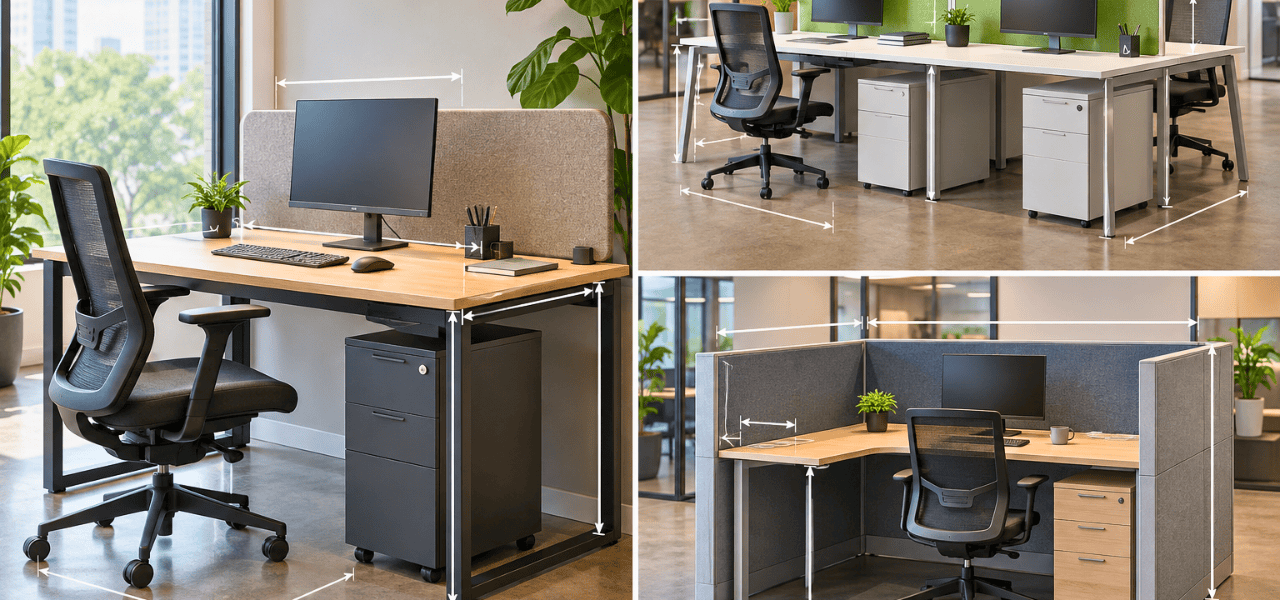
Key Dimensions You Must Know
Before looking at any size table, it helps to understand exactly what each measurement means and why it matters in practice.
Width is the horizontal span of the desk surface from left to right when you are seated. A width that is too narrow forces monitors and keyboards into uncomfortable positions. Too wide, and you are paying for surface area no one uses.
Depth is the front-to-back measurement, essentially how far the desk extends away from you. Depth determines whether a monitor can sit at the recommended 500–700 mm distance from your eyes, whether there is room for paperwork alongside a screen, and whether you can rest your forearms comfortably on the surface while typing.
Height is the distance from the floor to the desk surface. Standard fixed-height desks in India sit at 720–760 mm, which suits the average Indian adult when paired with a properly adjusted chair. Height-adjustable or sit-stand desks offer a broader range, typically 650–1250 mm.
Leg clearance is the unobstructed space beneath the desk surface. A minimum of 650 mm clearance is required for comfortable seated leg movement, and this measurement is frequently neglected when comparing workstation specifications.
Partition or screen height matters in open-plan layouts. Screens in the 600–900 mm range encourage collaboration while offering a degree of visual separation. Screens at 1200–1500 mm provide genuine acoustic and privacy benefits for focused work or sensitive roles.
Understanding workstation width and depth together, as a paired measurement, is the most reliable way to evaluate whether a desk will actually serve its user, rather than simply fitting on a floor plan.
Standard Workstation Size in India (in mm)
The table below reflects workstation size in mm as used across Indian corporate, BPO, and institutional environments, aligned with ergonomic guidelines and typical Indian office space planning norms.
| Workstation Type | Width (mm) | Depth (mm) | Height (mm) |
| Single Seater (Standard) | 1200–1500 | 600–750 | 720–760 |
| Linear Workstation | 1200–1800 | 600–750 | 720–760 |
| L-Shaped Workstation | 1500–1800 | 750–900 | 720–760 |
| Executive / Manager Desk | 1800–2400 | 900–1200 | 720–760 |
| Call Centre / BPO Workstation | 900–1200 | 500–600 | 720–760 |
| Cluster / Pod Workstation (4-seater) | 2400–3000 | 1200–1500 | 720–760 |
These are the office desk dimensions India’s leading furniture manufacturers and corporate interior designers work with as baselines. Your specific configuration may vary depending on role requirements, available floor area, and whether you opt for fixed or modular furniture.
Types of Office Workstations and Their Ideal Dimensions
Linear or Straight Workstations
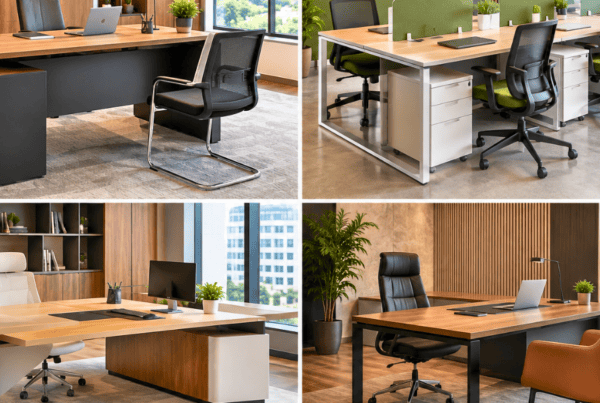
The linear workstation is the most common configuration in Indian offices, particularly in call centres, BPO facilities, technology firms, and any environment where large numbers of employees perform similar tasks side by side. The desk surface is a single straight rectangle, and multiple units are arranged end to end along a shared spine or panel system.
Standard dimensions in India run from 1200 mm to 1800 mm in width and 600 mm to 750 mm in depth. For BPO and call centre environments, the lower end of this range, around 1200 mm wide and 600 mm deep, is typical, as agents primarily need space for a monitor, keyboard, and headset rather than physical documents.
From a space planning perspective, linear workstation desking should account for a minimum of 4 to 6 square feet of desk surface per person, with total circulation and personal space bringing the per-person area to roughly 50 square feet in a standard corporate setting.
Vlite Furnitech’s linear workstation range spans this full dimension spectrum and is available in laminate finishes suited to both high-density BPO floors and more refined corporate environments.
L-Shaped Workstations
The L-shaped workstation extends the desk surface around a corner, creating two usable work zones from a single station. This configuration is particularly well suited to designers, software developers, finance professionals, architects, and anyone who regularly operates two monitors or needs simultaneous access to a screen and physical reference materials.
Standard L-shaped workstation dimensions in India range from 1500 mm to 1800 mm along the primary arm and 750 mm to 900 mm in depth. The secondary return arm typically measures 900 mm to 1200 mm in length. Corner radius or junction design varies, a gently curved corner panel is generally more ergonomic than a sharp 90-degree join, as it keeps frequently used items within comfortable arm’s reach.
One space planning consideration unique to L-shaped units is that they require a roughly square floor zone per seat rather than a long rectangular strip. This makes them better suited to private offices and smaller team clusters than to high-density open floors.
Cluster or Pod Workstations
Cluster workstations, also called pod workstations, are the dominant configuration in Indian corporate offices today. Four, six, or eight desks are arranged around a shared central spine, separated by low or mid-height screens, with cable management running through the central channel.
Dimensions for a standard four-seater cluster run from 2400 mm to 3000 mm in width and 1200 mm to 1500 mm in depth across the full pod footprint. Each individual bay within the cluster typically measures 1200 mm to 1500 mm wide and 600 mm to 750 mm deep, consistent with single-seater standards.
Partition heights in cluster configurations are a critical decision. Screens at 900 mm to 1050 mm height offer visual privacy without isolating employees, which suits collaborative teams. Screens at 1200 mm to 1500 mm are better for roles requiring concentration or confidentiality, such as finance, legal, or HR functions.
Aisle clearance between clusters is equally important for office workspace tables of this type. Primary aisles, those used as main circulation routes, should be a minimum of 1200 mm to 1500 mm wide. Secondary aisles between rows of clusters should maintain at least 900 mm to 1000 mm to allow comfortable passage and chair pullout without obstruction.
Executive or Manager Workstations
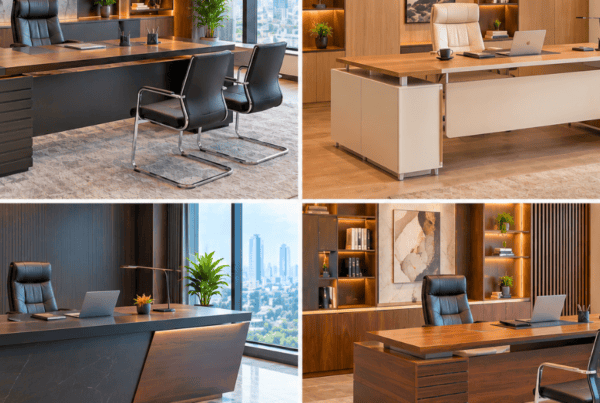
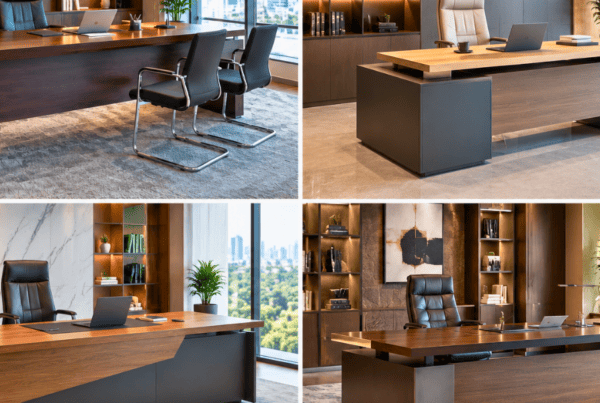
Executive tables occupy a different category from standard workstations. They are typically freestanding rather than panel-hung, significantly wider and deeper, and finished to a higher material and aesthetic standard. The extra surface area accommodates meetings across the desk, multiple screens, and the kind of document-heavy work that senior roles involve.
In India, standard executive table dimensions run from 1800 mm to 2400 mm in width and 900 mm to 1200 mm in depth. Many executive configurations include a return unit, a side extension that creates an L-shape, measuring 900 mm to 1200 mm in length. Modesty panels (solid front panels that conceal the leg zone from visitors seated across the desk) are standard in this category.
Height remains consistent at 720–760 mm unless a sit-stand mechanism is specified. The deeper surface of executive tables also means that monitor positioning becomes more important: a screen placed at the far end of a 1200 mm deep desk may sit too far from the user’s eyes, so monitor arms are frequently used in these configurations.
Indian Office Space Planning, How to Calculate Workstation Layout
One of the most common planning errors in Indian offices is purchasing workstations before calculating how many will actually fit in the available space with adequate circulation. The math is straightforward, but it requires accounting for more than just the desk footprints.
The average recommended space per employee in India is 50 to 75 square feet for standard corporate environments. High-density BPO and call centre operations work with 35 to 50 square feet per person. These figures include the workstation footprint, chair pullout space, and a proportional share of aisle and circulation area.
A simple formula: take your usable floor area in square feet, subtract fixed elements like columns, reception counters, server rooms, and meeting zones, then divide the net workable area by your target square footage per person.
For example, a 1,000 square foot open floor with 150 square feet of fixed elements leaves 850 square feet of net workable area. At 50 square feet per person, that floor supports approximately 17 workstations comfortably, not 20, which you might assume from the gross area alone.
Primary aisles should run at 1200 mm to 1500 mm width wherever people regularly walk between zones. Secondary aisles between rows need at least 900 mm. Both measurements should be validated on a scaled floor plan before finalising furniture orders. Vlite Furnitech’s project management team regularly provides complimentary space planning support for commercial projects, translating floor plans into optimised workstation layouts before manufacturing begins.
Ergonomic Considerations for Indian Users
India-specific ergonomics matter because most global furniture standards are calibrated against average Western body dimensions. The average Indian male height is approximately 165 cm (5 feet 5 inches), and the average Indian female height is approximately 152 cm (5 feet). This is meaningfully shorter than the 175–180 cm averages used in many European and American ergonomic standards.
In practical terms, this means that the standard Indian desk height range of 720–760 mm is already well calibrated. However, it also means that seat-height adjustability on chairs becomes more critical: a desk at 750 mm paired with a chair that cannot adjust low enough will leave shorter users working with elevated shoulders, which is a direct cause of neck and upper back fatigue.
The relationship between desk height and chair height determines whether your forearms are parallel to the floor when typing, the correct ergonomic position. Ideal monitor distance from the front edge of the workstation is 500 mm to 700 mm, which is why workstation depth matters so directly to eye comfort.
Under-desk leg clearance should be a minimum of 650 mm in height and 600 mm in width to allow comfortable leg movement throughout the day. When keyboard trays are specified, which can help with ergonomics in shallow-depth workstations, they typically extend 150 mm to 200 mm below the desk surface and reduce the available leg clearance zone accordingly, so this trade-off must be evaluated case by case.
BIFMA (Business and Institutional Furniture Manufacturers Association) certification is the most recognised international standard for office furniture performance and ergonomics. Vlite Furnitech’s workstations carry BIFMA certification, which provides an independent assurance that the products meet tested durability and ergonomic performance criteria, important for procurement teams managing health, safety, and compliance requirements.
Customisation, When Standard Sizes Don’t Work
Not every office floor is a clean rectangle. Column grids, curved walls, recessed windows, and irregular boundaries are common in older commercial buildings across Indian cities. In these situations, standard workstation dimensions simply do not fit cleanly, and forcing them results in wasted corners, awkward gaps, or compressed aisles.
When specifying custom-sized workstations, the details you need to provide to a manufacturer include: the exact usable width per bay, required depth, desk height (fixed or adjustable range), partition height, partition material, cable management requirements, and any modesty panel or return unit specifications. Edge treatments, grommets, and finish selections should also be confirmed at this stage.
Modular workstation systems offer a significant advantage over fixed furniture in this context. Modular components, individual desk panels, connectors, screens, and storage units, can be reconfigured as your team grows or your floor plan changes, without replacing the entire furniture investment. For companies projecting headcount growth over 12 to 24 months, this flexibility often justifies a modest premium over fixed alternatives.
Vlite Furnitech manufactures approximately 14,000 workstations per month from its production facility, with a dedicated custom design team capable of handling non-standard dimensions, unusual material combinations, and branded finish requirements for large commercial projects.
Material and Build Considerations That Affect Effective Dimensions
The material specifications of a workstation affect not just its appearance and durability, but its actual usable surface dimensions.
Pre-laminated particle board (PLPB) is the most widely used core material in Indian office workstations. It offers a good balance of stability, finish quality, and cost. MDF (medium-density fibreboard) provides a smoother edge finish and is often used for premium laminate or paint finishes. Solid wood is used in high-end executive-table applications. Each material comes in standard board thicknesses, typically 18 mm or 25 mm, and this thickness is included within the overall desk dimensions quoted by manufacturers.
Edge banding, the strip of material applied to the exposed edges of the board, adds a small amount of thickness on each edge, typically 1–2 mm, which is negligible for most planning purposes. However, grommet holes (the circular cable management openings cut into the desk surface) do reduce the effective usable surface area, particularly on desks with heavy cable loads. Grommets are typically 60 mm to 80 mm in diameter and positioned toward the rear of the desk surface.
Partition materials used in workstation desking include fabric-wrapped panels, glass panels, and acrylic inserts. Fabric panels in the 1200–1500 mm height range are standard for privacy-focused configurations and also offer modest acoustic dampening. Glass and acrylic panels in the 600–900 mm range are used where a more open, collaborative aesthetic is desired, though they offer limited acoustic benefit.
How to Choose the Right Workstation Size for Your Office in India
The following framework gives you a structured way to move from empty floor plan to confirmed workstation specification.
Step one: Measure your floor plan accurately, not just the gross area, but the net usable area after accounting for fixed elements, columns, and fire egress requirements.
Step two: Confirm your current headcount and your realistic 12-month growth projection. Design for where you will be in a year, not where you are today.
Step three: Map role-based needs across your team. Individual contributors doing screen-based work need different surfaces from managers who hold desk-side meetings, or creative professionals who work with large-format materials.
Step four: Select workstation type, linear, L-shaped, cluster, or executive, based on role requirements and floor plan geometry.
Step five: Select final dimensions with clearance buffers built in. Apply the aisle width standards (1200–1500 mm primary, 900–1000 mm secondary) before locking in how many units fit.
Step six: Get a scaled layout from your furniture partner before placing any order. A scaled floor plan with workstations, aisles, and storage annotated will surface conflicts early and save significant cost and delay later.
Vlite Furnitech’s design team offers complimentary space planning support for commercial projects, contact them to turn your floor dimensions and headcount into a ready-to-execute layout.
Still comparing modular, bespoke, and traditional office furniture?
Let Vlite Furnitech LLP help you choose the smartest investment for better ROI.
Frequently Asked Questions
What is the standard workstation size in India?
The standard single-seater workstation in India measures 1200 mm in width, 600 mm in depth, and 720–760 mm in height. Larger roles or dual-monitor setups typically use 1500 mm width and 750 mm depth.
What is the minimum workstation size for a call centre in India?
BPO and call centre workstations typically run 900–1200 mm wide and 500–600 mm deep, prioritising seating density while maintaining functional ergonomic minimums.
What is the standard desk height in India?
720–760 mm, which corresponds to approximately 29–30 inches and is calibrated to the average Indian user’s seated working height.
How much space does each employee need at a workstation?
The desk surface itself occupies 4–6 square feet, but the total recommended per-person area, including aisle and circulation, is 50–75 square feet in standard corporate environments.
What is the difference between a workstation and an executive table?
Workstations are modular, space-efficient units designed for general staff, typically 1200–1500 mm wide. Executive tables are larger (1800–2400 mm wide), freestanding, deeper, and finished to a higher specification, often with return units, modesty panels, and premium laminates or veneer.
Can workstation dimensions be customised in India?
Yes. Manufacturers like Vlite Furnitech offer fully customised office workstation dimensions to accommodate non-standard floor plans, specific ergonomic requirements, or unique brand aesthetics.
Get the Dimensions Right from Day One
Workstation dimension planning is not a detail to resolve after leasing a floor or finalising a headcount. It is the foundation on which every other office design decision rests. A desk that is 150 mm too shallow puts your team’s monitors in the wrong position for eight hours a day. A cluster that is 200 mm wider than your aisle clearance allows blocks emergency egress and creates daily frustration.
The standard office workstation dimensions in India, 1200–1500 mm wide, 600–750 mm deep, 720–760 mm high for a standard seat, give you a reliable starting point. But the right dimensions for your office depend on your roles, your floor plan, your headcount trajectory, and how you balance density with the comfort your team needs to perform at their best.
Vlite Furnitech brings BIFMA certification, ISO 9001:2015 quality management, and a manufacturing capacity of 14,000 workstations per month to commercial projects across India, with branches in Mumbai, Pune, Ahmedabad, Surat, and Hyderabad. Planning a new office or expanding your current workspace? Consult with Vlite Furnitech’s expert design team for a customised workstation layout built to Indian standards and delivered on time.

Vishnu Sharma
I am the co-founder and CEO of Vlite Furnitech, creating modular office solutions since 2009. With a background in Chemistry and Marketing, and experience as Regional Head at Featherlite, I help design ergonomic, adaptable, and sustainable workspaces. Alongside a team of 120+, we serve corporates like JCB, Just Dial, KFC, and educational institutions. Let’s connect to reimagine innovative, eco-friendly office environments.