Furniture costs for an office fit-out rarely come with a straight answer. Ask five vendors what a workstation costs and you’ll get five different numbers, not because anyone’s lying, but because the price depends on board material, partition height, chair mechanism, city, and how much customization you ask for. Regional variation alone can swing per-seat costs by 30-40%, and vendor markups on “premium” imports add another layer of confusion.
This guide breaks down real 2026 per-seat and per-project modular office furniture costs in India, organized by product category and material spec, so you can budget with confidence instead of guesswork. The numbers come from current Indian market data across entry, standard, mid-range, and premium segments.
The perspective here comes from Vlite Furnitech, a modular office furniture manufacturer running a 30,000 sq. ft. facility in Patalganga, Navi Mumbai, with a production capacity of 14,000 workstations a month, branches across Mumbai, Pune, Ahmedabad, Surat, and Hyderabad, and BIFMA, ISO 9001:2015, and LEED-aligned credentials, the kind of verifiable manufacturing scale that most cost guides skip entirely.
What Determines Modular Office Furniture Cost
Before comparing numbers, it helps to understand why they vary so much in the first place. Six factors drive the bulk of the difference between a ₹4,000 workstation and a ₹35,000 one.
Material Grade
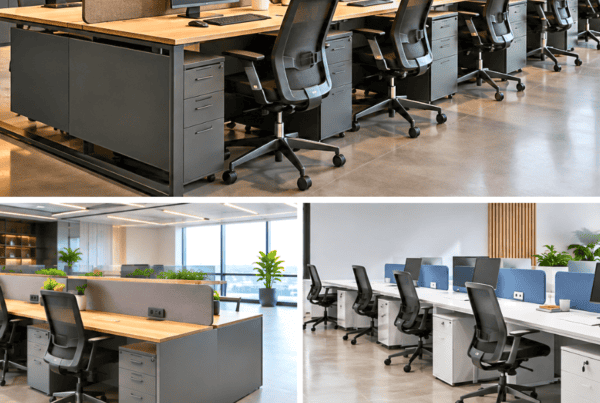
Board thickness and type are the single biggest lever on price. Entry-level setups typically use 18mm pre-laminated particle board, while mid-range and premium ranges move to 25mm boards or HDHMR (High-Density HDF) for better load-bearing strength and moisture resistance. MDF sits in between on cost and durability, while BWP (Boiling Water Proof) ply commands a premium for high-moisture or high-traffic environments. Laminate quality, textured, high-gloss, or anti-scratch finishes, adds further variation.
Workstation Configuration
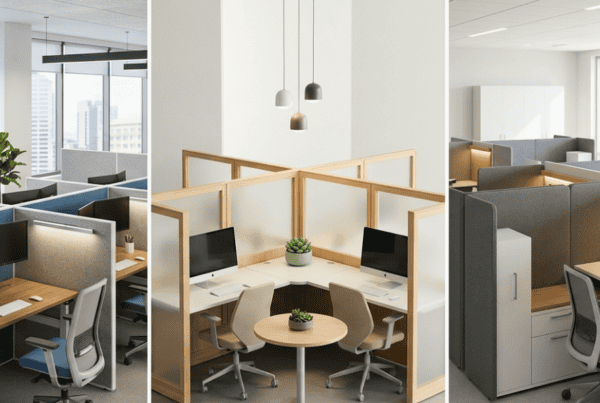
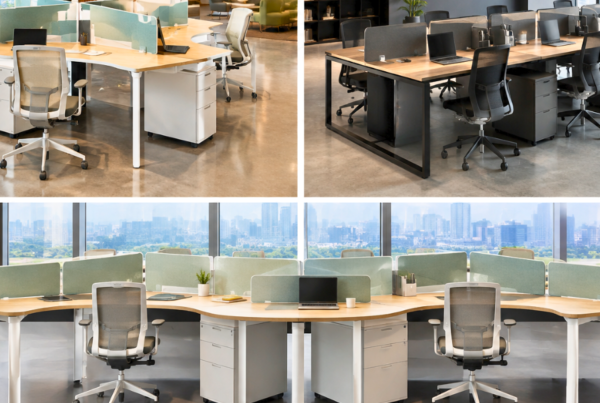
A simple linear bench-style desk costs less than an L-shaped or cluster/cubicle configuration, mainly because of the extra panels, joinery, and partitions involved. Partition height also matters: low screens (under 3 feet) are cheaper than acoustic-rated panels at desk-plus-privacy height. Built-in cable management, trays, grommets, raceways, adds a modest but real cost per seat.
Ergonomic Features
Chair mechanisms are a major cost driver on their own. A fixed-back task chair costs far less than one with synchro-tilt, adjustable lumbar support, 4D armrests, and seat-depth adjustment. The same logic applies to desks: manual height-adjustable frames sit well below electric sit-stand mechanisms.
Customization vs. Standard Modular Ranges
Off-the-shelf modular ranges are priced for volume and repeatability. Fully custom dimensions, finishes, or branding-matched color schemes require new tooling or manual adjustment, which raises both cost and lead time. Most offices don’t need full customization, a well-chosen standard range covers 80-90% of layout needs.
Installation, Delivery, and After-Sales Service
Delivery and installation are sometimes bundled into per-seat pricing and sometimes billed separately, always confirm which. After-sales service (warranty coverage, reconfiguration support, replacement parts) is harder to price directly but affects total cost of ownership significantly over a 5-7 year furniture lifecycle.
Modular Office Furniture Price Breakdown (2026)
Here’s how 2026 Indian market pricing breaks down by category. These are general market ranges for orientation, actual project pricing depends on the factors above and should come from a vendor-specific quote.
| Category | Price Range (₹) | Notes |
| Entry/basic modular workstation | 3,500 – 8,000 per seat | 18mm particle board, basic laminate, linear layout |
| Standard modular workstation | 8,000 – 15,000 per seat | Better laminate, moderate partition height, cable management |
| Mid-range ergonomic workstation | 15,000 – 30,000 per seat | HDHMR/25mm board, improved ergonomics, cluster layouts |
| Premium/imported ergonomic system | 30,000 – 60,000+ per seat | Imported mechanisms, high-end finishes, full customization |
| Ergonomic task chair (standalone) | 5,000 – 15,000 per unit | Ranges from fixed-back to full synchro-tilt mechanisms |
| Storage units (pedestal/cabinet) | 4,000 – 12,000 per unit | Varies by material and locking mechanism |
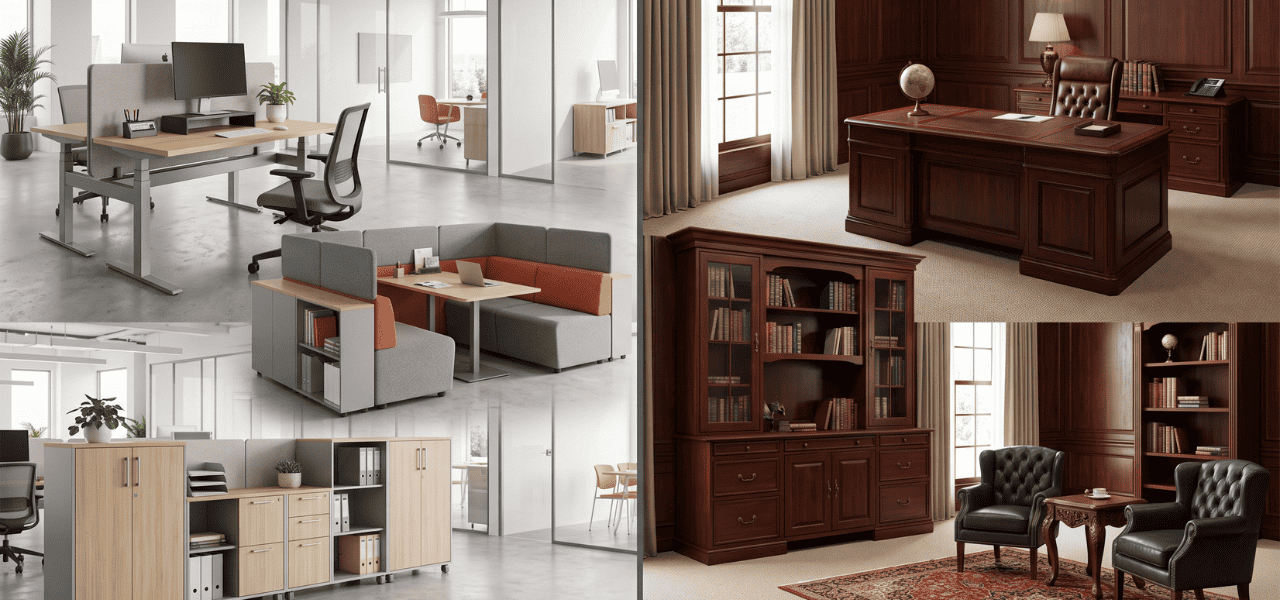
| Cabin/executive tables | 15,000 – 45,000 per unit | Depends on size, finish, and cable management |
| Conference tables | 25,000 – 1,00,000+ per unit | Scales with seating capacity and finish grade |
| Lounge/breakout furniture | 8,000 – 30,000 per seat | Soft seating, informal collaboration zones |
| Reception furniture | 20,000 – 80,000+ per set | Front desk, waiting seating, brand-finish elements |
| Full per-seat budget (workstation + proportional meeting/reception share) | 30,000 – 53,000 per seat | Blended figure for full-office planning |
Workstation desking accounts for the largest share of most office furniture budgets, since it scales directly with headcount, so it’s worth spending the most time getting this category right before moving to shared spaces.
Cost Per Seat vs. Total Project Cost, How to Budget
Total project cost is useful for approving a budget, but “cost per seat” (or cost per employee) is the more practical planning heuristic, it lets you scale the number up or down as headcount projections shift, and it’s the number most facility teams use when comparing vendor quotes apples-to-apples.
Worked example: 50-seat office
- 50 workstations at a standard/mid-range blend (₹12,000 average) = ₹6,00,000
- 50 ergonomic chairs (₹8,000 average) = ₹4,00,000
- Proportional share of meeting room, reception, and storage furniture (roughly 15-20% of workstation + chair cost) = ₹1,50,000 – 2,00,000
- Estimated total: ₹11,50,000 – 12,00,000, or roughly ₹23,000 – 24,000 per seat
This lands within the ₹30,000-53,000 full per-seat budget range once fit-out extras (electrical, IT infrastructure, design fees) are added on top of pure furniture cost.
A simple budgeting formula many procurement teams use for the full fit-out, not just furniture:
Total Budget = (Carpet Area × Fit-out Rate) + Design Fee + IT/Security Costs + 15% Contingency
Fit-out rates across Indian cities currently range from roughly ₹800 to ₹5,000 per sq. ft. depending on city tier, finish level, and whether the shell is bare or warm.
Modular vs. Carpenter-Made (Site-Built) Furniture, Cost & Time
This comparison is where a lot of buyers underestimate the real cost gap, because carpenter-made furniture looks cheaper on the initial quote but often isn’t once the full timeline and hidden costs are counted.
| Factor | Modular Furniture | Carpenter-Made (Site-Built) |
| Upfront cost | Slightly higher per unit | Appears lower initially |
| Installation timeline | Days to 2-3 weeks for most offices | Often 6-10+ weeks depending on scale |
| Quality consistency | Factory-tested, uniform across units | Varies by carpenter skill and site conditions |
| Reconfigurability | Designed for reuse/relayout | Often needs rebuilding for layout changes |
| VOC/emissions | Lower, factory-controlled finishing | Higher, on-site adhesives and paint |
| Hidden costs | Minimal | Rent paid during extended fabrication, labor overheads, rework |
The hidden-cost angle is the one competitors’ articles often gloss over: if a carpenter-built fit-out takes 8 extra weeks longer than a modular one, and the office is paying rent on an empty space during that time, that “savings” from the lower initial quote can be wiped out by rent paid with no productive use of the space. Add in variable labor overheads and higher VOC emissions from on-site finishing, and modular comes out ahead on total cost of ownership for most Indian offices in 2026, not just on paper cost, but on real cash outflow.
How Vlite Furnitech’s Manufacturing Scale Affects Your Cost
Manufacturing scale is one of the least-discussed factors in office furniture pricing, even though it directly affects what a buyer pays. Vlite Furnitech’s 30,000 sq. ft. Patalganga facility, with a production capacity of 14,000 workstations per month, allows raw material to be bought and processed at volumes that bring per-seat costs down on bulk and enterprise orders, without the quality trade-offs that often come with smaller, lower-capacity manufacturers trying to compete on price.
Beyond the factory floor, a dedicated project management team and a branch network spanning Mumbai, Pune, Ahmedabad, Surat, and Hyderabad reduce logistics costs and delivery timelines for large or multi-city rollouts. For a company opening offices in more than one of these cities, that regional presence can mean the difference between a single coordinated installation and several fragmented, higher-cost local vendor engagements.
When evaluating any supplier, not just Vlite, buyers should look for verifiable quality and sustainability assurances: BIFMA certification (structural and safety standards), ISO 9001:2015 (quality management systems), and LEED-aligned manufacturing (environmental compliance). These aren’t just badges; they indicate a manufacturer has the systems in place to deliver consistent quality at scale, which matters more as order size grows.
5 Ways to Reduce Modular Office Furniture Costs Without Cutting Quality
- Standardize workstation sizes across floors. Repeating the same dimensions across every floor reduces custom cutting, simplifies installation, and often qualifies for better bulk pricing than mixed configurations.
- Phase furniture procurement. For offices scaling headcount over 12-18 months, ordering in phases tied to actual hiring can avoid over-purchasing while still locking in negotiated rates for later phases.
- Negotiate bulk or annual rate contracts. Committing to a full-year or multi-location order with one supplier typically unlocks better per-seat pricing than one-off purchases spread across vendors.
- Choose modular over full-custom wherever layout allows. Custom tooling and one-off finishes carry a real cost premium; a well-selected standard modular range covers most layout needs at a fraction of custom pricing.
- Plan furniture and civil/electrical work in parallel. Coordinating furniture delivery with electrical and IT infrastructure work, rather than sequencing them, shortens total fit-out time and reduces the rent-paid-on-empty-space cost mentioned earlier.
Choosing the Right Modular Office Furniture Supplier in India
A useful checklist for shortlisting suppliers:
- Manufacturing capability and capacity, can they handle your order size and timeline without subcontracting critical stages?
- Certifications, BIFMA, ISO 9001:2015, and LEED-aligned facilities as baseline quality and sustainability signals.
- Material transparency, board thickness and grade specified in writing (18mm vs 25mm, particle board vs HDHMR vs MDF vs BWP ply), not left vague in the quote.
- Pan-India delivery and installation network, relevant if you’re opening offices in more than one city.
- After-sales and project management support, warranty terms, reconfiguration support, and a named point of contact post-installation.
- Portfolio across sectors, experience with offices similar in scale and industry to yours.
Want office furniture that reduces long-term costs without compromising quality?
Trust Vlite Furnitech LLP for cost-effective workspace solutions built to last.
FAQs
What is the average cost of a modular workstation in India?
In 2026, a basic modular workstation typically costs ₹3,500-8,000 per seat, standard configurations run ₹8,000-15,000, and mid-range ergonomic setups fall between ₹15,000-30,000. Premium or imported systems can exceed ₹60,000 per seat depending on material and customization.
Is modular office furniture cheaper than carpenter-made furniture?
On total cost of ownership, modular furniture is usually the more economical choice, even though the upfront per-unit price can look higher. Faster installation timelines reduce rent paid on unused space, and factory-consistent quality avoids rework costs common with site-built furniture.
What affects office chair pricing the most?
Chair pricing is driven primarily by the mechanism, a basic fixed-back chair costs far less than one with synchro-tilt, adjustable lumbar support, and 4D armrests. Material quality (mesh vs. fabric vs. leatherette) and warranty terms also factor into the final price.
How much should a 50-seat office furniture budget be?
A 50-seat office typically needs a furniture budget in the ₹11-15 lakh range for workstations, chairs, and a proportional share of shared spaces like meeting rooms and reception. This works out to roughly ₹23,000-30,000 per seat before accounting for broader fit-out costs like electrical and IT infrastructure.
Do modular furniture manufacturers offer bulk or corporate pricing?
Yes, most established manufacturers offer better per-seat rates for bulk orders, annual rate contracts, or multi-location rollouts. Manufacturers with their own production facilities, rather than resellers, are generally better positioned to offer meaningful bulk discounts without compromising material quality.
What’s the difference between HDHMR, MDF, and BWP ply for office furniture?
HDHMR (High-Density HDF) offers strong load-bearing capacity and moisture resistance, making it a common choice for mid-range and premium workstations. MDF is a mid-tier option balancing cost and durability, while BWP (Boiling Water Proof) ply is used where high moisture resistance is critical, typically at a higher price point.
Conclusion
Modular office furniture cost in India in 2026 comes down to a handful of clear drivers: material grade, workstation configuration, ergonomic features, and how much customization is involved. Entry-level setups start around ₹3,500 per seat, while full per-seat budgets, including a proportional share of meeting and reception furniture, typically land between ₹30,000-53,000. Beyond the sticker price, modular’s faster installation and lower hidden costs generally make it the stronger total-cost-of-ownership choice over carpenter-made alternatives.
If you’re planning a fit-out or expansion and want pricing grounded in real manufacturing capacity rather than guesswork, Vlite Furnitech’s project management team can put together a customized quote based on your seat count, city, and material preferences, reach out to get a customized furniture quote tailored to your project.

Vishnu Sharma
I am the co-founder and CEO of Vlite Furnitech, creating modular office solutions since 2009. With a background in Chemistry and Marketing, and experience as Regional Head at Featherlite, I help design ergonomic, adaptable, and sustainable workspaces. Alongside a team of 120+, we serve corporates like JCB, Just Dial, KFC, and educational institutions. Let’s connect to reimagine innovative, eco-friendly office environments.