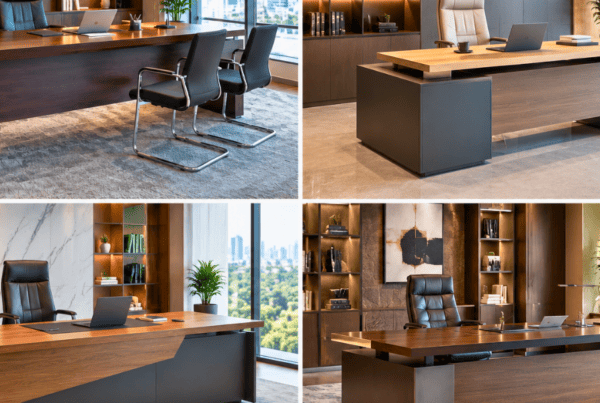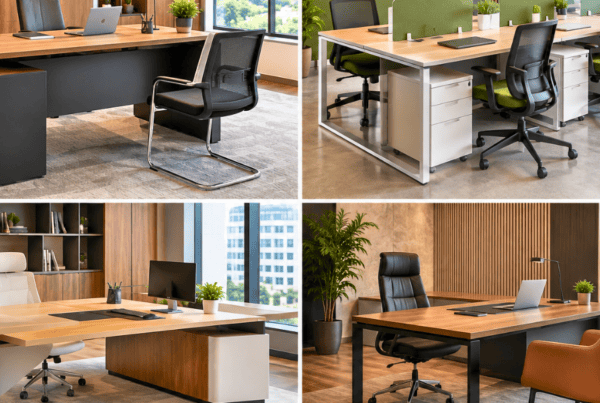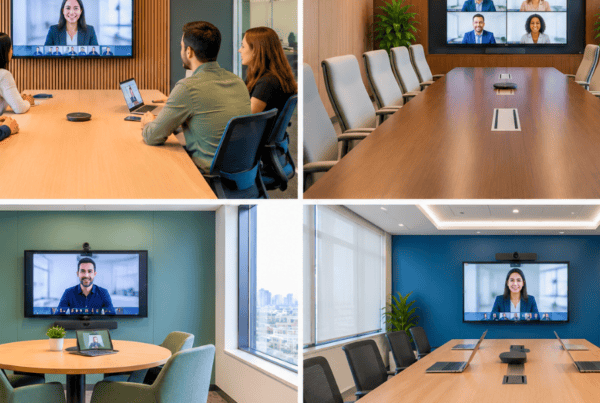
Running a healthcare facility is one of the most operationally complex challenges in facility management. Every corridor, every consultation room, and every administrative corner is under constant pressure, from patient volumes, staff workflows, regulatory requirements, and the simple reality that most healthcare buildings were not designed with today’s operational demands in mind.
The furniture problem in healthcare is uniquely difficult because it sits at the intersection of two very different needs. Clinical staff need workspaces that are efficient, organized, and ergonomically sound so they can perform under pressure without fatigue. At the same time, patients and visitors need environments that feel calm, accessible, and professional. Traditional fixed furniture, built-in counters, permanently positioned nurse stations, immovable reception desks, struggles to serve both masters simultaneously, and it fails completely when the facility needs to evolve.
This guide explores how modular office furniture and modular office workstations are transforming the way healthcare facilities in India are designed, furnished, and managed. Whether you’re outfitting a new hospital wing, refurbishing an aged clinic, or standardizing furniture across a multi-branch diagnostic chain, modular solutions offer a fundamentally smarter approach to healthcare facility furniture.
The Unique Challenges of Furnishing a Healthcare Facility
Space Constraints in Clinical Environments
Space is among the most valuable and contested resources in any healthcare facility. Nursing stations must accommodate multiple staff members simultaneously while keeping pathways clear for patient movement. Reception areas need to process high footfall efficiently without becoming bottlenecks. Administrative wings must house billing teams, HR departments, and medical records staff, often in floor plans that were originally designed for something else entirely.
The numbers tell a challenging story. Healthcare facilities in India are expanding rapidly, with the industry projected to grow significantly through the decade, yet construction costs and urban land prices mean that new space is rarely abundant. Most facilities are working within fixed footprints, which makes intelligent furniture design not a luxury but a necessity.
Hygiene, Durability, and Compliance Requirements
Healthcare furniture faces demands that no standard office furniture is built to handle. Every surface in a clinical environment is a potential vector for infection if it cannot be cleaned effectively. This means furniture must be made from non-porous materials, with sealed edges, powder-coated metal frames, and scratch-resistant laminates that can withstand repeated disinfection using hospital-grade cleaning agents.
Beyond hygiene, healthcare furniture must meet structural durability standards appropriate for high-traffic environments. In India, BIFMA (Business and Institutional Furniture Manufacturers Association) certification is the recognized benchmark for structural safety and load-bearing integrity. Facilities procuring furniture for clinical settings should insist on BIFMA-certified products, not as a formality, but as a genuine assurance that furniture will perform safely under the stresses of a busy hospital environment.
ISO 9001:2015 quality management compliance is equally important. It signals that the manufacturer’s production processes are systematically controlled and consistent, which matters when you’re outfitting multiple floors or multiple branches and need identical quality across every unit.
Adaptability to Changing Healthcare Workflows
A hospital that opens today will almost certainly look operationally different in three years. Departments expand. New specialties are added. Tele-consultation rooms appear where waiting areas once stood. Pandemic-era learnings permanently altered how facilities think about patient flow and staff proximity.
Fixed furniture cannot adapt to these changes without significant cost and disruption. Removing and replacing built-in nurse stations or custom reception counters requires contractors, downtime, and budget that healthcare administrators simply cannot afford to absorb repeatedly. This is precisely where the modular philosophy becomes not just convenient but economically essential.
What Is Modular Office Furniture and Why Does It Suit Healthcare?
Modular office furniture refers to pre-engineered, interchangeable furniture units designed to be configured, reconfigured, expanded, or reduced based on evolving space requirements. Rather than designing a custom piece for a specific corner of a specific room, modular systems work from a consistent set of components, panels, frames, work surfaces, storage units, and connectors, that can be assembled in multiple configurations.
The modular philosophy is built around flexibility rather than permanence. A workstation system that serves a billing department today can be reorganized to accommodate a larger team next year, or partially relocated to a new branch without replacing the entire installation.
For corporate offices, this flexibility is a competitive advantage. For healthcare facilities, it is a genuine operational necessity. The same logic that makes modular office furniture the preferred choice for fast-growing tech companies applies with even greater force in medical environments where change is constant, budgets are scrutinized carefully, and downtime during refurbishment affects patient care.
Key Space-Saving Modular Solutions for Healthcare Facilities
1. Modular Nurse and Reception Stations
The nurse station and the reception desk are the operational nerve centers of any healthcare facility. They are where patient intake happens, where care coordination is managed, and where the first impression of a facility is formed. They are also, in traditional construction, among the most expensive and inflexible pieces of infrastructure in the building.
Modular nurse stations and reception desks change this entirely. Available in L-shaped, U-shaped, and linear configurations, they can be scaled to match the specific dimensions and footfall demands of any facility, from a compact clinic reception to a sprawling hospital OPD counter. Built-in cable management keeps electrical and data connections organized and hidden. Integrated storage panels and accessory rails mean that essential supplies and documentation can be kept close at hand without cluttering the work surface.
Critically, because these stations are modular in construction, extending or reconfiguring them as the facility grows is a matter of adding or rearranging components, not demolishing and rebuilding. This single feature alone delivers significant lifecycle cost savings for growing healthcare networks.
2. Modular Office Workstations for Administrative and Back-Office Teams
Behind every well-run hospital is an administrative infrastructure that most patients never see: billing departments processing thousands of claims, HR teams managing complex staffing requirements, medical records departments maintaining compliance with data retention regulations, and procurement teams managing supply chains. These teams need efficient, well-organized workspaces, and they typically operate in shared, open-plan offices where space optimization is critical.
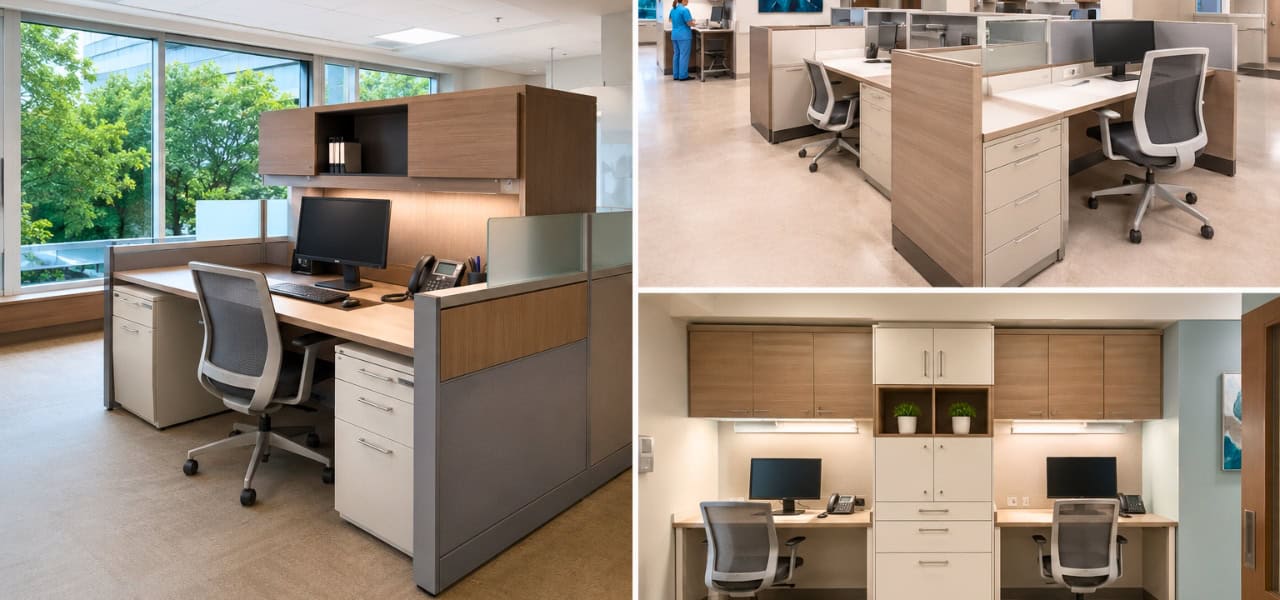
Modular office workstations are purpose-built for this environment. Benching-style workstation systems allow multiple staff members to share a common work surface and infrastructure while maintaining individual workspace organization. Cubicle-style modular configurations are appropriate where greater privacy is needed, for HR conversations, sensitive billing work, or documentation review.
The key advantage of modular office workstations for hospital administration is that they eliminate the clutter and inefficiency that characterize older, fixed office setups. Integrated cable management, under-desk pedestals, overhead storage bridges, and screen mounting options all contribute to workspaces that are genuinely organized rather than functionally chaotic. When teams grow or reorganize, the workstation system grows with them rather than requiring wholesale replacement.
3. Doctor Consultation Room Furniture
Consultation rooms present a specific challenge: they are small, they must accommodate both the doctor and the patient comfortably, they require storage for reference materials and medical equipment, and they ideally need to maintain a degree of acoustic privacy. Traditional custom furniture can address these requirements, but at significant cost and with zero flexibility for reconfiguration.
Modular consultation room furniture, compact desk-and-storage combinations, integrated overhead cabinets, modular acoustic privacy panels, delivers the same functionality at lower cost and with the added benefit that the configuration can be adjusted if the room’s purpose changes. For multi-floor hospitals looking to standardize consultation room layouts for consistency and cost efficiency, modular systems allow identical configurations to be replicated quickly and affordably across every floor.
4. Collaborative Zones and Waiting Lounge Configurations
Patient waiting areas are under constant pressure to be flexible. During normal operations, they need to maximize seating capacity. During heightened infection-control periods, the same space may need reconfigured layouts that maintain physical distancing. For facilities that serve diverse patient populations, the ability to create quieter, more private clusters within a larger waiting area is genuinely valuable.
Modular lounge seating systems make all of this possible. Unlike fixed bench seating, modular soft-seating clusters can be rearranged, expanded, or reconfigured as operational needs change. They can accommodate children’s areas, accessible seating arrangements, or quiet corners for patients who are anxious or unwell, all within the same furniture system.
5. Mobile and Height-Adjustable Workstations
Nursing floors and diagnostic rooms have a furniture requirement unlike any other in the facility: workstations that move with staff as they work. Mobile carts allow nurses to bring documentation, medication records, and equipment to the point of care rather than returning repeatedly to a fixed station. Height-adjustable workstations allow staff to work comfortably whether standing during rounds or seated for extended documentation tasks.
The ergonomic dimension of this matters enormously. Healthcare workers experience among the highest rates of musculoskeletal stress of any professional group. Furniture that forces prolonged awkward postures, hunching over a fixed counter that is too low, or standing at a workstation that is too high, contributes directly to fatigue, discomfort, and absenteeism. Ergonomic healthcare furniture, including height-adjustable and mobile options, is not a premium feature but a staff wellbeing investment with measurable returns.
6. Storage and Filing Modules
In a healthcare environment, organized and secure storage is not optional. Medical records, controlled documentation, and sensitive patient files must be stored in ways that are both accessible to authorized staff and secured against unauthorized access. Integrated storage modules, mobile pedestals, lateral filing cabinets, overhead storage units, that form part of a comprehensive modular workstation system ensure that storage is organized, lockable, and proportionate to actual need.
Mobile pedestals that move with staff between workstations, combined with fixed overhead storage for shared departmental files, create storage ecosystems that are far more functional than the combination of random cabinets and overloaded shelving that characterizes many older healthcare administrative offices.
Benefits of Choosing Modular Furniture for Healthcare Facilities
Space Optimization: Modular units are engineered to use every square foot efficiently. With configurable layouts that adapt to irregular floor plans, they consistently outperform fixed furniture in space utilization.
Cost Efficiency: The ability to reconfigure, expand, or relocate modular components without replacing entire installations makes the lifecycle cost of modular furniture significantly lower than traditional alternatives. When a department grows, you add modules. When a layout changes, you reconfigure. You do not replace.
Faster Installation: Pre-engineered modular systems install far more quickly than built-in or custom-fabricated furniture. For healthcare facilities where every day of disruption affects patient services, faster installation timelines are a meaningful operational benefit.
Consistency Across Departments: For multi-floor hospitals or multi-branch healthcare networks, modular systems allow identical configurations to be deployed consistently, creating a coherent visual identity and simplifying procurement and maintenance.
Sustainability: Modular components can be reused, relocated, and repurposed rather than discarded when spaces change. This significantly reduces waste compared to custom-built furniture and supports the sustainability objectives that are increasingly central to hospital design and LEED certification goals.
Durability: Quality modular healthcare furniture is built for high-traffic, high-demand environments, with scratch-resistant surfaces, robust metal frames, and finishes that withstand the rigors of institutional use over many years.
What to Look for in a Healthcare Furniture Manufacturer
Not every furniture manufacturer is equipped to serve the specific demands of healthcare facility projects. When evaluating suppliers, healthcare procurement teams and facility managers should prioritize the following:
BIFMA Certification is non-negotiable for structural safety. It confirms that the furniture has been independently tested to meet recognized standards for load-bearing capacity and durability under institutional use conditions.
ISO 9001:2015 Compliance confirms that the manufacturer’s quality management systems are systematically controlled, ensuring consistency across large orders and multi-location deployments.
LEED-Compliant Manufacturing matters for hospitals pursuing green building certification or with formal sustainability commitments. It confirms that the manufacturing process meets environmental standards covering materials, waste, and energy use.
Customization Capability is essential because no two healthcare layouts are identical. A manufacturer with genuine design and engineering capability can work from your floor plans to create configurations that maximize your specific space rather than forcing you to adapt your space to a standard product range.
Project Management Support separates capable healthcare furniture partners from standard commercial suppliers. From initial space planning through delivery, installation, and handover, experienced project management teams minimize the disruption to active healthcare operations.
Pan-India Distribution and Delivery Reliability matters enormously for large healthcare networks with facilities across multiple cities. Consistent quality, reliable timelines, and post-installation support all depend on the manufacturer’s logistics and service infrastructure.
Vlite Furnitech, Modular Healthcare Furniture Built for India’s Healthcare Sector
Vlite Furnitech is a manufacturer that genuinely meets the criteria that healthcare facility procurement demands. Operating from a state-of-the-art 30,000 square foot manufacturing facility in Patalganga, Navi Mumbai, Vlite produces modular office furniture and workstation systems at a capacity of 14,000 workstations per month, the kind of scale that makes large hospital projects and multi-branch rollouts genuinely executable rather than aspirational.
Vlite holds BIFMA certification, ISO 9001:2015 compliance, and manufactures in line with LEED sustainability standards, the full set of credentials that premium hospital clients and green-certified healthcare developments require.
What distinguishes Vlite from a standard furniture supplier is the project approach. A dedicated project management team works with healthcare clients from initial space planning through installation, ensuring that the final outcome reflects the specific requirements of the facility rather than a generic product catalogue selection. For healthcare administrators dealing with complex multi-department refurbishments or new facility fit-outs, this support is not incidental, it is what makes the difference between a smooth project and a chaotic one.
Vlite’s distribution network spans Mumbai, Pune, Ahmedabad, Surat, and Hyderabad, enabling consistent quality and service delivery across major Indian healthcare markets. Whether the project involves a single clinic or a network of hospitals across multiple cities, Vlite has the infrastructure to execute at scale without compromising on quality or timeline.
Still comparing modular, bespoke, and traditional office furniture?
Let Vlite Furnitech LLP help you choose the smartest investment for better ROI.
Frequently Asked Questions
Can modular office workstations be used in hospital administrative offices?
Yes, and they are often the best choice for hospital administrative environments. Modular office workstations offer flexible configurations that adapt to different team sizes and workflow requirements, making them ideal for billing departments, HR teams, medical records staff, and back-office operations of all scales.
What materials are best for healthcare facility furniture?
Scratch-resistant laminates on work surfaces, powder-coated metal frames for structural components, and non-porous finishes throughout are the standard for healthcare-appropriate furniture. These materials withstand repeated disinfection, resist surface damage from daily use, and maintain their appearance over extended service life.
How long does modular furniture installation take in a healthcare facility?
Modular systems install significantly faster than traditional built-in or custom-fabricated furniture. The exact timeline depends on project scope, but a well-managed modular installation, like those delivered by Vlite Furnitech’s dedicated project management teams, can furnish an entire floor with minimal disruption to active operations.
Is modular office furniture cost-effective for hospitals?
Over the lifecycle of a healthcare facility, modular furniture is consistently more cost-effective than fixed alternatives. The ability to reconfigure, expand, or relocate components without full replacement means that furniture expenditure adapts to the facility’s evolution rather than requiring repeated full-scale procurement every time a department grows or reorganizes.
Can Vlite Furnitech handle large-scale hospital projects across multiple cities?
Yes. With a production capacity of 14,000 workstations per month and branch offices in Mumbai, Pune, Ahmedabad, Surat, and Hyderabad, Vlite Furnitech has the manufacturing scale and distribution reach to execute large, multi-location healthcare projects with consistent quality across every site.
Build Smarter Healthcare Spaces with Modular Solutions
Healthcare facilities operate in environments where every decision about space, workflow, and infrastructure has direct consequences for staff performance and patient experience. Furniture that cannot adapt to changing departmental structures, that resists proper cleaning, or that consumes more floor space than necessary is not a neutral choice, it is an operational liability.
Modular office furniture and modular office workstations resolve the core challenges of healthcare facility furniture in a single coherent approach: they optimize space through intelligent configuration, they endure the demands of clinical environments through quality materials and construction, they install quickly to minimize operational disruption, and they scale affordably as the facility grows.
For India’s rapidly expanding healthcare sector, where new hospitals, diagnostic chains, and multi-specialty clinics are coming online at pace, the question is not whether to choose modular solutions but which manufacturer has the capability, certification, and project infrastructure to deliver them reliably.
Planning to furnish or refurbish your healthcare facility? Connect with Vlite Furnitech’s expert team for a customized space planning consultation tailored to your facility’s specific requirements, layout, and operational goals.

Vishnu Sharma
I am the co-founder and CEO of Vlite Furnitech, creating modular office solutions since 2009. With a background in Chemistry and Marketing, and experience as Regional Head at Featherlite, I help design ergonomic, adaptable, and sustainable workspaces. Alongside a team of 120+, we serve corporates like JCB, Just Dial, KFC, and educational institutions. Let’s connect to reimagine innovative, eco-friendly office environments.