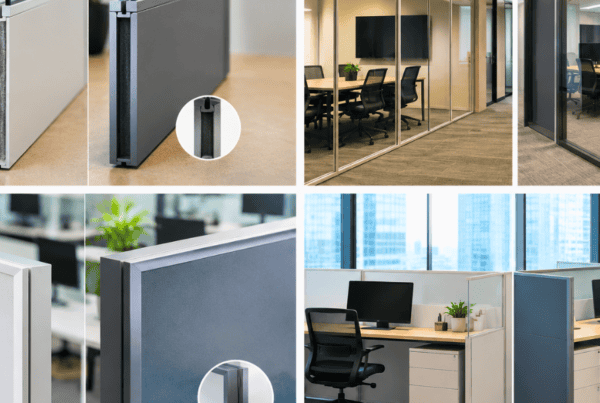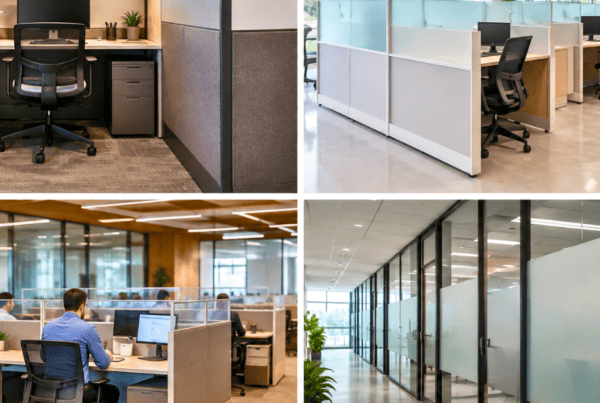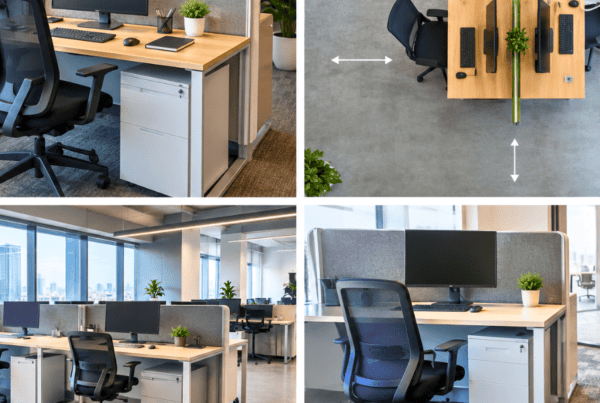
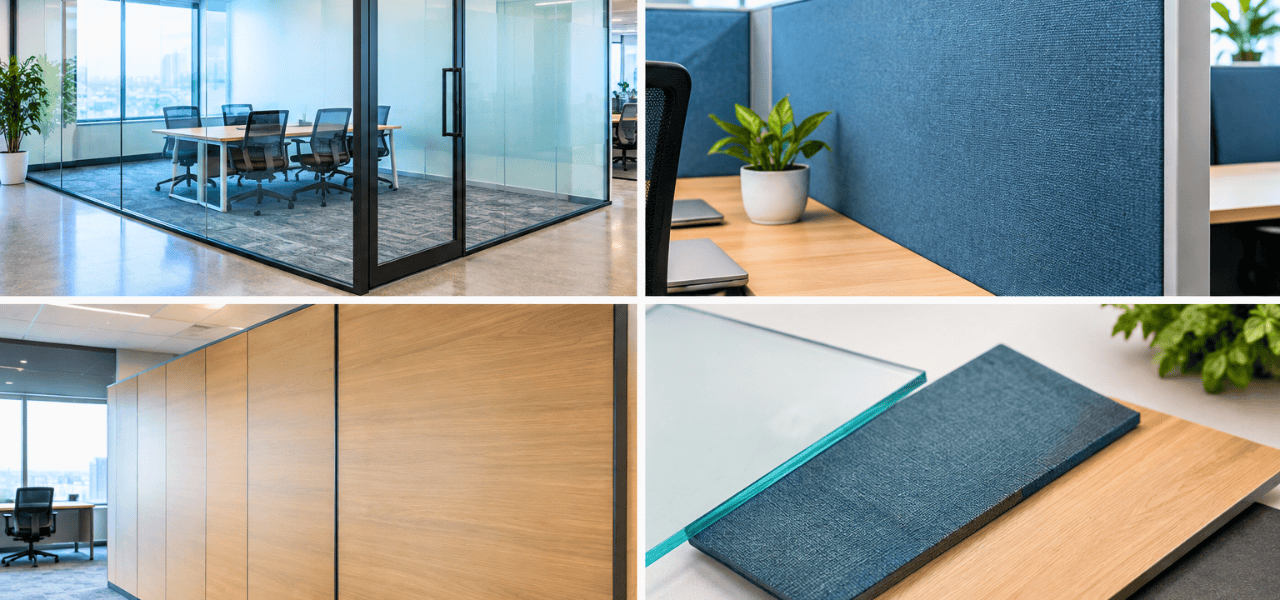
Why Office Partition Material Selection Matters
A fast-growing tech company invests in a sleek new office fit-out, only to find that their open-plan glass partitions turn every phone call into a shared experience for the entire floor. Or a BPO operation installs premium laminate workstations, then struggles with noise complaints from day one. The wrong partition material does not just look out of place, it actively undermines the way people work, collaborate, and concentrate.
Modern offices are no longer one-size-fits-all environments. Hybrid work schedules, pod-based workstations, open collaborative zones, and executive suites all coexist within the same floor plate, often within the same company. Each of these spaces has different demands when it comes to privacy, acoustics, light, and visual identity. The office partition material you choose directly shapes how all of these demands are met, or missed.
In this guide, we compare three leading materials, Glass – Fabric or Laminate Office Partition across the dimensions that matter most to facility managers, procurement heads, and interior designers: aesthetics, acoustics, durability, cost, maintenance, and sustainability. By the end, you will have a clear, practical framework to make the right office partition material comparison for your specific workspace needs.
What Are Office Partitions and Why Do They Matter?
The Role of Partitions in the Modern Workplace
Office partitions are modular wall systems and panel dividers that subdivide open floor areas into functional zones, without the permanence or expense of fixed construction. They serve multiple purposes at once: creating visual and acoustic privacy, defining team territories, managing noise flow, expressing brand identity, and enabling flexible reconfiguration as organisations grow and change.
Use cases span the full breadth of corporate real estate. In open-plan offices, workstation partitions define individual work zones while keeping the space feeling connected. In executive floors, full-height glass panels project authority and transparency. In call centres and BPO operations, fabric-upholstered panels absorb sound and reduce fatigue. In co-working spaces, laminate partitions deliver a clean, professional aesthetic at a cost that makes sense across dozens of bays.
The point is that no single partition type works for every environment. The decision starts with understanding what each material actually delivers.
How to Choose the Right Office Partition Material
Before diving into each material, it helps to frame the decision around five key factors that should guide any office partition material comparison:
Acoustics and Privacy, How much sound does the partition absorb or block? Is visual privacy also a requirement?
Aesthetics and Brand Identity, Does the partition reinforce the company’s visual identity and the experience you want clients or employees to have?
Durability and Maintenance, How will the material hold up over five to ten years of daily use? What does upkeep look like?
Cost and ROI, What is the upfront investment, and how does it compare to long-term performance and replacement costs?
Sustainability and Certifications, Does the material support green building goals, LEED points, or responsible sourcing commitments?
With these in mind, let us look at each material in detail.
Glass Office Partitions, Transparency Meets Professionalism
Key Characteristics of Glass Partitions
Glass office partitions come in several configurations: fully frameless systems for a seamless, architectural look; framed glass with aluminium or steel profiles; and semi-glass combinations that pair a glass upper panel with a solid lower section for added privacy. Each variant carries the core advantage of glass, natural light transmission, while offering varying degrees of visual openness.
The aesthetic impact of a glass office partition is immediate and significant. These systems communicate professionalism, openness, and a forward-thinking brand personality. They are the material of choice for reception areas, boardrooms, client-facing meeting rooms, and executive corridors where first impressions are part of the brief.
Beyond appearance, glass partitions genuinely reduce dependence on artificial lighting by allowing daylight to penetrate deeper into the floor plan, a benefit that translates into energy savings over time.
Pros and Cons of Glass Office Partitions
Glass partitions carry a premium upfront cost that is higher than both fabric and laminate alternatives. On the acoustic side, standard glass provides relatively limited sound insulation, a significant consideration for open-plan environments where phone conversations and meetings happen in close proximity. However, acoustic-rated glazing and double-glazed systems can address this at additional cost.
Privacy is manageable through practical design interventions: frosted film, manifestation graphics, or smart glass technology that switches between transparent and opaque on demand. Structurally, glass partitions require careful planning, they are heavier than panel systems and may need reinforced fixing points.
On the positive side, glass is exceptionally durable, highly resistant to wear, and one of the lowest-maintenance office partition materials available. A clean with a standard glass cleaner keeps it looking new indefinitely. For organisations that view their workspace as a long-term asset rather than a depreciating fit-out, the ROI calculation for glass often makes sense.
Best Use Cases for Glass Partitions
Glass office partitions perform best in client-facing zones, boardrooms, reception areas, and executive offices where the premium aesthetic directly supports business credibility. They are also excellent for collaborative areas where visual connectivity matters, where you want people to see activity and feel part of a larger, energised environment.
Brands that project innovation, transparency, and modernity will find glass partitions align naturally with their identity. At Vlite Furnitech, custom frameless and framed glass partition systems are manufactured at a 30,000 sq. ft. facility in Patalganga, with BIFMA-certified quality standards and the ability to tailor configurations to individual floor layouts and design briefs.
Fabric Partition Panels, Acoustic Comfort for Focused Work
Key Characteristics of Fabric Partitions
Fabric partition panels are constructed by stretching upholstered fabric over a structural core, typically MDF, honeycomb board, or acoustic foam, to create panels that absorb sound rather than reflecting it. They are available in an extensive range of heights, widths, colours, and textures, making them one of the most visually flexible workstation partition options for open-plan offices.
The defining advantage of the fabric partition panel is acoustic performance. Where glass bounces sound and laminate offers moderate absorption, fabric panels genuinely dampen noise at the source. This is not just about comfort, in high-density work environments, acoustic management directly affects concentration, call quality, and employee well-being.
Fabric panels also offer a practical surface benefit: most upholstered panels accept push pins, making them functional notice boards for team communication, project tracking, or individual organisation.
Pros and Cons of Fabric Partition Panels
The acoustic office partition built around fabric is the strongest performer in noise-sensitive environments, this is its defining strength and the primary reason organisations in the BPO, financial services, and insurance sectors favour it. The material creates a warmer, more human-scaled aesthetic than glass or laminate, which can contribute positively to employee comfort in long-shift environments.
Cost sits in the mid-range: lower than glass, broadly comparable to or slightly above standard laminate depending on specification. The trade-offs are real but manageable. Fabric can absorb stains and show wear in high-traffic areas over time, particularly in humid climates. Periodic cleaning, and eventual panel replacement, is a maintenance reality that procurement plans should account for. Fabric panels also lack the visual prestige of glass and are not appropriate for client-facing spaces where a premium impression is expected.
Best Use Cases for Fabric Partitions
The acoustic office partition in fabric is the clear choice for call centres, BPO operations, trading floors, and any workstation-dense environment where noise management is a functional requirement rather than a nice-to-have. It is equally appropriate for open-plan offices with significant collaborative activity, the fabric panels contain sound within zones without creating the full visual and acoustic isolation of solid walls.
Vlite Furnitech’s fabric panel workstations are available in customisable colour palettes aligned to client brand guidelines, designed in collaboration with Vlite’s dedicated design team and built to ergonomic standards that support healthy, productive posture across the working day.
Laminate Office Partitions, Durability Meets Design Flexibility
Key Characteristics of Laminate Partitions
Laminate partitions use high-pressure laminate (HPL) or melamine laminate bonded to a structural substrate panel. The result is a surface that convincingly mimics premium finishes, wood grain, stone, matte solids, brushed metal effects, at a cost that makes large-scale office fit-outs financially viable without aesthetic compromise.
HPL is the premium end of the laminate spectrum: denser, more impact-resistant, and more moisture-tolerant than standard melamine. Both variants offer a wide library of colours, grains, and textures, giving interior designers and facility managers genuine creative latitude to align partition finishes with broader office design schemes.
Pros and Cons of Laminate Partitions
The laminate partition excels in durability and low-maintenance performance. HPL surfaces resist scratching, scuffing, and the daily wear that accumulates in high-traffic corridors and workstation bays. Cleaning requires nothing more than a damp cloth, and the surface does not stain the way fabric does. Over a typical fit-out lifecycle of seven to ten years, this translates into a genuinely low cost of ownership.
Cost-effectiveness is laminate’s other standout quality. Across large floor plates, forty, eighty, a hundred and fifty workstations, the per-unit cost advantage over glass compounds into a significant budget difference, making laminate the practical choice for mid-tier corporate offices, co-working operators, and organisations fitting out multiple floors simultaneously.
Acoustic performance sits in the middle of the range: better than glass, but not in the same category as fabric panels with acoustic cores. For organisations where some degree of visual separation and privacy is sufficient, and where noise is managed through other means, such as acoustic ceiling treatments or white noise systems, laminate delivers entirely adequate performance.
The visual limitation is the absence of transparency. Laminate partitions do not allow light to pass through, and in deep floor plates they can create darker pockets if not planned carefully around the lighting design. Edge quality is worth specifying carefully, low-grade laminate can chip at corners over time, while premium HPL with post-formed edges holds up significantly better.
Best Use Cases for Laminate Partitions
The laminate partition is the workhorse of the mid-tier corporate office, the co-working operator, and the organisation that needs a consistent, professional finish across a large number of workstations without stretching the capital budget. It is also the material of choice when storage integration is required, laminate panels marry easily with overhead lockers, under-desk pedestals, and modular storage towers.
Vlite Furnitech’s laminate partitions are available in premium HPL and melamine finishes, manufactured with responsible material sourcing in a LEED-compliant facility.
Head-to-Head Comparison, Glass vs Fabric vs Laminate
| Criteria | Glass | Fabric | Laminate |
| Acoustic Performance | ★★ | ★★★★★ | ★★★ |
| Aesthetics | ★★★★★ | ★★★ | ★★★★ |
| Durability | ★★★★★ | ★★★ | ★★★★ |
| Maintenance | ★★★★★ | ★★★ | ★★★★ |
| Cost | ★★ | ★★★★ | ★★★★★ |
| Customisability | ★★★ | ★★★★★ | ★★★★★ |
| Eco-Friendliness | ★★★★ | ★★★ | ★★★★ |
| Best For | Executive floors, reception | Workstations, BPO, call centres | Mid-tier offices, co-working |
When you view this office partition material comparison side by side, the picture that emerges is not that one material wins, it is that each material wins in the right context. Glass dominates on aesthetics and durability but falls short on acoustics and cost. Fabric dominates on acoustic performance and customisability but requires more maintenance investment. Laminate strikes the most balanced position across cost, durability, and visual flexibility, which is why it remains the most widely specified workstation partition material in large-scale corporate projects across India.
Can You Combine Partition Materials? Hybrid Solutions
One of the most effective approaches in contemporary office design is the hybrid partition system: combining two materials within a single partition to capture the strengths of each. A common example pairs a glass upper panel, allowing light transmission and visual connectivity, with a solid lower panel in laminate or fabric for privacy, acoustic absorption, and the practical surface of a fabric pin-board.
Full-height versus partial-height is another dimension of the hybrid approach. Full-height partitions maximise acoustic separation and privacy; partial-height workstation partitions preserve the sense of openness and team visibility in collaborative environments while still defining individual zones.
Vlite Furnitech works with clients to design hybrid partition configurations that balance these variables within each project’s specific floor plan, budget, and work culture. Rather than presenting a standard catalogue, the Vlite design team collaborates with facility managers and interior designers to develop solutions specific to each organisation, a genuinely consultative process that commodity suppliers rarely offer.
Sustainability and Certifications, Why Material Choice Matters
As LEED and green building standards become increasingly central to corporate real estate decisions across India, the sustainability profile of office partition materials deserves serious consideration.
Glass is one of the most recyclable building materials in existence and, when manufactured to specification, contributes to LEED credits for daylighting and reduced energy consumption. FSC-certified laminates ensure that the wood-based substrates within partition panels come from responsibly managed forests, a specification worth confirming with any supplier. Fabric panels can be specified with low-VOC adhesives and recyclable acoustic cores to reduce their environmental footprint.
Vlite Furnitech operates with ISO 9001:2015 quality management certification, BIFMA certification for product safety and performance, and a LEED-compliant manufacturing facility in Patalganga. Responsible material sourcing is embedded in the procurement process, meaning clients who require green building documentation for their projects can access the supporting certification records they need.
Still comparing modular, bespoke, and traditional office furniture?
Let Vlite Furnitech LLP help you choose the smartest investment for better ROI.
Frequently Asked Questions
Which office partition material is best for soundproofing?
Fabric partitions with acoustic cores deliver the strongest noise absorption performance. Acoustic office partitions using dual-density foam are the standard specification for call centres, BPO operations, and open-plan offices where noise management is a functional priority. For environments where some acoustic control is needed alongside higher aesthetics, acoustic-rated glass or hybrid glass-fabric systems are worth considering.
Are glass office partitions more expensive than laminate?
Yes, glass office partitions carry a higher upfront cost than laminate alternatives. However, their exceptional durability, near-zero maintenance requirement, and premium aesthetic impact can deliver strong long-term ROI, particularly in client-facing areas where visual quality directly affects brand perception and the experience of visitors to the space.
How do I choose the right office partition material for an open-plan office?
Begin with the primary function of each zone within the floor plate. Noise-sensitive workstation clusters benefit most from fabric panels. Areas designed for collaboration, client meetings, or leadership visibility are well served by glass. Large mid-tier workstation bays where cost efficiency and durability matter most point toward laminate. Many well-designed open-plan offices use all three materials in combination, with each assigned to the zone where its strengths are most relevant.
Can office partitions be customised to match brand colours?
Yes. Fabric and laminate partitions offer the widest customisation options, with fabric available across an extensive range of upholstery colours and textures, and laminate offered in hundreds of standard and bespoke finishes. Glass can also be customised through tinted glazing, applied film, and graphic manifestation that incorporates brand colours and patterns into the partition surface itself.
What is the most durable office partition material?
Glass and high-pressure laminate are both excellent on durability. Glass is virtually scratch-proof and holds its finish indefinitely with basic cleaning. HPL laminate resists moisture, impact, and the accumulated wear of high-traffic environments, making it particularly well suited to busy office corridors and large workstation deployments where panels face daily physical contact.
Make the Right Choice for Your Workspace
The honest answer to “which office partition material is best” is that it depends, but that answer becomes precise and actionable once you apply the right framework. Glass delivers a premium, light-filled environment with outstanding durability and a visual language that communicates quality to every client and visitor who walks through the door. Fabric delivers acoustic comfort and human warmth in the workstation environments where people spend the most time and where noise has the greatest impact on performance. Laminate delivers design flexibility, cost efficiency, and long-term resilience across the large-scale corporate fit-outs where both visual quality and budget discipline are non-negotiable.
The most effective offices are not built around a single material. They are designed with intention, glass where presence matters, fabric where focus matters, laminate where scale and value matter, and often combined in hybrid configurations that deliver more than any single material could achieve alone.
At Vlite Furnitech, our design experts work with you to select and configure the right office partition solution for your specific workspace, culture, and commercial goals. With a manufacturing capacity of 14,000 workstations per month, a 30,000 sq. ft. production facility, and branches across Mumbai, Pune, Ahmedabad, Surat, and Hyderabad, Vlite brings the scale, certifications, and consultative expertise to deliver office furniture solutions that perform as well as they look. Get in touch with our team for a free consultation and let us help you build a workspace your people, and your brand, deserve.

Vishnu Sharma
I am the co-founder and CEO of Vlite Furnitech, creating modular office solutions since 2009. With a background in Chemistry and Marketing, and experience as Regional Head at Featherlite, I help design ergonomic, adaptable, and sustainable workspaces. Alongside a team of 120+, we serve corporates like JCB, Just Dial, KFC, and educational institutions. Let’s connect to reimagine innovative, eco-friendly office environments.