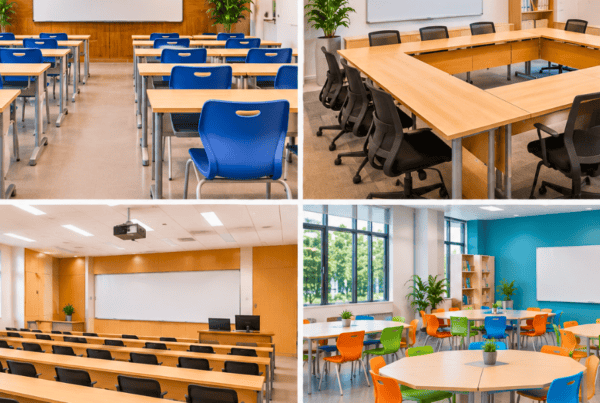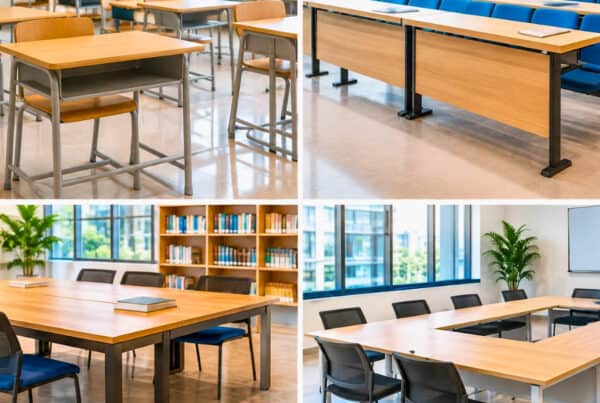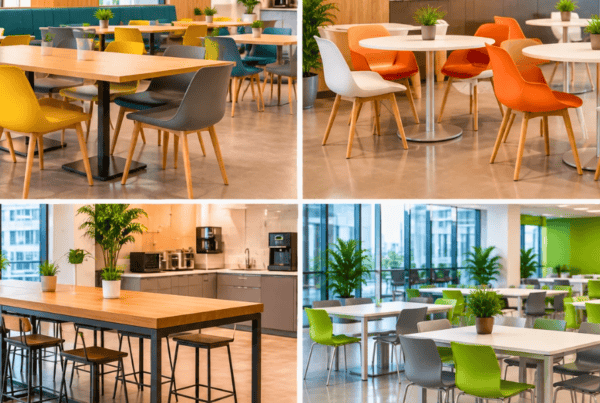
Walk into any office at 1:00 PM and you will see where the real culture lives: the canteen. It is where teams decompress, where informal ideas are traded over chai, and where new joiners find their circle. Yet many companies spend months planning workstations and meeting rooms, then furnish the canteen with whatever is cheapest and quickest to deliver.
The results are familiar. Wobbly tables, peeling laminate, stained tops and chipped edges make a break area feel neglected, and employees notice. A well-chosen canteen table for office use does the opposite. It signals that the company values its people, holds up to hundreds of meals a week, and keeps its looks for years instead of months.
This guide is written for office managers, HR heads, interior designers and procurement teams who want to choose well. We cover the materials used in office canteen tables, the durability factors that separate good furniture from throwaway furniture, realistic cafeteria table price ranges in India, and a step-by-step method for choosing the right setup. Whether you are fitting out a 50-seat pantry or a 1,000-seat corporate cafeteria, the principles are the same, and the right office furniture decisions here pay back for a decade.
What Is a Canteen Table and How Is It Different from Regular Office Tables?
A canteen table, also called a cafeteria table, is built for communal dining and informal gatherings. Unlike a workstation, which is designed around a laptop, cables and a single user’s posture, a canteen table has to cope with spills, hot trays, heavy elbows, frequent cleaning and constant movement of people around it.
That changes the design brief in several ways:
- Surface: it must resist stains, moisture, heat and scratches from cutlery and trays.
- Frame: it needs a sturdier base, because people lean, sit on edges and drag tables to reconfigure the room.
- Hygiene: surfaces and joints should be easy to wipe down several times a day.
- Flexibility: the same table often serves lunch, a town hall, a birthday celebration and a quick stand-up meeting.
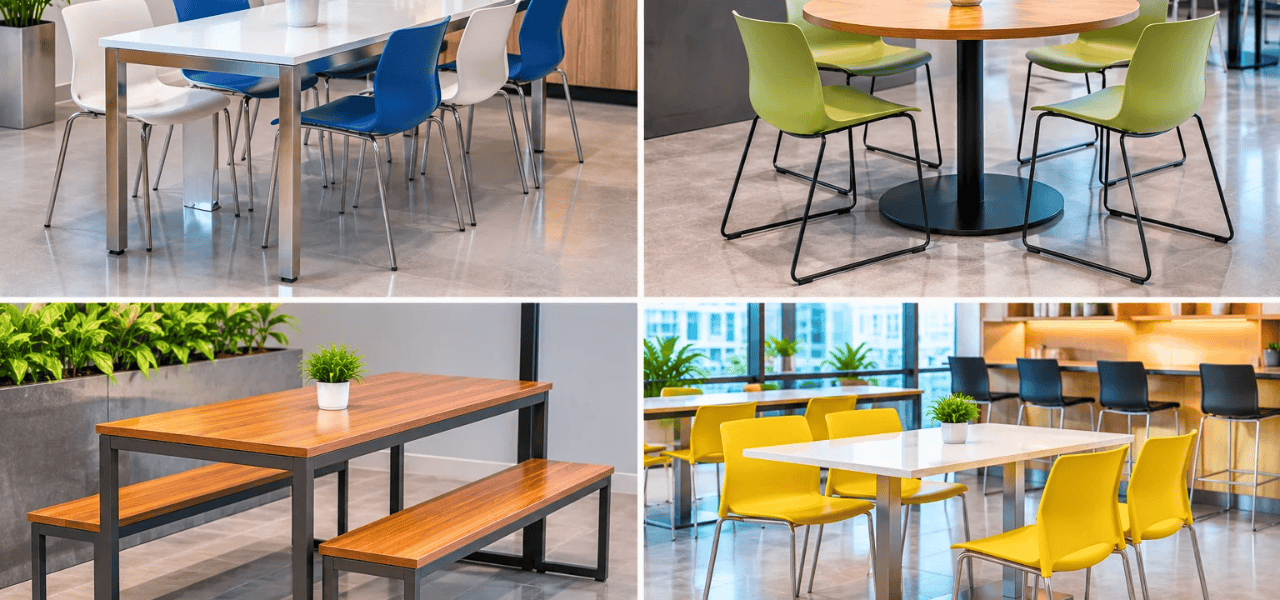
Canteen tables typically come in 4-seater, 6-seater and 8-seater configurations, along with long bench-style tables for high-density cafeterias. Square and round cafe tables suit smaller breakout zones, while rectangular tables maximise seating in larger halls. Compared with standard office workspace tables, canteen tables are usually slightly lower and chunkier, with tops that can take heavier daily wear.
Popular Materials Used in Office Canteen Tables
Material is the biggest driver of both durability and cost. Here is how the five most common options compare.
1. Stainless Steel Canteen Tables
A stainless steel canteen table is the workhorse of high-volume dining. Stainless steel is non-porous, which means it does not absorb liquids, odours or bacteria. It resists rust, handles heat without damage and can be cleaned with a simple wipe-down.
Pros: highly hygienic, rust-resistant, industrial look, very low maintenance, long lifespan.
Cons: higher upfront cost, a cooler aesthetic that may not suit warm interiors, and visible fingerprints on some finishes.
Best for: manufacturing units, hospitals, large corporate cafeterias and any space with heavy footfall.
Durability rating: ★★★★★
2. Laminate / MDF Tabletops
Laminate over MDF or particle board is the most widely used canteen top in India because it is affordable and available in an enormous range of colours and wood-grain finishes. It is easy to clean and looks good when new.
Pros: cost-effective, wide design range, quick to source and replace.
Cons: not ideal for heavy-duty use, the edges can chip, and prolonged moisture exposure can cause swelling.
Best for: mid-size offices, startups and coworking spaces with moderate usage.
Durability rating: ★★★☆☆
3. Compact Laminate (HPL)
High-pressure laminate (HPL) is a denser, tougher cousin of standard laminate. Layers of resin-impregnated paper are fused under extreme pressure, producing a surface that shrugs off scratches, moisture and everyday abuse while still offering a premium look.
Pros: scratch-resistant, moisture-resistant, heat-tolerant, premium finish, good colour retention.
Cons: costs more than standard laminate.
Best for: high-footfall office cafeterias where looks and longevity both matter.
Durability rating: ★★★★☆
4. Wooden / Engineered Wood
Wood brings warmth that metal and laminate struggle to match. Solid wood and quality engineered wood pair beautifully with modern, biophilic and boutique interiors.
Pros: warm, inviting aesthetic, pairs well with contemporary design.
Cons: needs regular maintenance, is vulnerable to moisture and heat in raw form, and can show rings and scratches.
Best for: boutique offices, creative studios and lounge-style breakout areas.
Durability rating: ★★★☆☆
5. Metal Frame with Mixed Tabletop
The most common professional combination is a powder-coated metal frame with a laminate or HPL top. It balances strength, hygiene, aesthetics and cost, and it is the standard construction for modular canteen setups. The frame handles the structural load while the top can be matched to your interiors or replaced independently if it ever gets damaged.
Durability rating: ★★★★★
A note on build quality: Vlite Furnitech uses premium-grade materials with BIFMA-certified construction standards, so every canteen table is engineered to withstand rigorous daily use across corporate environments.
Durability Factors to Evaluate Before Buying
Two tables can look identical in a catalogue and perform very differently after two years. These are the factors that decide which one you get.
Frame Strength and Load Capacity
Ask about the gauge thickness of the steel, the quality of the welds and whether the legs have anti-wobble levelling feet. Thin tubing and spot welds are common cost-cutting measures, and they are the first things to fail. As a practical benchmark, a good canteen table should handle a minimum load of 100 to 150 kg without flexing, because people lean, sit and rest heavy items on these tables all day.
Surface Resistance
A canteen top faces hot tiffin boxes, steel cutlery, spilled sambar and aggressive cleaning agents. Check three things:
- Scratch resistance: HPL performs far better than standard laminate here.
- Heat resistance: the surface should tolerate hot containers without discolouration.
- Stain resistance: non-porous, tight-grain surfaces keep turmeric and tea from leaving permanent marks.
Standard laminate is perfectly adequate for light use, but in a cafeteria serving hundreds of people daily, HPL or stainless steel will last considerably longer.
Edge Finishing
Edges are where tables fail first. Exposed or poorly bonded edges absorb moisture, swell and peel. PVC edge banding, applied with strong adhesive and a clean finish, protects the core and lasts well. Metal edge guards go a step further for very high-traffic areas. Run your thumb along the edge of a sample: it should feel smooth, sealed and fully bonded, with no gaps.
Coating and Finish
Powder-coated frames are the standard for good reason. The coating is baked on, forming a hard, even layer that resists rust, chips and fading far better than ordinary paint. For tabletops, matte finishes hide fingerprints and minor scratches better, while gloss finishes look striking but need more frequent wiping to stay pristine.
Certifications That Signal Quality
Certifications are an independent check on a manufacturer’s claims. Look for:
- BIFMA certification, which verifies that furniture meets rigorous standards for safety, durability and performance. Vlite Furnitech complies with BIFMA standards.
- ISO 9001:2015, which indicates consistent, documented quality management in manufacturing.
When shortlisting suppliers of office furniture, ask for these certificates up front. Reputable manufacturers will share them readily.
Cafeteria Table Price in India: What to Expect
Pricing is the question every buyer asks first and every supplier answers vaguely. Here are realistic ranges for the Indian market. Treat them as a planning guide rather than a quotation.
| Table Type | Material | Approx. Price Range (INR) |
| Basic 4-seater canteen table | MDF + MS frame | ₹8,000 – ₹15,000 |
| Mid-range 6-seater | HPL + powder-coated frame | ₹18,000 – ₹35,000 |
| Premium stainless steel table | SS 304 grade | ₹25,000 – ₹60,000+ |
| Custom modular cafeteria setup | Mixed materials | ₹50,000 – ₹2,00,000+ |
Final cafeteria table price depends on several variables:
- Size and seating capacity: an 8-seater or bench-style table costs more than a 4-seater.
- Material grade: SS 304 costs noticeably more than SS 202, and HPL costs more than standard laminate.
- Customisation: special colours, shapes, branding elements or foldable mechanisms add to the cost.
- Quantity: bulk orders qualify for meaningful discounts.
- Delivery and installation location: logistics costs vary by city.
When assessing an office dining table cost, look beyond the sticker price. A ₹10,000 table that needs replacing in three years costs more than a ₹18,000 table that lasts twelve. Total cost of ownership, including maintenance, repairs and replacement cycles, is the number that matters.
As a direct manufacturer based in Patalganga, Navi Mumbai, with 30,000 sq. ft. of production capacity, Vlite Furnitech eliminates middlemen and offers competitive pricing without compromising on quality. Bulk procurement discounts are available for larger projects.
How to Choose the Best Canteen Table for Your Office
Use this five-step framework to move from a vague requirement to a confident purchase.
Step 1: Assess Your Space and Footfall
Start by measuring your canteen area precisely, including walkways, entry points and service counters. Then estimate how many people will use the space at peak time. A common planning approach is to calculate seating for 40 to 60 percent of your headcount if lunch is staggered, or a much higher share if everyone breaks at once. This tells you how many seats you need and whether 4-seater, 6-seater or bench-style tables will use your floor space most efficiently. Leave enough room between tables for people to pass comfortably with trays.
Step 2: Match Material to Environment
Let the usage pattern decide the material:
- Heavy industrial or high-volume use: stainless steel.
- Standard corporate office cafeteria: HPL top with a powder-coated frame.
- Aesthetic-focused lounge or breakout area: engineered wood with a protective finish.
- Budget-conscious, lower-footfall pantry: quality laminate on a sturdy metal frame.
Step 3: Prioritise Ergonomics
Comfort affects how long people linger and how much they enjoy the space. The standard canteen table height is 73 to 76 cm. Pair tables with chairs or benches of the right seat height so that diners’ knees and elbows sit naturally. If you are furnishing the full space, consider coordinating with ergonomic office chairs for breakout and lounge zones.
Step 4: Think Long-Term: Maintenance and Warranty
Ask every supplier for a minimum warranty of one to two years and clarify exactly what it covers: frame, top, finish or hardware. Check whether after-sales service is genuinely available in your city, because a warranty is only as useful as the support behind it. Vlite Furnitech’s branches in Mumbai, Pune, Ahmedabad, Surat and Hyderabad ensure dedicated after-sales support for clients in these regions.
Step 5: Explore Customisation Options
Off-the-shelf tables work for many offices, but customisation can turn a generic canteen into a brand statement. Consider:
- Colours and finishes that match your brand palette or interior scheme.
- Shapes and sizes that fit awkward floor plans.
- Branding elements such as logos or accent panels.
- Foldable or stackable designs for multi-purpose halls that double as event spaces.
Vlite Furnitech’s design team collaborates directly with clients to develop custom requirements, from concept to installation.
Why Vlite Furnitech Is a Trusted Canteen Table Manufacturer in India
Choosing a manufacturer is as important as choosing a material. Here is what sets Vlite Furnitech apart:
- 30,000 sq. ft. manufacturing facility in Patalganga, Navi Mumbai, giving direct control over quality and timelines.
- Capacity of 14,000 workstations per month, which means large corporate projects can be scaled without delays.
- BIFMA-certified, ISO 9001:2015 and LEED-compliant production, reflecting commitment to quality, safety and sustainability.
- PAN-India distribution with branches in five major cities.
- Customised project management teams that handle everything from design consultation to final delivery.
For companies furnishing multiple floors or multiple offices, working with one manufacturer for canteen tables, workstations and breakout furniture also keeps design language consistent and simplifies procurement. If you are planning a larger fit-out, explore Vlite’s modular office furniture range and office workstation tables alongside canteen solutions.
Still comparing modular, bespoke, and traditional office furniture?
Let Vlite Furnitech LLP help you choose the smartest investment for better ROI.
Frequently Asked Questions (FAQ)
1. What is the standard size of a canteen table for an office?
Sizes vary by seating capacity. A typical 4-seater canteen table measures around 120 cm x 75 cm, while a 6-seater is roughly 150 to 180 cm long and 75 to 90 cm wide. Larger 8-seater and bench-style tables can run 210 cm or more. Standard height is 73 to 76 cm. Always leave at least 90 to 100 cm of circulation space around each table.
2. Which material is best for a stainless steel canteen table in a corporate office?
SS 304 is the preferred grade for a stainless steel canteen table. It contains higher nickel and chromium content than SS 202, which gives it superior corrosion resistance and a longer lifespan, especially in humid or heavily cleaned environments. SS 202 is cheaper but is more prone to staining and rust over time, so it suits only light-duty or short-term use.
3. What is the average cafeteria table price in India?
Cafeteria table price depends on material, size and customisation. Basic 4-seater tables with an MDF top start around ₹8,000 to ₹15,000. Mid-range 6-seater tables with HPL tops cost roughly ₹18,000 to ₹35,000. Premium stainless steel tables fall between ₹25,000 and ₹60,000 or more, and custom modular cafeteria setups range from ₹50,000 to ₹2,00,000 and above. Bulk orders usually qualify for discounts.
4. Can canteen tables be customised for a branded office cafeteria?
Yes. Colours, finishes, shapes, sizes, branding elements and folding or stacking mechanisms can all be customised. Vlite Furnitech’s in-house design team works directly with clients to create canteen furniture that matches their brand identity and floor plan.
5. How long do office canteen tables typically last?
With BIFMA-grade materials and proper maintenance, office canteen tables typically last 7 to 15 years. Stainless steel and powder-coated frames with HPL tops sit at the upper end of that range, while basic laminate-on-MDF tables usually need replacing sooner in high-traffic settings.
6. What is the difference between a canteen table and a cafe table?
A canteen table is larger and built for communal, high-volume dining, so it uses tougher materials and sturdier frames. Cafe tables are typically smaller, often round or square, and designed for short stays, casual conversations or breakout corners. Material expectations are also lighter for cafe tables, with more emphasis on style than on heavy-duty performance.
Invest in the Right Canteen Table
The right canteen table for office use is not just a piece of furniture. It is a daily-use asset that shapes how employees experience their breaks, and by extension their workplace. Material choice drives durability: stainless steel and HPL on powder-coated frames deliver the longest life in busy cafeterias, while laminate and engineered wood suit lighter-use and design-led spaces. Price depends on material grade, size and customisation, but the smartest buyers compare total cost of ownership rather than the lowest quote.
Before you decide, measure your space, estimate footfall, match the material to the environment, verify certifications and confirm warranty and after-sales support. Do that, and your canteen will keep looking and performing well long after the budget conversation is forgotten.
Ready to upgrade your cafeteria? Explore Vlite Furnitech’s range of office canteen tables, built to last and priced to suit. Contact our team for a free consultation or visit your nearest showroom.

Vishnu Sharma
I am the co-founder and CEO of Vlite Furnitech, creating modular office solutions since 2009. With a background in Chemistry and Marketing, and experience as Regional Head at Featherlite, I help design ergonomic, adaptable, and sustainable workspaces. Alongside a team of 120+, we serve corporates like JCB, Just Dial, KFC, and educational institutions. Let’s connect to reimagine innovative, eco-friendly office environments.