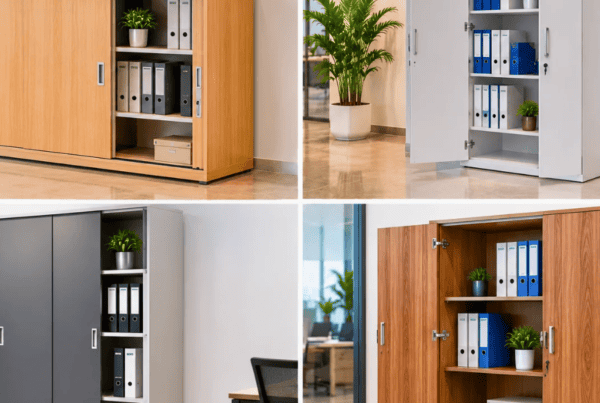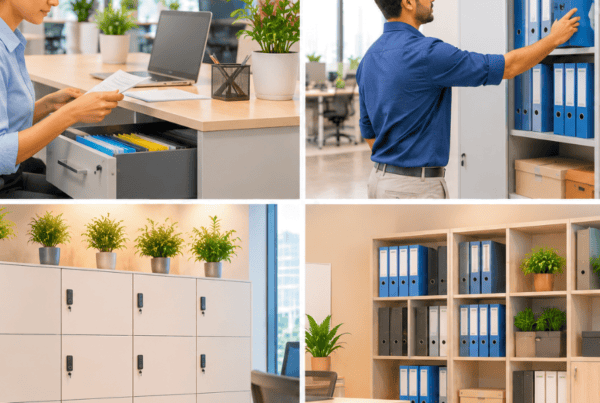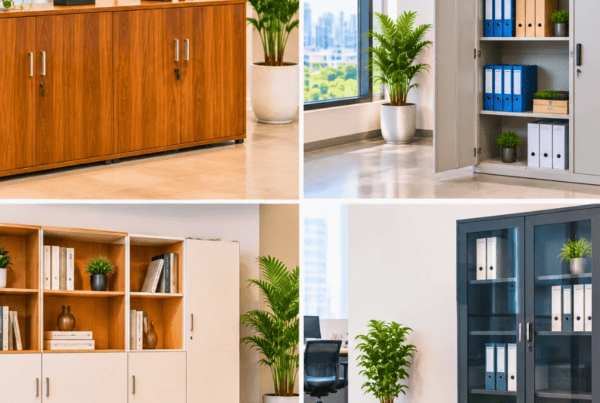
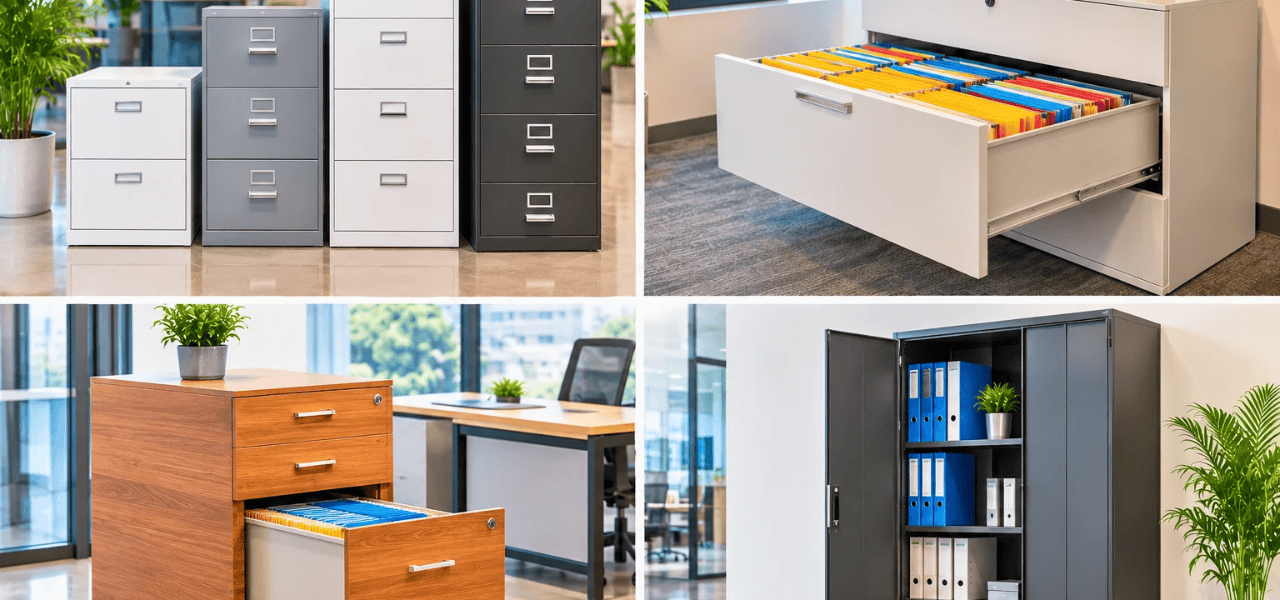
Walk into almost any Indian office and you will find the same scene: files stacked on desks, lever arch folders wedged onto open shelves, and a cabinet whose drawers no longer close properly. Despite the shift to digital tools, paper remains central to Indian business. Statutory registers, GST records, HR files, contracts, and client documentation all need to be stored, retrieved, and often produced for audits at short notice.
That is why understanding filing cabinet sizes and capacity is a practical business decision, not a minor furniture detail. A cabinet that is too small forces documents into unsafe piles. One that is too large wastes expensive floor space. A poorly chosen one can mean drawers that jam, files that sag, or cabinets that tip when overloaded.
At Vlite Furnitech, we design and manufacture office workspace storage for workplaces across India, and we see the same sizing questions repeatedly. This guide covers standard dimensions, real-world capacity, the main cabinet types, and a step-by-step checklist to help you choose the right option for your office.
Standard Filing Cabinet Sizes in India
Filing cabinets fall into three broad height categories. Knowing them helps you match the cabinet to the space and to how people will use it.
Common Height Categories
Under-desk and pedestal cabinets (500–600mm)
These low-height units slide beneath a desk and typically hold two or three drawers. They suit personal storage: active files, stationery, and confidential papers the user needs within arm’s reach.
Mid-height cabinets (900–1,050mm)
These sit at roughly counter height. They work well beside workstations, in reception areas, or as a base for display items and printers, while still offering two or three generous drawers.
Full-height cabinets (1,200–1,800mm)
These are the workhorses of document storage. A tall four-drawer unit gives the most capacity per square foot of floor space, which matters in Indian offices where rental costs are high.
| Cabinet Type | Typical Height | Typical Width | Typical Depth | Drawers |
| Under-desk pedestal | 500–600mm | 400mm | 450–550mm | 2–3 |
| Mid-height cabinet | 900–1,050mm | 450–500mm | 450–550mm | 2–3 |
| Full-height vertical | 1,200–1,800mm | 450–500mm | 500–620mm | 3–5 |
Width and Depth Dimensions
Standard widths run from 400mm to 500mm, with 450mm being the most common. Standard depths range from 450mm to 550mm for compact units, and up to around 620mm for full-height vertical cabinets designed for suspension files.
Depth deserves special attention. Indian offices often favour compact footprints, especially in open-plan layouts where circulation space is tight. A deeper cabinet holds more, but its drawers need more pull-out clearance. Always check the depth of the cabinet against the depth of the space in front of it, not just the space it occupies.
The A4 Filing Cabinet: The Indian Office Standard
A4 (210 × 297mm) is the dominant paper size across Indian business, covering legal documents, HR records, compliance paperwork, invoices, and correspondence. As a result, the A4 filing cabinet has become the default choice for most offices.
Inside an A4 cabinet, the usable drawer width is typically 320–340mm. This accommodates A4 suspension files and standard folders without wasted space.
It helps to understand the difference between A4 and foolscap compatibility. Foolscap paper is longer than A4, and older offices, courts, and some government departments still hold foolscap records. Foolscap-compatible cabinets have wider internal dimensions, generally 350mm or more. If you hold a mix of formats, confirm the internal drawer dimensions before ordering. Do not rely on the external filing cabinet size alone, since wall thickness and suspension rails reduce usable space.
Filing Cabinet Capacity: How Much Can They Actually Hold?
Capacity figures vary with drawer depth, paper weight, and how tightly files are packed. The numbers below are realistic planning estimates for standard A4 documents.
Drawer-by-Drawer Capacity Breakdown
A well-built vertical drawer holds roughly 600–800 A4 sheets in a practical working arrangement. That translates to:
- 2-drawer cabinet: approximately 1,200–1,600 sheets
- 3-drawer cabinet: approximately 1,800–2,400 sheets
- 4-drawer cabinet: approximately 2,400–3,200 sheets
These figures assume documents stored in folders, with enough room left to add and remove files comfortably. Packing a drawer to the limit makes retrieval slow and damages the paper.
Weight is the other half of capacity. Most quality steel drawers are rated for 25–40 kg each. Paper is heavier than it looks: a single ream of A4 weighs about 2.5 kg, so a full drawer approaches its limit quickly. Always check the load rating, and never exceed it. Overloaded drawers wear out their runners and can make a tall cabinet unstable when several drawers are opened at once.
Lever Arch Storage in Filing Cabinets
Lever arch files are ubiquitous in Indian offices. Accounts teams, legal departments, and HR use them for bulk records, and they hold far more than a standard folder. This makes lever arch storage one of the most important factors in sizing a cabinet.
Capacity in lever arch units is a useful way to plan:
- 2-drawer cabinet: approximately 8–12 lever arch files
- 4-drawer cabinet: approximately 20–28 lever arch files
Note that lever arch files are bulky and sit differently from suspension files. Cabinets designed for suspension filing may not take lever arch files efficiently unless the drawer height and layout allow it. If your office uses both formats, look for cabinets with adjustable suspension bars. These let you switch between hanging files and upright lever arch storage as your needs change.
Lateral vs. Vertical Cabinets
The choice between lateral and vertical cabinets affects both capacity and layout.
Vertical cabinets have deeper, narrower drawers. They take up less wall space, suit small and medium offices, and are the standard in most Indian workplaces. Their limitation is the depth needed to open a drawer.
Lateral cabinets have wider, shallower drawers. They hold large volumes of documents in a more accessible format, since you can see across the whole drawer at once. They suit high-volume environments such as large corporate offices, banks, and legal practices, and they need less front clearance but more wall length.
| Factor | Vertical | Lateral |
| Space requirement | Narrow footprint, deeper clearance | Wide footprint, shallow clearance |
| Best for | Small to mid-size offices | Large corporates, high-volume storage |
| Accessibility | Good | Excellent |
| Typical use | HR, admin, general filing | Banking, legal, compliance archives |
Types of Document Storage Cabinets for Indian Offices
Beyond size, the material and format of a cabinet determine how well it suits your workplace.
Steel Filing Cabinets
Steel is the preferred material wherever durability and security matter most. It offers fire resistance, strong lock options, and a long service life, which is why banks, law firms, and government offices rely on it. A good powder-coated finish resists scratches, rust, and wear. Vlite Furnitech’s powder-coated steel cabinet range is built for exactly these demanding environments.
Wooden and Laminate Filing Cabinets
Where appearance matters, wooden and laminate cabinets are the natural choice. They suit executive cabins, co-working spaces, boardrooms, and premium offices where storage should blend with the interior. Laminate options also allow a wide choice of finishes and colours. Vlite Furnitech’s modular design approach makes it possible to customise these units to match a particular interior scheme.
Mobile Pedestals
A mobile pedestal is a compact, wheeled unit that sits under a desk. It is a space-saving document storage cabinet office solution, ideal for open-plan workstations where each person needs private, lockable storage without a separate cabinet. Pedestals pair naturally with workstation systems and can often be tucked beneath the desktop when not in use.
Combination Storage Units
Combination units blend lockable drawers with open shelving, overhead hutches, or cupboard sections. They make the most of limited square footage and suit teams that need both secure document storage and open display or reference space. For smaller offices, a single combination unit can often replace several separate pieces of office workspace storage.
How to Choose the Right Filing Cabinet Size for Your Indian Office
Choosing the right size is easier when you follow a structured process. Work through these steps in order.
1. Assess your document volume
Count your current lever arch files and loose folders, then add a realistic estimate of growth over the next year. Plan for 20–30% extra capacity so the cabinet is not full on day one.
2. Map your floor space
Measure the available area, and remember to allow for drawer pull-out clearance. A minimum of 600mm of free space in front of a cabinet is advisable so drawers open fully and people can pass.
3. Match the paper format
Confirm whether you store A4, foolscap, or both. Check the internal drawer dimensions, not just the external size, to make sure your files fit properly.
4. Consider security needs
A single lock may be enough for general files, but sensitive records such as payroll, legal contracts, and client data call for multi-point locking or digital locks. Match the lock type to the sensitivity of what you store.
5. Factor in the Indian climate
In humid coastal cities such as Mumbai and Chennai, moisture can corrode poorly finished metal and warp low-grade laminate. Choose humidity-resistant coatings and quality materials to protect both the cabinet and your documents.
6. Think modular
Teams grow and layouts change. Systems that can be stacked, reconfigured, or expanded protect your investment far better than fixed units.
7. Consider ergonomics
Keep the top drawer at or below about 1,200mm so most people can reach it comfortably. Frequently used files should sit in the middle drawers, with archival material at the top or bottom.
Following this checklist helps you balance filing cabinet sizes and capacity against budget, space, and long-term needs. Good office furniture choices come from planning for how your team actually works, not just from picking the cheapest unit.
Vlite Furnitech’s Filing Cabinet and Storage Solutions
Vlite Furnitech is an office furniture manufacturer in India, producing workplace solutions at our facility in Patalganga, Navi Mumbai. Our manufacturing meets international standards: our products are BIFMA-certified and our processes are ISO 9001:2015 certified, giving buyers confidence in quality and consistency.
Our storage range includes pedestals, lateral cabinets, tall storage units, and combination modules, all designed with Indian office conditions in mind. We also customise solutions for different sectors, including IT, banking, healthcare, and education, since each has its own document volumes, security needs, and space constraints.
If you are planning a wider fit-out, our storage units integrate smoothly with our modular workstation solutions and ergonomic office chairs, so your whole workspace works as one system.
Explore our document storage cabinet office range or speak to our design team to find the right configuration for your workplace.
Still comparing modular, bespoke, and traditional office furniture?
Let Vlite Furnitech LLP help you choose the smartest investment for better ROI.
Frequently Asked Questions (FAQ)
What is the standard filing cabinet size for Indian offices?
The most common size is a four-drawer vertical cabinet of about 1,320mm (H) × 460mm (W) × 620mm (D), compatible with A4 suspension files. Smaller two- and three-drawer versions are also widely used.
How many files can a standard filing cabinet hold?
A standard four-drawer filing cabinet holds approximately 20–28 lever arch files, or 2,400–3,200 loose A4 sheets, depending on drawer depth and how files are arranged.
What is the difference between an A4 filing cabinet and a foolscap cabinet?
An A4 filing cabinet is designed for 210 × 297mm paper, while foolscap cabinets are wider, at 350mm or more, for older, longer documents. Most Indian offices today use A4-compatible cabinets.
Which is better for Indian offices, steel or wooden filing cabinets?
Steel cabinets offer better durability, fire resistance, and security. Wooden or laminate cabinets offer superior aesthetics for premium workspaces. Many offices use both, depending on the zone and the sensitivity of the documents.
How do I maximise office workspace storage in a small office?
Use mobile pedestal units under desks, choose tall four-drawer cabinets over several small ones, and consider combination units with open shelving above locked sections. Vertical space is usually the most underused resource.
Are Vlite Furnitech filing cabinets customisable?
Yes. Vlite Furnitech offers modular cabinet systems that can be customised for dimensions, finishes, locking mechanisms, and integration with your workstation layout.
Storage That Works as Hard as Your Team
Choosing the right cabinet comes down to a few fundamentals. Know your document volume and paper format, measure your space including drawer clearance, respect weight ratings, and match the material and locking system to the sensitivity of your records. A well-chosen cabinet keeps documents organised, supports compliance, and improves how your office looks and runs.
The right filing cabinet size is rarely the biggest or the smallest. It is the one that fits your files, your floor plan, and your plans for growth.
At Vlite Furnitech, we engineer office furniture that transforms how Indian workplaces function. Explore our office storage units or connect with our team to find the perfect fit for your office.

Vishnu Sharma
I am the co-founder and CEO of Vlite Furnitech, creating modular office solutions since 2009. With a background in Chemistry and Marketing, and experience as Regional Head at Featherlite, I help design ergonomic, adaptable, and sustainable workspaces. Alongside a team of 120+, we serve corporates like JCB, Just Dial, KFC, and educational institutions. Let’s connect to reimagine innovative, eco-friendly office environments.