Institutional procurement teams face a recurring challenge: furniture decisions made under budget pressure today often translate into expensive replacements within two or three years. This pattern plays out across colleges, universities, and private hostel operators throughout India, and it quietly drains operational budgets that could be directed toward better facilities and student welfare.
The stakes are higher than most procurement committees realize. India’s student housing sector is expanding rapidly, with millions of hostel beds needed across government and private institutions. Every room that gets poorly furnished becomes a dissatisfaction point, something that directly affects student retention, hostel reputation, and in competitive private markets, occupancy rates. Furniture is not a background decision. It shapes how students live, study, sleep, and socialize for months or years at a stretch.
This guide is built for the people making these decisions: procurement managers, hostel wardens, college administrators, and real estate developers building PG or hostel facilities. It covers what distinguishes genuinely institutional-grade furniture from products that merely look adequate in a showroom, what to demand from a hostel furniture manufacturer before signing any order, how modular furniture changes the long-term economics of hostel management, and how to build a procurement framework that protects your institution over the full lifecycle of the furniture.
Throughout, Vlite Furnitech, one of India’s leading hostel furniture manufacturers, serves as the benchmark for what best practices look like in practice.
Understanding What Institutional Hostel Furniture Actually Requires
How Hostel Furniture Differs from Regular Furniture
The single biggest mistake institutional buyers make is applying residential or commercial office furniture standards to hostel environments. These environments are fundamentally different in ways that matter enormously to durability and cost.
A hostel room is occupied by a rotating series of users, often students who have little personal investment in maintaining shared property carefully. Furniture in these settings is subjected to daily stress from multiple users, often around the clock. Surfaces get scratched, hinges get forced, humidity builds up in densely occupied rooms, and cleaning protocols involve water and chemicals that consumer-grade finishes cannot withstand long-term.
Commercial-grade hostel furniture is engineered specifically for these conditions. Board thicknesses are higher. Edge banding is reinforced. Hardware, hinges, drawer slides, locking mechanisms, is rated for far more open-close cycles than residential equivalents. Finishes are selected for resistance to cleaning agents and humidity, not just aesthetics.
Aesthetic uniformity is another consideration that residential buyers never have to think about. An institution furnishing 200 or 500 rooms needs every room to look consistent. This is only achievable when working with a manufacturer who controls production to tight standards rather than assembling rooms from whatever is available in the market.
Types of Spaces That Need to Be Furnished
A complete institutional hostel involves far more than bedroom units. Procurement planning needs to account for the full range of spaces:
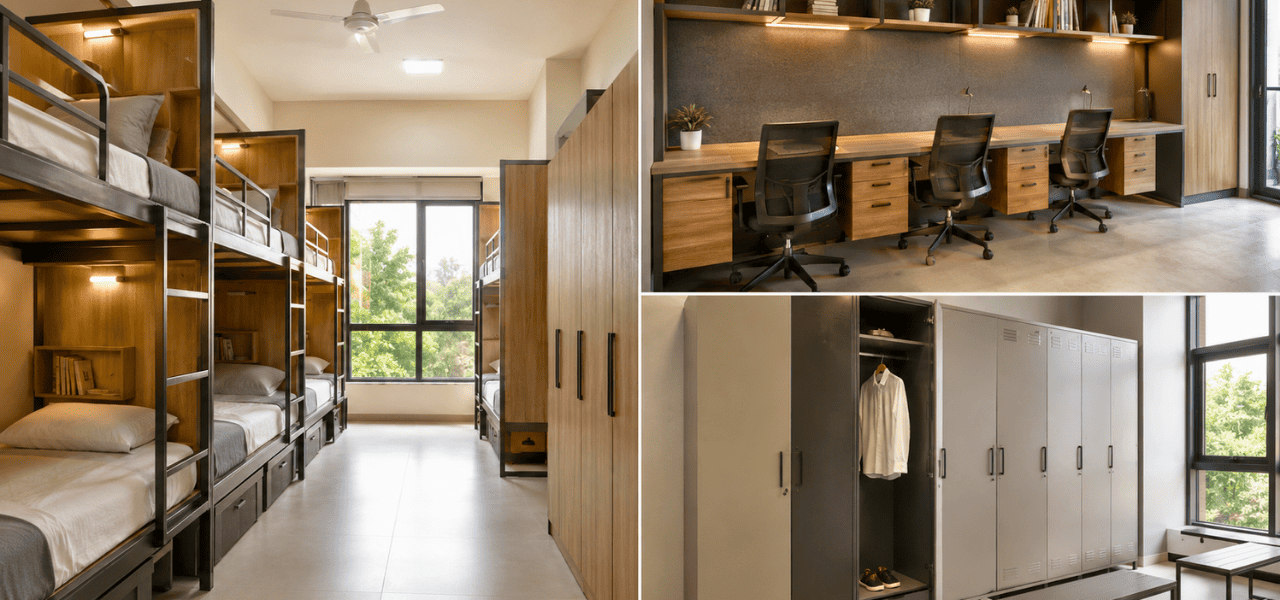
Dormitory and bedroom units are the obvious core, but the furniture mix within each room, bed, wardrobe, study table, chair, shelf, must be thought through as a system, not as separate purchases. Common rooms and recreation areas require seating that handles very heavy daily use and occasional rearrangement for events. Study rooms and reading halls need ergonomically designed furniture that students can comfortably use for extended periods. Dining areas require canteen-grade tables and seating that can be cleaned quickly between meal services. Warden and administrative offices, reception areas, and lobbies complete the picture, and consistency of finish and quality across all these spaces reflects on the institution’s overall standards.
Key Furniture Categories Every Institution Needs
Beds and Bunk Beds
The bed is the most-used piece of furniture in any hostel room, and decisions here carry the longest consequences. For institutions managing space efficiently, bunk beds are often the right answer, they effectively double sleeping capacity per square foot without sacrificing comfort when properly designed.
The material choice between metal and engineered wood frames involves trade-offs. Metal frames are highly durable and resistant to moisture, but can feel industrial in appearance and produce noise with movement. Engineered wood frames with quality hardware offer a warmer aesthetic and are easier to customize, but require careful selection of board grade and finish to match institutional durability requirements.
Under-bed storage integration is worth serious attention. Modular beds with built-in drawers solve student storage needs without adding separate furniture pieces, keeping rooms functionally organized in limited square footage. For bunk beds specifically, safety standards around railing height, ladder design, and load capacity should be non-negotiable requirements in any procurement specification.
Wardrobes and Storage Units
Student storage needs are significant and, when unmet, lead to rooms that look chaotic regardless of how well-designed the furniture is. Individual locker-style wardrobes, each student having a lockable personal space, are strongly preferred in hostel settings over shared wardrobe systems, because they reduce conflict and provide security.
Modular storage solutions have a particular advantage here: they can be reconfigured as occupancy patterns change. A room that starts as a two-person room can be re-specified for three without needing entirely new furniture if the storage system was modular from the start. Anti-rust hardware and high-durability laminate finishes are baseline requirements, particularly in coastal or high-humidity regions.
Study Tables and Chairs
Student wellbeing depends more on study furniture quality than most institutions acknowledge. Students in hostels spend extended periods at their study tables, poor ergonomics translate directly into discomfort, reduced study effectiveness, and complaints that reflect on hostel management.
Ergonomic chairs with appropriate lumbar support, adjustable height, and durable upholstery are a meaningful investment. BIFMA-certified chairs, meeting the globally recognized Business and Institutional Furniture Manufacturers Association performance standards, provide an objective benchmark for durability and ergonomic compliance. Vlite Furnitech’s range includes BIFMA-certified seating specifically designed for institutional study environments.
For compact rooms, wall-mounted or foldable study tables are worth considering. They return floor space when not in use and work particularly well in single-occupancy rooms where space is tight.
Common Area and Lounge Furniture
Common areas are where hostel culture is built, and where furniture takes its hardest beating. Seating that handles five hundred different users over a semester, potentially including sitting on armrests and other non-standard uses, needs upholstery and frame construction well beyond residential standards.
Modular seating clusters, configurations that can be rearranged for different activities, give hostel managers flexibility without requiring additional furniture purchases. L-shaped seating sections, individual chairs, and corner units from the same modular system can be rearranged to support movie nights, group study sessions, or casual socializing.
Dining and Cafeteria Furniture
Cafeteria furniture needs to be robust enough to be pushed, stacked, and cleaned with industrial-strength products daily. Canteen-grade tables with laminate or stainless steel surfaces and bench seating with powder-coated metal frames are the institutional standard for good reason. Stackable designs dramatically simplify cleaning routines and allow flexible use of dining space for other purposes during off-meal hours.
A useful planning benchmark: allow approximately one dining seat per 1.5 to 2 students, accounting for staggered meal timings. This figure should be adjusted based on actual meal schedule planning.
What to Look for When Choosing a Hostel Furniture Manufacturer
Manufacturing Capability and Capacity
The first qualification test for any hostel furniture manufacturer is whether they can actually handle the scale of your order, and deliver on time. Ordering 800 beds and 800 wardrobes from a manufacturer whose monthly output is 200 units is a planning disaster waiting to happen. Delays cascade into construction timeline problems, occupancy launch delays, and significant financial consequences.
Before committing to any manufacturer, get specific answers about production capacity, current order book, and lead times for your order volume. Vlite Furnitech’s manufacturing facility in Patalganga, Navi Mumbai spans 30,000 square feet and is capable of producing over 14,000 workstations per month, a benchmark that demonstrates what genuine institutional-scale capacity looks like. This kind of infrastructure means large orders can be fulfilled within agreed timelines without being deprioritized when other orders come in.
Certifications to Demand
Certifications are not bureaucratic box-ticking. They are the most reliable objective evidence that a manufacturer’s products will perform as claimed over time.
ISO 9001:2015 certification means the manufacturer operates a documented, audited quality management system. This is the foundation, it tells you that the consistency you see in samples will be maintained across bulk production. BIFMA certification means the furniture has been independently tested against internationally recognized performance standards covering durability, stability, and structural integrity. This is particularly important for seating and beds where failure under load creates safety risks.
LEED compliance is increasingly relevant as institutions, particularly government-funded ones, face green procurement mandates and as private developers seek green building ratings. LEED-compliant furniture uses responsible material sourcing and low-VOC finishes that contribute to indoor air quality requirements within the certification framework.
Any hostel furniture manufacturer who cannot provide these certifications should be approached with significant caution for institutional procurement.
Customization and Design Flexibility
Hostels rarely have perfectly standardized room dimensions. Floor plans vary between wings, older buildings have irregular dimensions, and institutional identity requirements may call for specific color palettes or finishes. An off-the-shelf product range rarely accommodates all of these variables.
Manufacturers with in-house design teams can work with institution architects and facilities managers to specify furniture that fits actual room dimensions rather than requiring rooms to be adapted to standard furniture sizes. Vlite Furnitech maintains a dedicated design team that collaborates with institutional clients to develop bespoke solutions while maintaining the manufacturing efficiencies of a modular system.
After-Sales Service and Project Management
A furniture order for a large institution is not complete at delivery. Installation coordination, snagging, identifying and resolving quality issues post-delivery, warranty claims, and replacement of damaged units are all part of the relationship that needs to continue post-purchase.
Manufacturers who treat the sale as the end of the engagement create significant operational headaches for hostel management teams who have no dedicated facilities staff to handle these issues. Look for manufacturers who provide dedicated project managers for large institutional rollouts, documented warranty terms, and accessible regional service points. Vlite Furnitech’s branch network, covering Mumbai, Pune, Ahmedabad, Surat, and Hyderabad, means that post-installation support is available across major institutional markets without relying on distant head office teams.
Modular Furniture: The Smart Long-Term Choice for Hostels
Modular furniture is distinct from fixed or built-in furniture in a way that matters enormously for institutional buyers: individual components can be replaced, reconfigured, and added to without replacing entire units. A modular wardrobe system where one door hinge fails can have that component replaced. A fixed wardrobe requires replacement of the entire unit.
For hostels specifically, the advantages of modular hostel furniture compound over time. Scalability is the most significant: as occupancy changes, a wing repurposed from double to triple occupancy, new blocks added, modular systems can be added to rather than replaced. Consistent aesthetics across all rooms and floors is achievable even when furniture is procured in phases, because modular systems from the same manufacturer maintain design continuity. Individual unit replaceability means that damage to one piece of furniture doesn’t cascade into replacement of the full room set.
Modular furniture also has a meaningful sustainability advantage. Because components rather than entire pieces are replaced when damaged or worn, significantly less furniture ends up as waste over the lifecycle of the building. For institutions pursuing sustainability credentials or simply trying to reduce operational waste, this matters.
The economics of modular systems are sometimes misunderstood: the upfront cost can be higher than standard furniture, but the total cost of ownership over a ten-year institutional lifecycle is consistently lower when replacement frequency and maintenance costs are included in the comparison.
Budgeting and Cost Considerations
The most important mindset shift for institutional furniture procurement is moving from sticker price comparison to total cost of ownership (TCO) analysis. Sticker price comparison is how institutions end up buying cheap furniture that needs replacing every three years, and spending twice as much over a decade as they would have on quality furniture bought once.
TCO includes the purchase price, installation costs, ongoing maintenance costs, warranty claim costs, replacement unit costs, and the hidden operational cost of dealing with furniture failures, broken chairs creating safety incidents, wardrobe doors that won’t close creating student complaints, beds that squeak keeping dormitory floors awake.
Per-room budget planning should account for the full furniture package: bed with storage, wardrobe, study table, chair, and supplementary shelving. Getting accurate per-room costs from manufacturers, rather than per-piece costs that require mental assembly, simplifies planning and makes it easier to compare proposals from different suppliers on a like-for-like basis.
Bulk pricing negotiation is standard practice for institutional orders. Manufacturers expect it and price their products accordingly. However, negotiating only on price without specifying quality standards creates risk, ensure that specifications are locked before price discussions begin, not after. Phased procurement strategies, committing to total volumes with phased delivery and payment, can often unlock better pricing while managing cash flow across financial years.
Sustainability in Institutional Furniture Procurement
Green procurement is moving from a preference to a requirement across both government and private institutional sectors. Tenders increasingly include sustainability criteria, and institutions pursuing green building certifications, LEED, IGBC, need furniture that contributes to rather than undermines those credentials.
Key sustainability criteria in furniture selection include responsible material sourcing (verified through supply chain documentation, not just manufacturer claims), low-VOC finishes that contribute to healthy indoor air quality rather than off-gassing chemicals into student living spaces, and use of recyclable or recycled-content materials where performance specifications allow.
LEED-compliant furniture contributes directly to credits within the LEED certification framework, a meaningful consideration for institutions pursuing or maintaining green building status. Vlite Furnitech’s manufacturing practices and material sourcing standards position their products as a viable choice for institutions with sustainability procurement requirements.
Still comparing modular, bespoke, and traditional office furniture?
Let Vlite Furnitech LLP help you choose the smartest investment for better ROI.
Frequently Asked Questions
What type of furniture is best for hostel rooms?
Modular furniture is the most appropriate choice for hostel rooms, it is space-efficient, durable enough for multi-user institutional environments, and can be customized to fit various room sizes and layouts. It also offers long-term cost advantages through component-level replaceability.
How do I choose a reliable hostel furniture manufacturer in India?
Start with certifications, ISO 9001:2015, BIFMA, and LEED compliance are the objective quality markers. Verify bulk manufacturing capacity against your actual order volumes and timelines. Look for manufacturers with proven institutional client references and dedicated project management capability for large rollouts.
Is modular furniture cost-effective for hostels?
Yes, when evaluated on total cost of ownership rather than purchase price alone. The upfront cost of quality modular hostel furniture is typically higher than standard products, but significantly lower replacement frequency and maintenance costs make it the more economical choice over a five-to-ten year horizon.
Can hostel furniture be customized to match institution branding?
Yes. Manufacturers with in-house design capability, including Vlite Furnitech, offer custom laminate finishes, color specifications, and configurations that can be aligned with institutional identity requirements.
What certifications should I check before buying hostel furniture?
ISO 9001:2015 for quality management system assurance, BIFMA for furniture performance standards, and LEED compliance if your institution has sustainability procurement requirements or green building certification goals.
How long does delivery take for bulk hostel furniture orders?
Delivery timelines depend directly on the manufacturer’s production capacity relative to your order size. A facility producing 14,000-plus units per month, like Vlite Furnitech’s Patalganga plant, can commit to specific delivery schedules for large institutional orders. Always get these commitments in writing with milestone-based delivery plans before finalizing the order.
Conclusion
Hostel furniture is institutional infrastructure, not a consumable. The decisions made at procurement stage will shape student living conditions, operational costs, and hostel reputation for a decade or more. Institutions that approach furniture procurement with the same rigour applied to construction decisions, specifying performance standards, demanding certified products, evaluating total cost of ownership, and selecting manufacturers with genuine institutional capability, consistently achieve better outcomes than those that optimize purely for the lowest tender price.
The buying framework is straightforward: prioritize commercial-grade durability over residential aesthetics, choose modular furniture systems that can scale and adapt, demand ISO, BIFMA, and LEED certifications as baseline qualifications, and partner with a hostel furniture manufacturer who has the production capacity, design capability, and post-sales infrastructure to support a large institutional project from specification through to long-term maintenance.
Vlite Furnitech, with its certified manufacturing facility, dedicated institutional design team, and pan-India service network, is built precisely for this category of procurement. If your institution is planning a hostel furnishing project, contact Vlite Furnitech for a custom quote tailored to your room count, space specifications, and budget framework.

Vishnu Sharma
I am the co-founder and CEO of Vlite Furnitech, creating modular office solutions since 2009. With a background in Chemistry and Marketing, and experience as Regional Head at Featherlite, I help design ergonomic, adaptable, and sustainable workspaces. Alongside a team of 120+, we serve corporates like JCB, Just Dial, KFC, and educational institutions. Let’s connect to reimagine innovative, eco-friendly office environments.