Research consistently shows that well-designed learning environments can improve student focus and academic outcomes by up to 30%. Yet furniture procurement remains one of the most under-planned decisions in institutional budgeting, treated as a one-time expense rather than a long-term infrastructure investment.
For school principals, college administrators, and procurement officers, getting furniture right the first time matters enormously. The wrong choices mean recurring repair costs, student discomfort, safety risks, and eventual premature replacement, all of which strain already tight institutional budgets.
This guide walks you through every critical consideration before purchasing school furniture or college furniture, from room-wise requirements to certifications, sustainability, and supplier selection. As a trusted school furniture manufacturer with pan-India reach, Vlite Furnitech has equipped hundreds of institutions with thoughtfully designed, durable modular furniture built for the demands of real educational environments.
Why Furniture Matters in Educational Institutions
Furniture is not a background detail in a school or college environment. It directly shapes how students feel, focus, and perform, every single day.
Impact on Student Health & Posture
Growing students spend six to eight hours daily seated at desks. Poorly designed chairs without adequate back support, desks set at the wrong height, and seats that offer no lumbar alignment cause measurable long-term posture damage. Musculoskeletal problems that begin in school years frequently persist into adulthood.
Ergonomic furniture for students addresses this directly. Height-adjustable desks, chairs with proper lumbar contouring, and desk angles calibrated to reduce neck strain are no longer premium add-ons, they are baseline requirements for responsible institutional procurement. Investing in ergonomic school furniture is an investment in student health, and institutions that overlook this pay for it in parent complaints, absenteeism, and reputational cost.
Modular furniture systems further support this by allowing individual workstations to be adjusted rather than replaced when student demographics or classroom configurations shift.
Effect on Learning & Productivity
Rigid, fixed rows of desks were designed for passive lecture-based learning. Modern pedagogy has moved far beyond that. Today’s classrooms require flexible arrangements, collaborative clusters for group projects, individual carrels for focused work, open spaces for presentations and movement-based learning.
Furniture that cannot adapt to these formats becomes a barrier to teaching innovation. Modular furniture enables teachers to reconfigure classrooms in minutes without physical effort or institutional cost. When seating arrangements can match the learning activity, student engagement rises, and so do outcomes. This is why forward-looking institutions across India are increasingly specifying modular furniture in their procurement requirements rather than sourcing fixed, traditional pieces.
Key Furniture Requirements, Room by Room
Every space within a school or college campus has distinct functional demands. A one-size-fits-all approach to procurement almost always results in mismatched furniture that underperforms in actual use. Here is a room-wise breakdown of what to prioritize.
Classroom Furniture
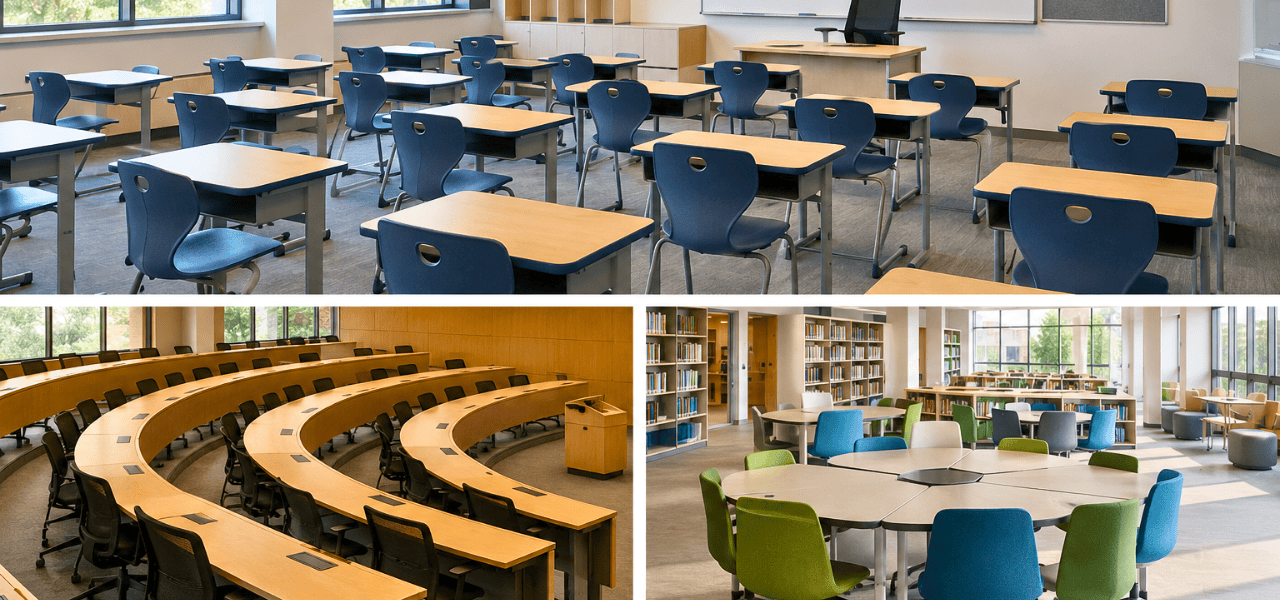
The classroom is where furniture choices have the highest daily impact. Student desks and chairs should be stackable to enable easy reconfiguration and storage, height-adjustable to serve different age groups, and finished with durable, scratch-resistant laminates that can withstand years of heavy use.
Teacher’s desks and podiums deserve equal attention, they set the tone of command and organization at the front of the room. Built-in storage is essential. Writing boards, display units, and wall-mounted shelving should complement the overall layout without cluttering sight lines.
Key buying tip: For classroom furniture, always specify scratch-resistant and easy-to-sanitize surface finishes. Post-pandemic hygiene standards have made this non-negotiable, and institutions that chose easy-clean laminates have found ongoing maintenance costs significantly lower.
Library Furniture
Library furniture must serve dual purposes: focused individual study and comfortable collaborative reading. Reading tables should be spacious, low-glare, and arranged to minimize noise travel. Individual study carrels offer students a sense of privacy and reduce distraction during exam preparation periods.
Shelving units in a library need to be genuinely modular, capable of being reorganized as collections grow and cataloguing needs evolve. Fixed shelving that cannot expand or shift becomes a liability within three to five years. Comfortable reading chairs and lounge seating in informal reading zones encourage voluntary library use, which has a measurable positive effect on reading culture.
Key buying tip: Prioritize matte, low-glare finishes on all library surfaces. High-gloss tables create eye strain during extended study sessions, a detail that generic procurement overlooks but students notice immediately.
Laboratory & Computer Lab Furniture
Science laboratory furniture operates in a completely different performance category from standard classroom furniture. Lab benches must have chemical-resistant tops, typically HPL (High Pressure Laminate) or epoxy resin, that can withstand spills, heat, and reagent exposure without surface degradation. Standard laminates will fail within months in an active science lab.
Computer lab tables require robust cable management solutions built into the desk design. Exposed cables are both a safety hazard and a maintenance problem. Ergonomic lab stools with adjustable height are essential for science and computer environments where students alternate between sitting and standing tasks.
Key buying tip: Safety compliance and wire management are non-negotiable in laboratory and computer lab furniture. These are not features to value-engineer out, they are legal and operational requirements. Ensure your supplier can demonstrate compliance with relevant safety standards before signing any purchase order.
Staff Room & Administrative Furniture
Staff rooms and administrative zones set the professional tone of an institution for visitors, parents, and external partners. Ergonomic workstations, properly designed chairs, and organized storage cabinets reflect institutional credibility.
Reception counters should balance visual presence with functional practicality, visitor seating in reception areas needs to be comfortable but also durable, given the volume of daily traffic. Vlite Furnitech’s expertise in modular office furniture translates naturally into institutional administrative zones, where workstation planning and space efficiency are just as important as they are in a corporate office.
Hostel & Common Area Furniture
Hostel furniture faces some of the hardest use conditions of any institutional setting. Dorm beds with integrated storage, under-bed drawers, side shelves, maximize limited room space. Wardrobes and study tables must be built to survive years of intensive daily use without surface deterioration or structural weakening.
Cafeteria tables and benches should be stackable and easy to clean, allowing the space to be rapidly cleared and reconfigured for events. Lounge areas in recreation zones benefit from modular seating arrangements that students can organize themselves, creating a sense of ownership over shared spaces that improves campus culture.
7 Critical Factors to Evaluate Before Buying School & College Furniture
Before finalizing any institutional furniture purchase, evaluate every shortlisted option against these seven factors. This framework will protect your institution from the most common procurement mistakes.
1. Durability & Material Quality
MDF, particle board, solid wood, and metal frames each have different performance profiles. For high-traffic institutional use, metal-frame furniture with quality laminated surfaces consistently outperforms pure wood alternatives on longevity. Solid wood is premium but demands more maintenance in humid Indian climates. Look for BIFMA-certified products, this certification tests furniture under rigorous load, durability, and safety conditions designed to reflect real institutional use.
2. Ergonomics & Age-Appropriateness
Furniture specifications must match the age group being served. Primary school children need lower desk and chair heights with rounded edges. Secondary school students need larger work surfaces and more structured lumbar support. College-level furniture should match adult ergonomic standards. Adjustable furniture future-proofs the investment, particularly valuable for institutions that serve mixed age groups or plan to repurpose spaces over time.
3. Modularity & Flexibility
Modular furniture is built in interchangeable, reconfigurable units. Unlike fixed traditional furniture, modular systems can be expanded, reduced, or reorganized without purchasing entirely new pieces. This is particularly valuable for multi-purpose halls, seminar rooms, examination centers, and modern open classrooms that serve different functions across the academic calendar.
4. Safety Standards & Certifications
All institutional furniture, especially anything used by minors, must meet clear safety standards. Rounded edges prevent injury. Non-toxic finishes protect students who are in prolonged contact with surfaces. Fire-retardant materials are increasingly required by building and safety codes. Verify ISO 9001:2015, BIFMA, and BIS certifications from any shortlisted school furniture manufacturer before proceeding.
5. Maintenance & Cleaning Ease
Powder-coated metal surfaces and quality laminates are easy to wipe down and sanitize, critical for institutions managing hygiene across hundreds of students daily. Avoid untreated wood or porous materials in high-contact areas. Post-pandemic procurement policies across Indian educational institutions have elevated cleaning ease from a preference to a procurement requirement.
6. Budget & Total Cost of Ownership
The most common institutional furniture mistake is optimizing for upfront cost while ignoring total cost of ownership. Cheap furniture purchased at a low unit price typically requires repair or replacement within two to three years, whereas quality institutional furniture from a certified school furniture manufacturer routinely lasts ten to fifteen years. Calculate cost per year of use, not cost per unit. Direct purchasing from a manufacturer also eliminates dealer markups and enables volume-based pricing that further reduces total cost.
7. After-Sales Service & Warranty
A supplier’s commitment does not end at delivery. Institutional furniture installations are large, complex projects, and issues will arise. Ensure your supplier offers on-site service support, clear warranty terms, and spare parts availability. Vlite Furnitech’s dedicated Project Management teams provide end-to-end support from design and delivery through installation and post-sales service, a level of accountability that dealer-dependent supply chains simply cannot match.
Modular Furniture, The Smart Choice for Modern Institutions
Traditional fixed furniture was built for a world where classrooms looked the same year after year. That world no longer exists. Modern educational institutions run lectures, workshops, examinations, seminars, collaborative projects, and community events, often in the same physical space across a single week.
Modular furniture is engineered for exactly this reality. Built in discrete, interchangeable units, it can be configured, reconfigured, expanded, or reduced based on immediate need, without replacement costs or structural modifications.
Consider a practical example: a college with a 200-seat lecture hall that needs to convert to an examination center with individual, spaced seating within a 30-minute window. With traditional fixed furniture, this is impossible without major disruption. With modular seating systems, it is routine.
The long-term financial case for modular furniture is equally strong. When institutional needs evolve, a new department, a shift in pedagogy, a campus expansion, modular furniture adapts. Fixed furniture becomes waste. Institutions that specified modular furniture ten years ago have consistently found they have spent less on furniture over that decade than peers who chose cheaper, fixed alternatives and replaced them repeatedly.
Vlite Furnitech’s modular furniture solutions are designed with precisely this institutional reality in mind, scalable, aesthetically versatile, and built to the production standards of a facility capable of delivering 14,000 workstations per month.
How to Choose the Right School Furniture Manufacturer
The supplier decision is as important as the product decision. A high-quality furniture design delivered late, installed incorrectly, or unsupported after purchase creates serious operational problems for institutions. Evaluate every shortlisted school furniture manufacturer against these criteria.
Manufacturing capacity determines whether a supplier can realistically fulfill your order at your required scale and timeline. Undercapitalized manufacturers routinely overpromise and underdeliver on large institutional orders.
Certifications, ISO 9001:2015 for quality management, BIFMA for furniture safety, and LEED compliance for sustainability, are verifiable proof points, not marketing claims. Any manufacturer unwilling or unable to demonstrate current certification should be removed from consideration.
Customization capability matters significantly for institutional projects, where standard dimensions rarely fit existing spaces perfectly. A manufacturer with a dedicated design team can collaborate on bespoke solutions, specific dimensions, custom finishes, institutional color schemes, that off-the-shelf products cannot provide.
Direct manufacturers consistently outperform dealer networks on cost, accountability, and customization. When you purchase through a dealer, you lose direct access to manufacturing oversight, you absorb an additional margin layer, and you often sacrifice the ability to request customization.
Vlite Furnitech, with its 30,000 sq. ft. manufacturing facility and the capacity to produce 14,000 workstations per month, has become a preferred school furniture manufacturer for institutions across India, from Mumbai to Hyderabad. Holding ISO 9001:2015, BIFMA, and LEED certifications, Vlite combines manufacturing scale with verified quality standards and pan-India project management capability, a combination that institutional procurement officers rarely find in a single supplier.
Sustainability in Institutional Furniture, Why It Matters
Green campus certification is moving from aspiration to mainstream institutional priority. LEED (Leadership in Energy and Environmental Design) certification for educational buildings is increasingly sought by universities, schools, and government institutions, and furniture procurement is a scored component of that process.
LEED-compliant furniture is manufactured using responsibly sourced materials, low-VOC (volatile organic compound) finishes, and production processes that minimize waste and environmental impact. Institutions specifying LEED-compliant college furniture contribute directly to their overall green building score.
Beyond certification, sustainability-conscious procurement reflects values that resonate with students, parents, and faculty, particularly as environmental awareness grows among the student population. An institution that can demonstrate responsible sourcing in its capital purchases builds a meaningful dimension of institutional credibility.
Vlite Furnitech’s sustainability-first manufacturing approach, eco-friendly materials, responsible sourcing, and LEED-compliant production processes, positions it as the natural choice for institutions pursuing green campus goals without compromising on product performance or cost efficiency.
Still comparing modular, bespoke, and traditional office furniture?
Let Vlite Furnitech LLP help you choose the smartest investment for better ROI.
Frequently Asked Questions
Q1: What type of furniture is best for school classrooms?
Ergonomic, height-adjustable desks and chairs with scratch-resistant, easy-to-clean surfaces are ideal for classroom environments. Modular furniture that can be rearranged for group activities, individual study, or examination formats is increasingly the standard choice for modern schools, it extends functional life and adapts to evolving teaching methods without requiring replacement.
Q2: How is modular furniture different from regular furniture?
Modular furniture is constructed in interchangeable, reconfigurable units that can be expanded, reduced, or reorganized as institutional needs change. Traditional fixed furniture is designed for a single configuration and becomes a liability when space use evolves. Modular systems offer greater flexibility, scalability, and long-term value, which is why they are the preferred specification for forward-looking institutional procurement.
Q3: What certifications should I look for in a school furniture manufacturer?
Prioritize ISO 9001:2015 for quality management systems, BIFMA for furniture structural safety and durability under intensive use, and BIS compliance for Indian regulatory alignment. For institutions pursuing green building goals, LEED-compliant manufacturers are the appropriate choice. These certifications are independently verified, always ask suppliers to provide current documentation rather than accepting verbal assurances.
Q4: How long does institutional furniture typically last?
High-quality institutional furniture from a certified manufacturer typically lasts ten to fifteen years with appropriate maintenance. BIFMA-certified products are specifically tested for durability under heavy daily use conditions that reflect real institutional environments. Budget furniture, by contrast, typically requires repair or replacement within two to four years, making total cost of ownership far higher despite a lower unit price.
Q5: Can furniture be customized for specific institutional needs?
Yes, and for most institutional projects, customization is essential rather than optional. Standard product dimensions rarely fit existing architectural layouts perfectly. Leading manufacturers like Vlite Furnitech offer full customization across dimensions, surface finishes, colors, and configurations, designed collaboratively with your team to match your institution’s specific layout, functional requirements, and visual identity.
Q6: What is the typical lead time for bulk institutional furniture orders?
Lead times vary based on order volume, degree of customization, and supplier capacity. With a high-capacity facility like Vlite Furnitech’s, rated at 14,000 workstations per month, large institutional orders can typically be planned for fulfillment within four to eight weeks. Early engagement with the supplier’s project management team is the most reliable way to ensure delivery aligns with your campus opening or renovation timeline.
Conclusion
Furniture procurement is one of the most consequential infrastructure decisions an educational institution makes, and it deserves the same rigorous evaluation applied to any major capital project.
The core principles are consistent: prioritize ergonomics to protect student health, specify modular furniture for long-term flexibility and value, verify certifications rather than accepting manufacturer claims at face value, and partner with a school furniture manufacturer who brings genuine capacity, customization capability, and post-sales accountability to the relationship.
Institutions that apply these principles consistently, rather than defaulting to the lowest bid, spend less over a ten-year horizon and create better environments for the students and staff who inhabit them daily.
Planning to furnish your school or college? Vlite Furnitech’s expert team can guide you from initial design consultation through delivery and installation, with custom solutions built for institutional scale, certified quality, and pan-India project management support. Contact us today for a free consultation.

Vishnu Sharma
I am the co-founder and CEO of Vlite Furnitech, creating modular office solutions since 2009. With a background in Chemistry and Marketing, and experience as Regional Head at Featherlite, I help design ergonomic, adaptable, and sustainable workspaces. Alongside a team of 120+, we serve corporates like JCB, Just Dial, KFC, and educational institutions. Let’s connect to reimagine innovative, eco-friendly office environments.