Walk into any busy office and you’ll spot the same problem in different disguises: files stacked on desks because there’s nowhere else to put them, personal bags tucked under chairs, stationery drawers that don’t shut properly. It looks like a minor inconvenience, but poor storage quietly chips away at productivity. Employees spend extra minutes hunting for documents, shared spaces look cluttered to visitors, and confidential paperwork ends up sitting in the open longer than it should.
Office storage solutions are often treated as an afterthought, something to sort out once the desks, chairs, and partitions are in place. In reality, storage is as much a part of good office furniture planning as ergonomics or layout. Get it wrong, and even a well-designed workspace starts to feel disorganized within a few months.
The good news is that most storage needs fall into three broad categories: pedestals, modular cabinets, and lockers. Each is built for a different job, and the right choice isn’t about picking a favorite, it’s about matching the format to how your team actually works. This guide breaks down all three, compares them side by side, and gives you a practical framework for choosing (or combining) the right office workspace storage for your setup.
Understanding Office Workspace Storage, The Basics
Before comparing formats, it helps to think about office workspace storage in three tiers:
- Personal storage, items an individual needs close at hand: stationery, personal belongings, daily-use files.
- Document and file storage, records, contracts, and paperwork that need to be organized, protected, and sometimes archived for years.
- Communal or shared storage, space used by multiple people or teams, often in open-plan or shared areas.
A decade ago, most Indian offices defaulted to assigned desks with a pedestal underneath, and that alone covered most personal storage needs. That’s changing. Hybrid work and hot-desking mean fewer people have a fixed desk to call their own, which has pushed many workplaces toward shared lockers instead of, or alongside, pedestals. Meanwhile, document-heavy departments like HR, finance, and admin still lean on cabinets for bulk, long-term storage regardless of how flexible the seating gets.
Keeping these three tiers in mind makes the rest of this comparison much easier to apply to your own office.
Pedestal Storage, Compact, Personal, Under-Desk
What Is Pedestal Storage?
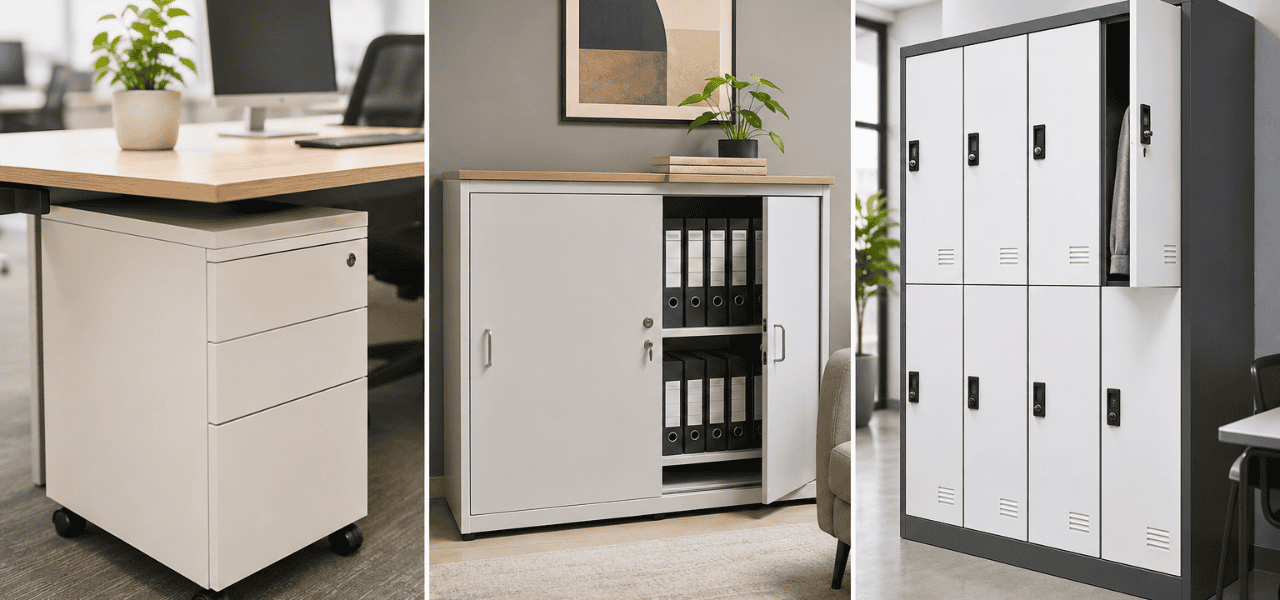
Pedestal storage refers to compact, usually 2–3 drawer units designed to sit under or beside a desk. They can be mobile (fitted with castors) or fixed, and they’re built for one purpose: keeping an individual’s daily-use items, stationery, personal documents, small electronics, frequently accessed files, within arm’s reach.
Pros of Pedestal Storage
Pedestals are the most space-efficient personal storage option available, since they occupy the “dead” space under a desk rather than taking up floor area elsewhere. Mobile versions can be rolled between workstations or meeting rooms, which adds a layer of flexibility. Most importantly, they offer instant access, no walking to a shared cabinet, no waiting for someone else to finish using it.
Limitations of Pedestal Storage
The trade-off is capacity. A typical pedestal has three drawers at most, which makes it unsuitable for bulk filing or long-term document archival. Pedestals also assume a fairly fixed relationship between a person and a desk, which is exactly the assumption that hot-desking and hybrid work break down. In a shared-desk environment, a pedestal tied to one workstation becomes a storage unit nobody consistently owns.
Best Use Cases
Pedestal storage works best in traditional office layouts with assigned desks or cabin setups, think individual contributors, managers, and roles where the same person sits at the same desk day after day.
Modular Office Storage Cabinets, Capacity Meets Organization
What Are Modular Office Storage Cabinets?
Where pedestals solve for individual convenience, modular office storage cabinets solve for volume and structure. These are larger units, open shelving, shutter-door cabinets, tambour-front cabinets, or multi-drawer filing systems, designed to hold significantly more files, records, and supplies than any under-desk unit could.
The word “modular” matters here. Rather than a single fixed design, modular cabinets can be configured and reconfigured: shelving heights adjusted, additional units added as storage needs grow, and layouts customized to fit an irregular floor plan or a specific department’s workflow. That flexibility is what separates a genuinely modular system from an off-the-shelf cabinet that only fits one use case.
Pros of Modular Office Storage Cabinets
The obvious advantage is capacity, these units are built to store far more than a pedestal ever could. Beyond that, they impose organization: labeled shelves, dedicated filing sections, and locking compartments make it easier to keep sensitive records in order rather than scattered across desks. Because they’re modular, they scale with the business, a growing office can add cabinet units without ripping out and replacing the entire storage system. Many configurations also include lockable sections, which matters for HR files, contracts, and financial records that shouldn’t be freely accessible.
Limitations of Modular Office Storage Cabinets
The main constraint is floor space. Cabinets need dedicated area, usually along a wall or in a records room, and that has to be planned for rather than squeezed in as an afterthought. They’re also typically stationary, once installed, moving them isn’t a five-minute job the way rolling a pedestal is.
Best Use Cases
Modular cabinets are the natural choice for shared or departmental storage, HR and finance record-keeping, reception and common-area storage, and any growing office that expects its document and supply volumes to increase over time.
Office Lockers, Secure, Shared, Built for Modern Workplaces
What Are Office Lockers?
Office lockers are individually lockable compartments housed within a shared unit. Unlike pedestals, which are tied to a specific desk, lockers are typically placed in a common area, near the entrance, in a break room, or along a corridor, and give each employee a dedicated, secure spot for personal belongings that’s completely independent of where they sit that day.
Pros of Office Lockers
The standout benefit is security: each compartment locks individually, so employees can store personal items, bags, or valuables without worrying about a shared desk drawer. Lockers are also the natural fit for hot-desking and hybrid offices, since they decouple personal storage from a fixed workstation, an employee can sit anywhere and still have a secure place for their belongings. For shared or open-plan teams, a single locker bank is far more space-efficient than giving every desk its own storage unit, and it supports flexible seating policies without anyone losing a dedicated space of their own.
Limitations of Office Lockers
Each compartment is relatively small, which makes lockers unsuitable for bulk document storage or anything beyond personal items and a few files. They’re a personal-storage solution, not a records-management one.
Best Use Cases
Lockers make the most sense in hybrid workplaces, coworking spaces, and hot-desk environments, as well as factory or warehouse settings where staff need secure personal storage separate from their work area. They’re also increasingly common in shared, open-plan offices even outside strict hot-desking policies, simply as a way to give every employee a secure personal spot.
Pedestal vs Cabinet vs Locker, Quick Comparison Table
| Feature | Pedestal | Modular Cabinet | Locker |
| Storage capacity | Low (2–3 drawers) | High, scalable | Low–moderate per compartment |
| Mobility | Mobile or fixed | Stationary | Stationary (unit), but not desk-tied |
| Best for | Individual, daily-use items | Bulk files, records, supplies | Personal belongings, shared use |
| Security | Basic lock (optional) | Lockable sections available | Individual lock per compartment |
| Ideal work setup | Assigned desks | Any office with document volume | Hybrid, hot-desking, shared spaces |
| Space required | Minimal (under-desk) | Higher (dedicated floor area) | Moderate (common-area footprint) |
How to Choose the Right Office Storage Solution for Your Workspace
There’s no single “best” option among the three, the right choice depends on a handful of practical factors specific to your office:
Team size and growth plans.
A small, stable team can often get by with pedestals and a modest cabinet setup. A growing organization should lean toward modular cabinets precisely because they can expand without a full replacement.
Work model.
This is often the deciding factor. Offices with assigned desks lean naturally toward pedestals. Hybrid or hot-desking offices, where no one has a permanent seat, are far better served by lockers for personal storage, with cabinets handling shared documents.
Document and security needs.
If your teams, HR, finance, legal, handle sensitive records, modular cabinets with lockable sections are close to non-negotiable, regardless of what personal storage looks like elsewhere.
Available floor space.
Pedestals cost almost nothing in floor area since they sit under existing desks. Cabinets and locker banks both need planned space, so this should factor into layout decisions early, not after furniture has already been ordered.
Budget and future scalability.
Modular systems generally offer better long-term value because they can be added to over time, rather than requiring a full re-purchase as needs change.
In practice, most well-run offices don’t pick just one format, they combine them. A common and effective setup looks like this: lockers near the entrance or common area for personal belongings, pedestals at individual desks for daily-use items, and modular cabinets in a dedicated area for departmental records. This layered approach covers all three tiers of office workspace storage, personal, document, and communal, without over- or under-investing in any single format.
Why Choose Vlite Furnitech for Your Office Storage Needs
Once you know which combination of pedestals, cabinets, and lockers fits your workspace, the next question is who builds them well. Vlite Furnitech designs and manufactures modular, customizable office storage, pedestals, modular office storage cabinets, and lockers, built for durability and adaptable to how your office actually works, not a fixed template.
That flexibility comes from scale: Vlite’s 30,000 sq. ft. manufacturing facility in Navi Mumbai has the capacity to produce up to 14,000 workstations a month, which means storage systems can be configured, customized, and delivered without the long lead times smaller manufacturers often struggle with. The facility’s certifications, BIFMA compliance, LEED-aligned manufacturing, and ISO 9001:2015, are a signal that quality and sustainability aren’t afterthoughts in the production process.
With branches across Mumbai, Pune, Ahmedabad, Surat, and Hyderabad, Vlite also offers dedicated project management and after-sales support close to where offices actually operate, rather than a one-time delivery and no follow-up. For organizations that care about sourcing responsibly, Vlite’s sustainability commitments extend across its production process, not just its finished products.
Whether you need mobile pedestal storage units for individual workstations, modular office storage cabinets for department-wide filing, or office lockers for hybrid workplaces to support a flexible seating policy, Vlite’s modular approach means the system can grow and adapt as your office does, a genuine advantage for any organization planning storage as a long-term investment rather than a one-time purchase. For architects and designers looking to specify a complete workspace, Vlite’s broader modular office furniture solutions extend well beyond storage into desks, seating, and partitions, all built by a certified modular furniture manufacturer.
Still comparing modular, bespoke, and traditional office furniture?
Let Vlite Furnitech LLP help you choose the smartest investment for better ROI.
Frequently Asked Questions
What is the difference between a pedestal and a cabinet in office furniture?
A pedestal is a small, usually 2–3 drawer unit designed to sit under or beside an individual desk for daily-use items. A modular cabinet is a larger, higher-capacity unit, often with shelves, shutters, or filing drawers, built for bulk document and supply storage, typically shared across a team or department.
Are office lockers necessary if we already have pedestals?
It depends on your work model. If desks are assigned and fixed, pedestals may cover most personal storage needs on their own. If your office uses hot-desking or hybrid seating, lockers become important because they give employees a secure, dedicated storage spot that isn’t tied to a specific desk they may not use every day.
Which office storage solution is best for a hybrid or hot-desking office?
Lockers are generally the best fit for personal storage in hybrid or hot-desking environments, since they decouple secure storage from a fixed workstation. Modular cabinets can still handle shared department records in these setups; pedestals become less practical since no one occupies the same desk consistently.
Can modular office storage cabinets be customized to fit specific spaces?
Yes, that’s the core advantage of a modular system. Configurations, shelving, and unit combinations can be adjusted to fit irregular floor plans, specific departmental needs, or future expansion, rather than being locked into a single fixed design.
How do I choose office storage that matches my existing office furniture?
Look for a manufacturer that builds storage as part of a broader modular furniture range, so pedestals, cabinets, and lockers can be matched in finish, material, and design language to your existing desks, seating, and partitions, rather than looking like an add-on purchased separately.
Conclusion
Pedestals, modular cabinets, and lockers each solve a different storage problem. Pedestals are built for personal, quick-access storage at an individual desk. Modular cabinets handle capacity and organization for shared documents and records. Lockers provide secure, shared storage suited to hybrid and hot-desking offices where no one owns a fixed desk. None of the three is inherently “better”, the right office storage solutions for your workspace usually come from combining formats based on team size, work model, security needs, and available space, rather than picking just one.
If you’re planning or upgrading your office storage setup, it’s worth thinking through all three tiers, personal, document, and communal, before settling on a layout. Explore Vlite Furnitech’s modular storage range or request a consultation to work out the right combination of pedestals, cabinets, and lockers for your workspace.

Vishnu Sharma
I am the co-founder and CEO of Vlite Furnitech, creating modular office solutions since 2009. With a background in Chemistry and Marketing, and experience as Regional Head at Featherlite, I help design ergonomic, adaptable, and sustainable workspaces. Alongside a team of 120+, we serve corporates like JCB, Just Dial, KFC, and educational institutions. Let’s connect to reimagine innovative, eco-friendly office environments.