Modern workplaces are changing faster than ever. Hybrid work models, flexible schedules, and evolving team structures are reshaping how offices are designed. While traditional cubicles once defined corporate environments, open office layouts gained popularity for encouraging collaboration. Today, many organisations are rethinking both approaches to find a better balance.
Choosing the right office furniture layout is no longer just about space; it directly impacts productivity, company culture, and employee well-being. A poorly planned setup can lead to distractions or disengagement, while the right one can improve efficiency and satisfaction. This blog compares open office and cubicle layouts to help businesses decide what works best today.
What Is an Open Office Layout and Why Is It Popular?
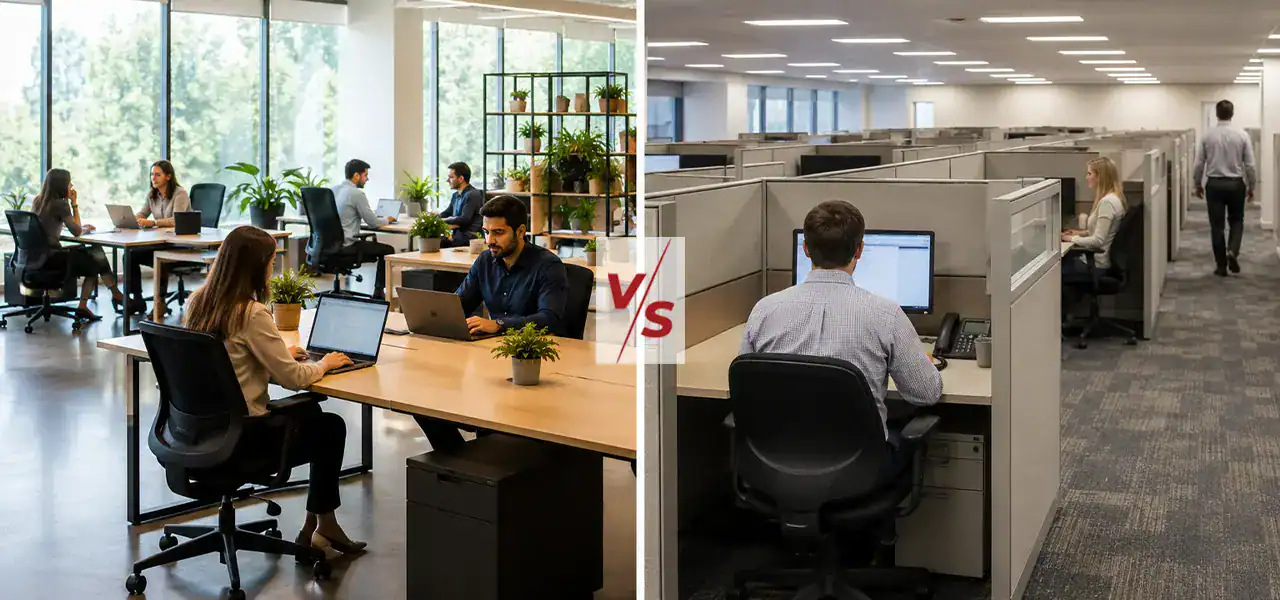
An open office layout is designed with minimal partitions, creating a shared and collaborative workspace. Instead of enclosed cabins, employees work in open areas with desks arranged in groups or rows. This layout became popular with startups and modern organisations aiming to promote transparency and teamwork.
It focuses on accessibility and flexibility, allowing teams to interact more freely. Key characteristics include:
- Collaborative seating: Teams sit together to encourage interaction.
- Flexible workstations: Desks can be rearranged as needed.
- Open design: Fewer barriers create a more connected environment.
Open office layouts work best for creative teams, marketing departments, and agile work cultures. Common furniture ideas include modular desks, benching systems, breakout zones, and smart storage units that help keep shared spaces organised while maintaining a clean, clutter-free environment.
What Is a Cubicle Office Setup and Where Does It Fit Today?
A cubicle office setup consists of partitioned workspaces that provide employees with individual areas to work. This layout has traditionally been used in structured corporate environments where focus and privacy are important.
Cubicles create a sense of personal space while still maintaining an organised office layout. They are especially useful in roles that require concentration and minimal interruptions. Some important features include the following:
- Privacy panels: Help reduce visual and noise distractions.
- Dedicated desks: Each employee has a defined workspace.
- Structured layout: Promotes order and consistency.
Cubicles are still widely used in industries like finance, legal services, and administrative roles. However, modern designs have evolved to include lower partitions, better ergonomics, and more open visibility, making them feel less restrictive while retaining their functional benefits.
Open Office vs Cubicle Office Layout Comparison: Key Differences
Both layouts serve different purposes, and the choice depends largely on how teams work.
Key differences include the following:
- Collaboration: Open offices encourage interaction, while cubicles reduce interruptions.
- Privacy: Cubicles offer personal space; open layouts provide limited privacy.
- Noise levels: Open offices can be noisy, whereas cubicles help control sound.
- Space efficiency: Open layouts use space more efficiently; cubicles require more structure.
- Flexibility: Open offices adapt easily to changes; cubicles are more fixed.
Open offices are ideal for teamwork and quick communication, but they may affect concentration. Cubicles, on the other hand, support focused work but can sometimes limit collaboration.
Ultimately, business goals play a major role in this decision. A company focused on innovation may prefer open layouts, while one that values precision and deep work may lean towards cubicles.
Pros and Cons of Open Office and Cubicle Furniture
Open Office Furniture – Pros
- Better collaboration: Encourages communication and teamwork.
- Space efficiency: Accommodates more employees in less space.
- Team visibility: Makes supervision and coordination easier.
Open Office Furniture – Cons
- Noise distractions: Conversations can affect focus.
- Limited privacy: Difficult for confidential or deep work.
- Reduced concentration: Not ideal for tasks requiring attention.
Cubicle Furniture – Pros
- Improved focus: Minimises distractions.
- Personal workspace: Employees feel more comfortable and organised.
- Task efficiency: Supports detail-oriented work.
Cubicle Furniture – Cons
- Less interaction: Can reduce collaboration.
- Higher space usage: Requires more floor planning.
- Rigid setup: Harder to adapt to changing needs.
Confused between open office and cubicle furniture?
Let Vlite Furnitech LLP help you create a workspace that boosts productivity and comfort.
Which Office Layout Improves Productivity Today?
Productivity is not defined by a single layout; it depends on the nature of work. Roles that require teamwork and frequent communication benefit from open office setups. While tasks that demand focus and accuracy perform better in cubicle environments.
Open offices improve collaboration and idea-sharing, but they can also introduce distractions. Cubicles support deep work but may reduce spontaneous interactions. Both layouts come with their own productivity challenges.
Today, many organisations are moving towards hybrid layouts. These combine open collaborative zones with quiet, private spaces. Exploring how modular workstations improve collaboration in offices can provide useful insights into creating environments that balance flexibility with productivity.
A balanced environment that supports both teamwork and individual focus tends to deliver the best results. Flexibility, rather than a fixed layout, is becoming the key driver of productivity.
Conclusion
Open office and cubicle layouts each offer distinct advantages. While open offices support collaboration and flexibility, cubicles provide privacy and focus. There is no universally “better” option; the right choice depends on business goals, team structure, and the type of work being performed.
Today, many organisations are adopting hybrid layouts to create a balance between interaction and concentration. This approach helps improve both productivity and employee satisfaction.
If you’re planning to redesign your workspace and need expert guidance, consider working with Vlite Furnitech, a reliable modular furniture supplier. You can also contact us to create an office environment that supports your team’s performance and well-being.
Choose the right office layout with Vlite Furnitech LLP.
Discover furniture solutions designed for collaboration, privacy, and efficiency.
FAQs
1. Which is better for productivity: open office or cubicle workspace?
It depends on the work type; open offices support collaboration, while cubicles are better for focused tasks.
2. Are open office layouts still popular in modern workplaces?
Yes, but many organisations now prefer hybrid layouts that balance openness with privacy.
3. What are the advantages of cubicle office furniture?
Cubicles provide better focus, privacy, and structured workspaces, making them ideal for task-heavy roles.
4. Is open office furniture more cost-effective than cubicles?
Generally, yes. Open layouts utilise space more efficiently and reduce infrastructure costs.
5. How do I choose between open office and cubicle furniture for my company?
Consider your team’s work style, need for collaboration, and level of privacy required before deciding.

Vishnu Sharma
I am the co-founder and CEO of Vlite Furnitech, creating modular office solutions since 2009. With a background in Chemistry and Marketing, and experience as Regional Head at Featherlite, I help design ergonomic, adaptable, and sustainable workspaces. Alongside a team of 120+, we serve corporates like JCB, Just Dial, KFC, and educational institutions. Let’s connect to reimagine innovative, eco-friendly office environments.